
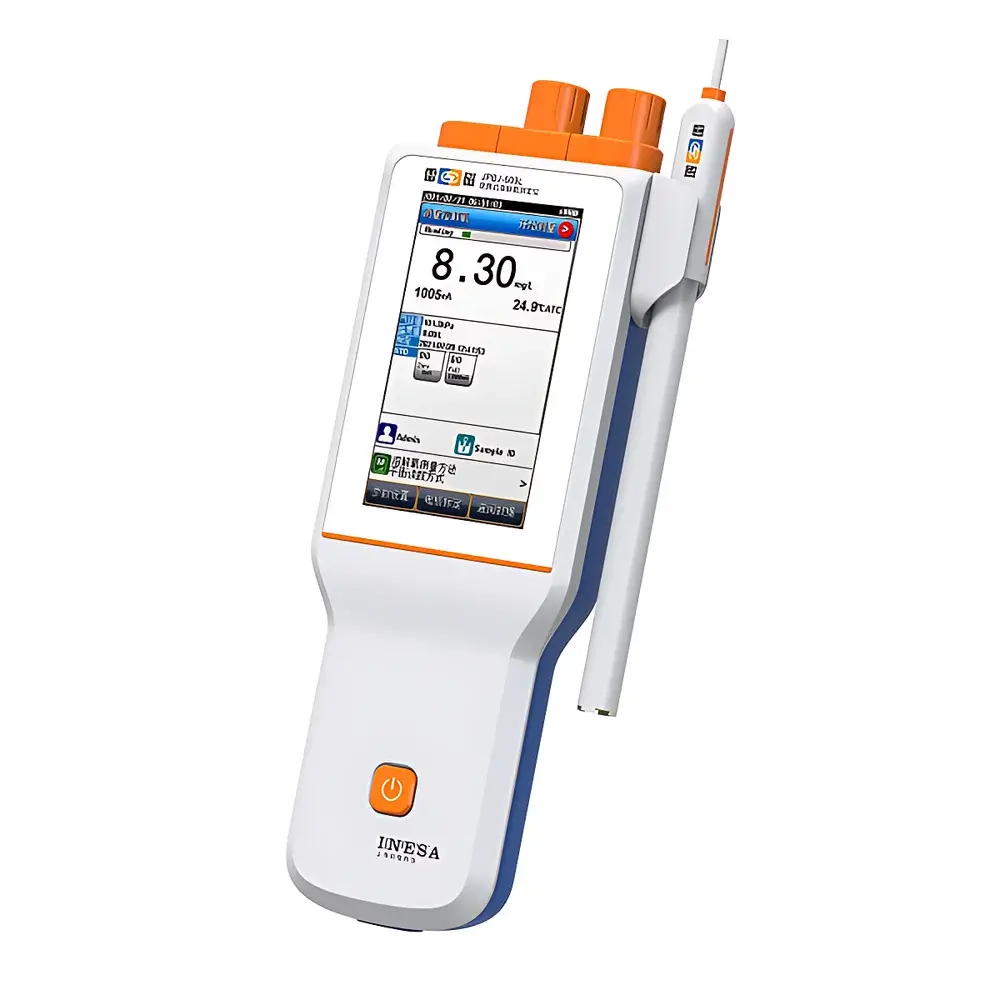
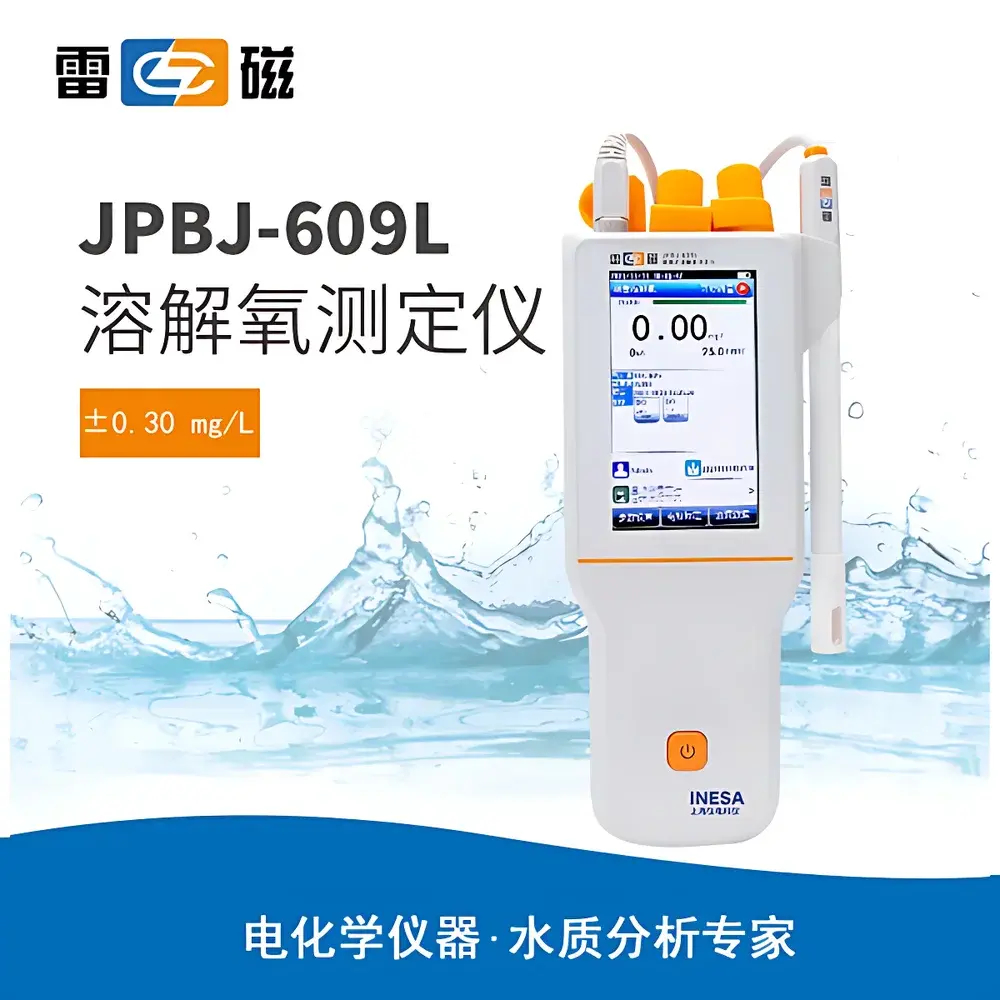
Leici JPBJ-609L Portable Dissolved Oxygen Meter
| Brand | Leici |
|---|---|
| Origin | Shanghai, China |
| Manufacturer Type | Manufacturer |
| Country of Origin | China |
| Model | JPBJ-609L |
| Instrument Type | Portable |
| Measurement Principle | Electrochemical Clark-type Polarographic Probe |
| Measurement Range | (0.00–50.00) mg/L |
| Accuracy | ±0.10 mg/L (0.00–50.00 mg/L) |
| Resolution | 0.01 mg/L |
| Response Time | ≤45 s (90% response at 20 °C) |
| Temperature Compensation | Automatic/Manual (−10.0 to 135.0 °C) |
| Atmospheric Pressure Compensation | Manual (kPa, mbar, Torr, atm) |
| Salinity Compensation | Manual |
| IP Rating | IP65 |
| Battery | Rechargeable Li-ion |
| Dimensions | 90 × 255 × 40 mm |
| Weight | 0.5 kg |
Overview
The Leici JPBJ-609L Portable Dissolved Oxygen Meter is a field-deployable electrochemical analyzer engineered for precise, on-site measurement of dissolved oxygen (DO) concentration, saturation percentage, and temperature in natural waters, wastewater, aquaculture systems, and environmental monitoring applications. It operates on the Clark-type polarographic principle: an oxygen-permeable membrane separates the sample from a cathode and silver/silver chloride anode immersed in electrolyte. Molecular oxygen diffuses through the membrane and is reduced at the cathode, generating a current proportional to the partial pressure of O₂—converted to mg/L or % saturation using temperature, atmospheric pressure, and salinity corrections. Designed for regulatory compliance and operational robustness, the JPBJ-609L meets core requirements for field-based water quality assessment under ISO 5814:2012 (water quality — determination of dissolved oxygen — electrochemical probe method) and supports traceable data acquisition aligned with GLP practices.
Key Features
- High-resolution 4.3-inch color TFT touchscreen with intuitive icon-driven interface supporting both English and Chinese languages
- IP65-rated enclosure ensuring dust-tight operation and resistance to low-pressure water jets—suitable for outdoor, humid, or splash-prone environments
- Integrated dual-compensation system: automatic or manual temperature compensation (−10.0 to 135.0 °C), plus configurable atmospheric pressure compensation across kPa, mbar, Torr, and atm units
- Manual salinity input (0–50 g/L) to correct for ionic strength effects on oxygen solubility—critical for estuarine, coastal, and brackish water analysis
- Intelligent endpoint detection with multiple read modes: auto-hold, timed reading, interval logging, and manual capture
- Onboard calibration management: zero-oxygen (sodium sulfite) and full-scale (air-saturated water or Winkler-standard reference) calibration with built-in alerting for overdue or failed calibrations
- Dual power architecture: long-life rechargeable lithium-ion battery (up to 100 hours typical runtime) + USB-C compatibility for charging via PC or portable power banks
Sample Compatibility & Compliance
The JPBJ-609L is validated for use with freshwater, seawater, wastewater effluents, drinking water distribution systems, and biological reactor samples. Its polarographic sensor exhibits stable performance across pH 4–10 and turbidity levels up to 1000 NTU. The instrument complies with ISO 5814:2012 for DO measurement methodology and incorporates hardware and firmware features required for Good Laboratory Practice (GLP): unique user login with role-based permissions (administrator, operator, viewer), mandatory electronic signatures for calibration and data export events, and immutable audit trails for all configuration changes. Data files include embedded metadata—timestamp, operator ID, probe serial number, calibration history, and environmental correction parameters—to support regulatory audits per EPA Method 360.1 and EU Directive 2000/60/EC (Water Framework Directive).
Software & Data Management
The meter stores up to 1,000 complete measurement records locally, each containing DO concentration (mg/L), saturation (%), temperature (°C/°F), pressure (kPa), salinity (g/L), and calibration status flags. Data retrieval supports chronological, parameter-filtered, or session-based browsing; trend visualization is rendered as interactive time-series plots directly on-device. Export options include USB mass-storage mode (CSV/Excel-compatible), Bluetooth 5.0 wireless transmission to iOS/Android tablets or Windows laptops, and direct LIMS integration via Leici’s certified communication protocol (LeiciLink™). A dedicated PC software suite enables advanced statistical analysis (mean, SD, CV%, linear regression), report generation with customizable headers/footers, and secure archiving compliant with FDA 21 CFR Part 11 requirements—including electronic signature enforcement and audit trail review functionality.
Applications
- Field monitoring of surface water bodies (rivers, lakes, reservoirs) for compliance with national ambient water quality criteria
- Wastewater treatment plant process control—especially in activated sludge basins, oxidation ditches, and membrane bioreactors where DO optimization directly impacts nitrification efficiency and energy consumption
- Aquaculture site management: real-time DO profiling to prevent hypoxic stress in finfish and shellfish production systems
- Environmental impact assessments (EIAs) and sediment pore-water characterization during benthic surveys
- Educational laboratories requiring rugged, student-safe instrumentation with multilingual UI and curriculum-aligned data export capabilities
FAQ
What type of electrochemical sensor does the JPBJ-609L use?
It employs a Clark-type polarographic dissolved oxygen probe with a Teflon-based gas-permeable membrane, Pt cathode, and Ag/AgCl reference anode.
Does the instrument support automatic temperature compensation?
Yes—both automatic (via integrated NTC thermistor) and manual temperature input are supported, with selectable units (°C or °F).
Can the JPBJ-609L be used in seawater?
Yes, provided salinity is manually entered (range: 0–50 g/L) to apply appropriate solubility correction per ISO 5814 Annex B.
Is the data export compatible with LIMS platforms?
Yes—via USB, Bluetooth, or optional RS-232 adapter using ASCII-delimited formats; LeiciLink™ SDK enables custom API integration.
What is the expected service life of the polarographic electrode?
With proper storage (in KCl solution), regular membrane replacement (every 2–3 months under daily use), and avoidance of mechanical abrasion or solvent exposure, the sensor typically maintains specification accuracy for 12–18 months.
Related Products







