
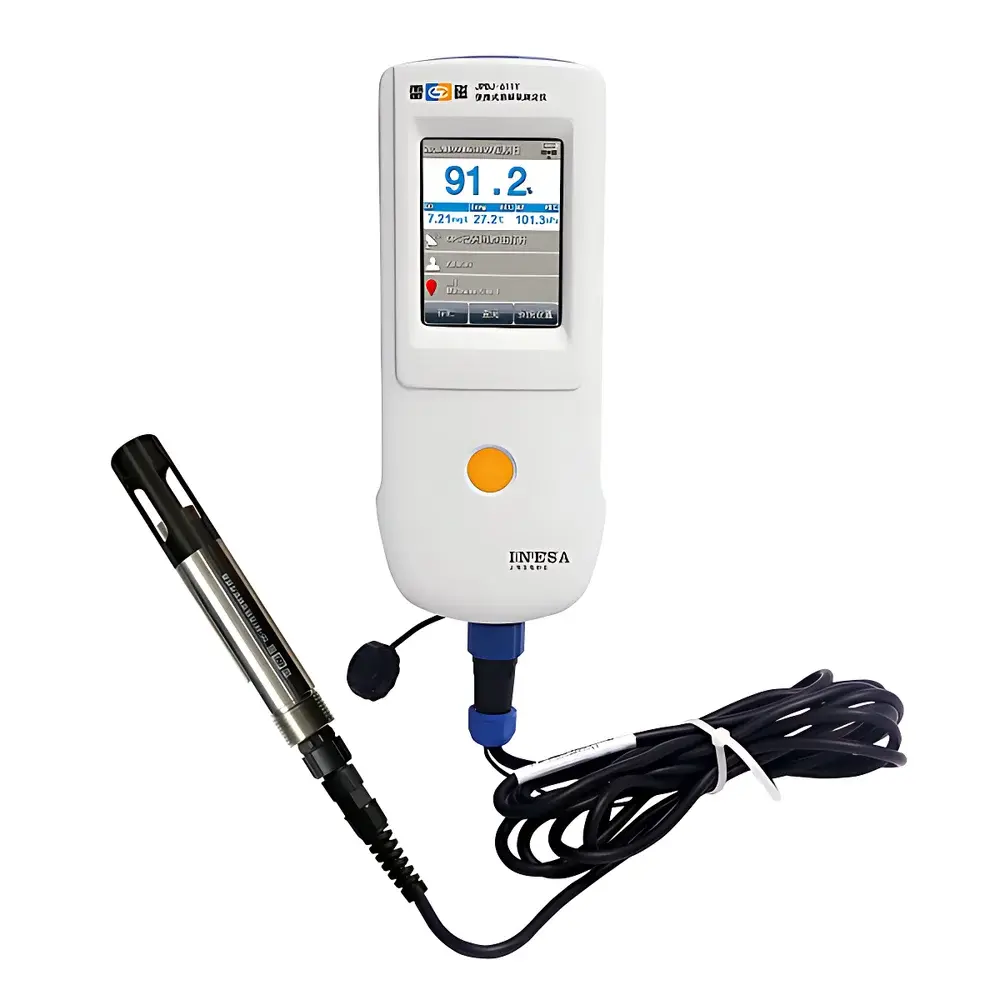
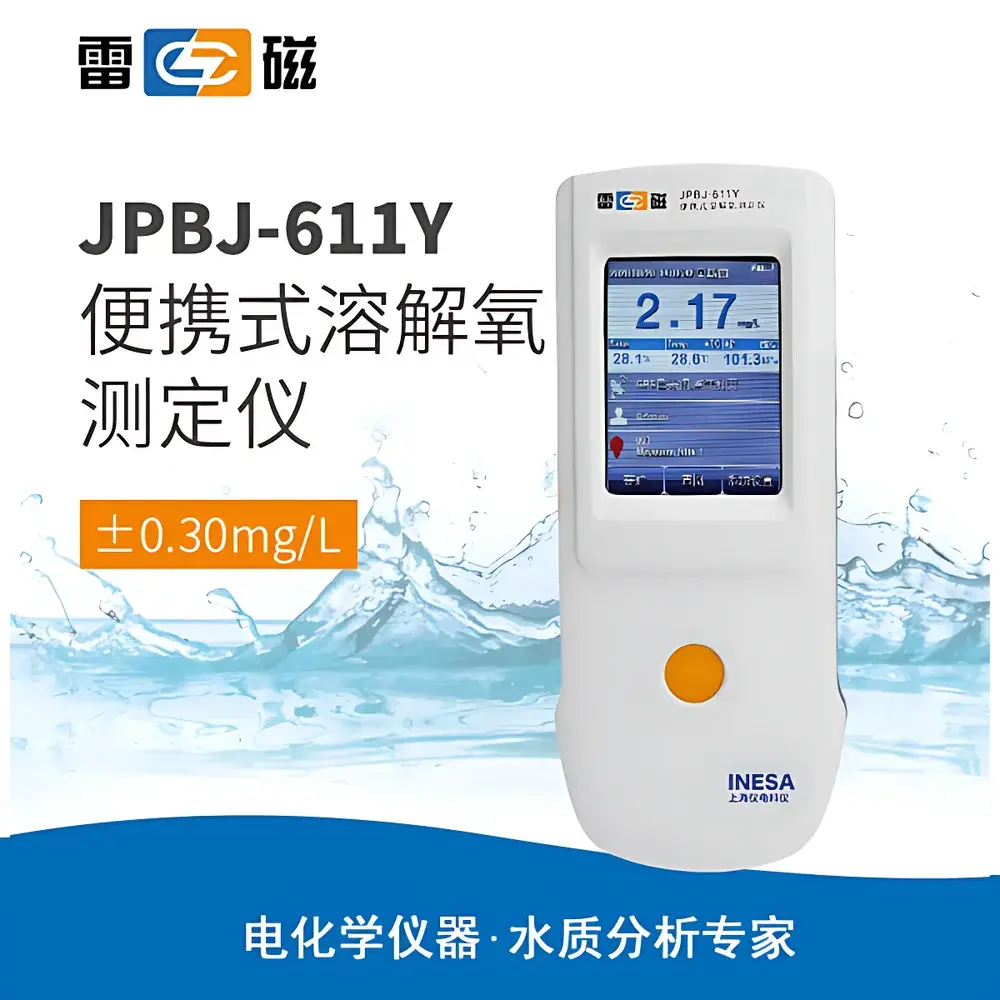
Leici JPBJ-611Y Portable Fluorescence-Based Dissolved Oxygen Meter
| Brand | Leici |
|---|---|
| Origin | Shanghai, China |
| Manufacturer Type | Direct Manufacturer |
| Regional Classification | Domestic (China) |
| Model | JPBJ-611Y |
| Instrument Type | Portable |
| Measurement Principle | Fluorescence Quenching |
| Measurement Range | (0.00–20.00) mg/L DO |
| Accuracy | ±0.30 mg/L |
| Resolution | 0.01 mg/L (DO), 0.1% (Saturation), 0.1 °C (Temperature) |
| Temperature Compensation | Automatic (0.0–50.0 °C) |
| Salinity Compensation | Manual (0.0–50.0 g/L) |
| Atmospheric Pressure Compensation | Automatic (50.0–110.0 kPa) |
| Power Supply | Rechargeable Li-ion Battery |
| Dimensions | 235 × 90 × 56 mm |
| Weight | ~0.3 kg |
| Data Storage Capacity | 1000 datasets with metadata (location, timestamp, operator ID, section ID, calibration logs) |
| Display | 3.5″ TFT Touchscreen |
| Standard Electrode | DO-962 Optical DO Sensor |
Overview
The Leici JPBJ-611Y is a field-deployable, fluorescence-based dissolved oxygen (DO) meter engineered for high-fidelity in situ water quality assessment. Unlike electrochemical Clark-type sensors, it employs optical fluorescence quenching technology—where molecular oxygen modulates the lifetime and intensity of a luminescent ruthenium complex immobilized on the sensor tip. This principle eliminates dependence on cathodic polarization, membrane permeability, or electrolyte diffusion, resulting in inherently stable, drift-free measurements unaffected by flow rate, stirring, hydrogen sulfide, or low-conductivity conditions. Designed explicitly for environmental monitoring workflows, the JPBJ-611Y bridges the gap between laboratory-grade accuracy and rugged field operability—supporting real-time decision-making in dynamic aquatic systems including urban rivers, wastewater outfalls, aquaculture ponds, coastal zones, and ecological restoration sites.
Key Features
- Optical DO sensing via fluorescence quenching—no membrane replacement, no electrolyte refills, zero polarization time required.
- Ruggedized DO-962 probe with IP68-rated housing, integrated temperature sensor, and mechanical design optimized for immersion in turbulent or debris-laden surface waters.
- 3.5″ high-transmittance TFT touchscreen with sunlight-readable contrast and intuitive icon-driven interface—engineered for gloved operation and outdoor visibility.
- Integrated GPS module enabling georeferenced data capture; each measurement record includes WGS84 coordinates, timestamp (UTC-sync capable), operator ID, and user-defined cross-section identifier.
- Comprehensive data management: up to 1000 full-attribute records stored locally, including calibration history (zero and span), atmospheric pressure compensation values, salinity input, and temperature-compensated DO saturation (%).
- Intelligent power architecture: rechargeable lithium-ion battery supports >12 hours of continuous operation; auto-backlight dimming and programmable auto-shutdown minimize energy consumption without compromising responsiveness.
- Full environmental compensation suite: automatic barometric pressure correction (50.0–110.0 kPa), manual salinity input (0.0–50.0 g/L), and real-time temperature compensation (0.0–50.0 °C) per ISO 5814 and ASTM D888 standards.
- Firmware-upgradable platform supporting future protocol expansions—including custom reporting templates, Bluetooth data export, and regulatory-compliant audit trails.
Sample Compatibility & Compliance
The JPBJ-611Y is validated for direct immersion in natural freshwater, brackish estuarine water, treated effluent, and marine environments (up to 35 g/L salinity). Its optical sensor exhibits negligible interference from common redox-active species (e.g., Fe²⁺, Mn²⁺, NO₂⁻) and is insensitive to biofouling over short-term deployments (<72 h). The instrument conforms to core performance benchmarks defined in ISO 5814:2012 (Water quality — Determination of dissolved oxygen — Electrochemical probe method) and aligns with methodology expectations in EPA Method 360.1 and APHA Standard Methods 4500-O G. While not certified for GLP/GMP production environments, its data integrity features—including timestamped calibration logs, operator authentication fields, and non-erasable storage—support defensible field data collection under QA/QC programs aligned with ISO/IEC 17025 requirements.
Software & Data Management
Data are stored in a structured binary format with embedded metadata headers. Users may retrieve records via multiple filters: cross-section ID (up to 30 user-defined locations), storage sequence number, date/time range, or operator identifier. Retrieval results display as tabular summaries or time-series plots—enabling rapid trend identification across spatial transects. Export is supported via USB-C to CSV-compatible formats for integration into LIMS, GIS platforms (e.g., QGIS, ArcGIS), or statistical analysis tools (R, Python pandas). The device’s firmware architecture supports secure over-the-air (OTA) updates—ensuring long-term compatibility with evolving regulatory reporting structures and analytical workflows.
Applications
- Real-time monitoring of dissolved oxygen dynamics in urban river corridors during stormwater events or diurnal algal bloom cycles.
- Regulatory compliance verification at wastewater discharge points per national effluent standards (e.g., China’s GB 8978-1996, EU Urban Wastewater Treatment Directive Annex I).
- Ecological health assessment in lakes and reservoirs—tracking hypolimnetic anoxia development and reaeration rates.
- Aquaculture site management: optimizing aeration schedules based on hourly DO minima and saturation thresholds in shrimp or finfish ponds.
- Marine and estuarine baseline surveys—mapping DO gradients across salinity fronts and tidal mixing zones.
- Educational field labs: teaching principles of aquatic biogeochemistry, sensor physics, and environmental data stewardship.
FAQ
Does the JPBJ-611Y require daily calibration?
No—fluorescence-based DO sensors exhibit long-term stability; zero and span calibration is recommended before critical campaigns or after extended storage (>30 days), per manufacturer guidelines.
Can the DO-962 probe be used in turbid or sediment-laden water?
Yes—the probe’s optical window is chemically hardened and resistant to abrasion; however, prolonged exposure to abrasive suspended solids may necessitate periodic cleaning with deionized water and soft lint-free cloth.
Is atmospheric pressure compensation mandatory for accurate DO reporting?
Yes—barometric pressure directly affects oxygen partial pressure; the JPBJ-611Y’s built-in pressure sensor automatically applies correction per the ideal gas law, ensuring mg/L values reflect true aqueous concentration rather than partial pressure artifacts.
How is traceability maintained for field-collected data?
Each dataset includes immutable metadata: GPS coordinates (±5 m CEP), UTC timestamp, operator ID, cross-section tag, calibration verification status, and firmware version—enabling full chain-of-custody reconstruction during audits.
What is the expected service life of the DO-962 optical sensor?
Under normal field use, the luminescent coating maintains performance for ≥24 months; sensor replacement is indicated only upon observed signal decay exceeding ±5% of full-scale response during routine verification checks.
Related Products







