
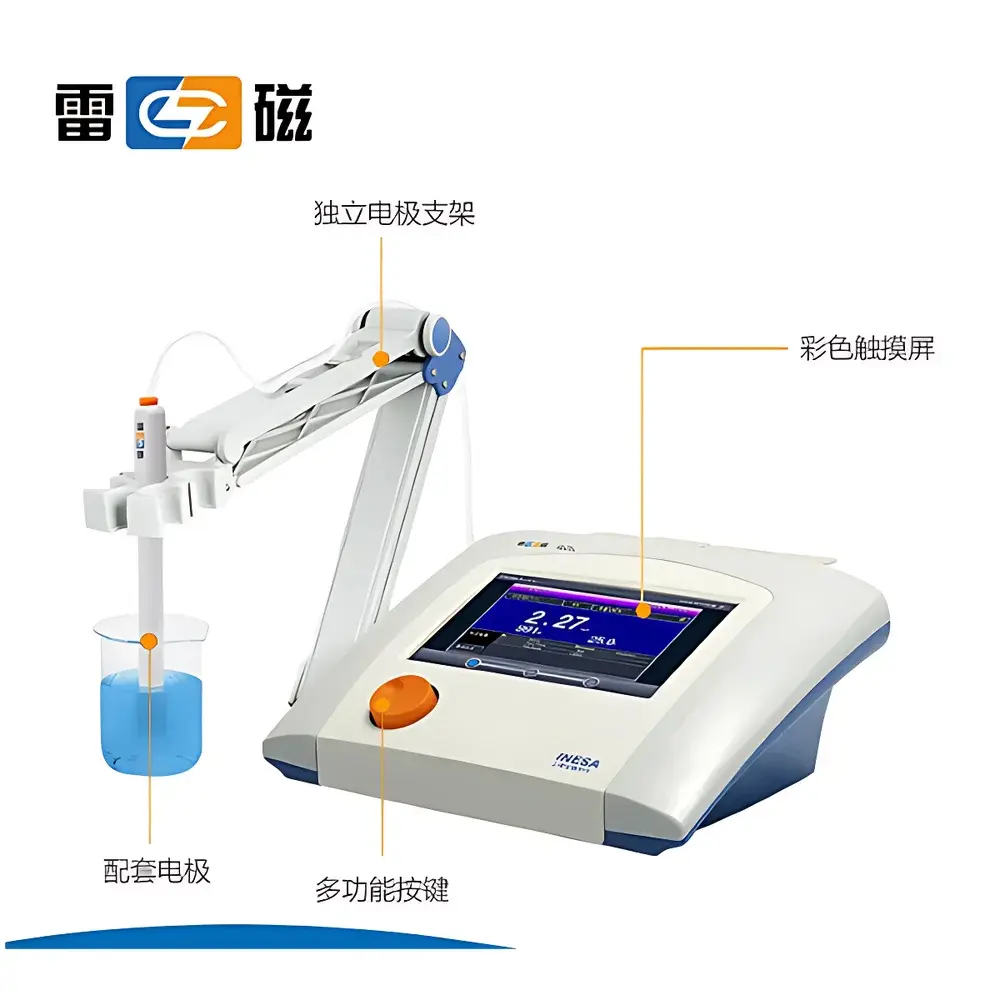
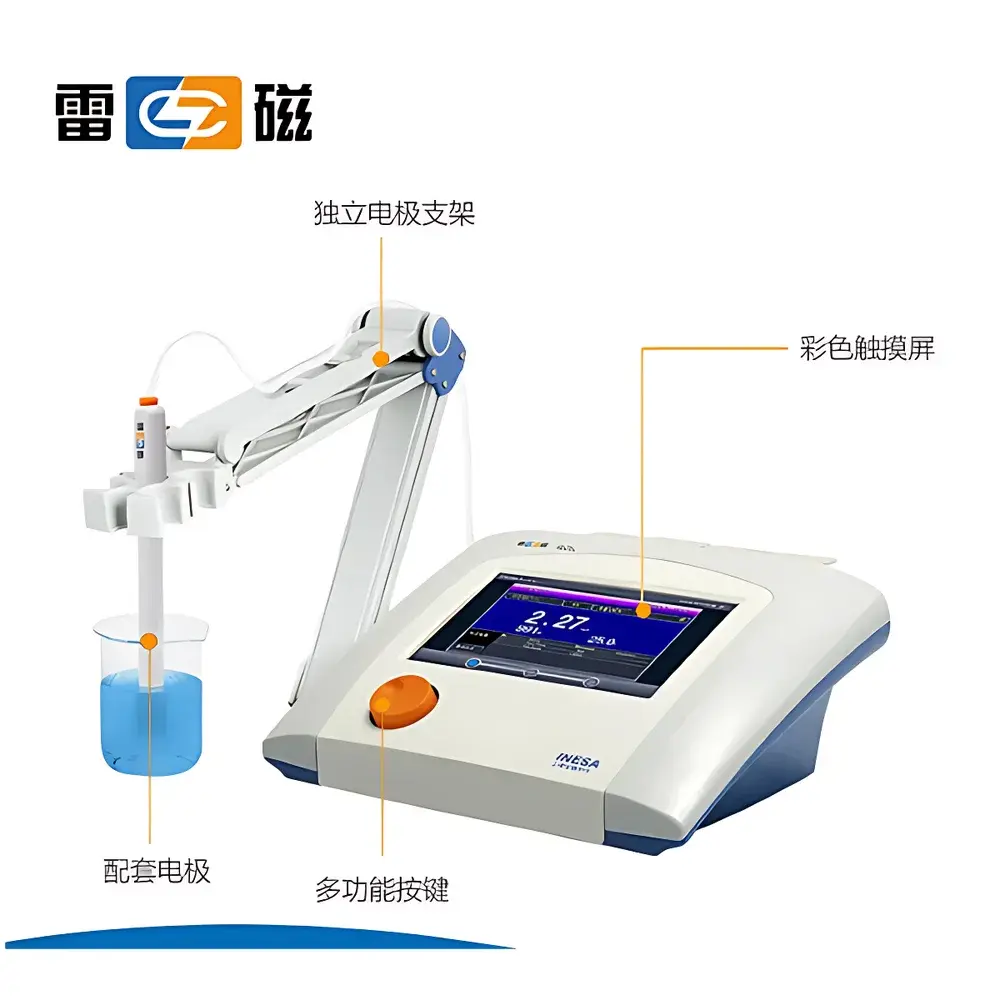
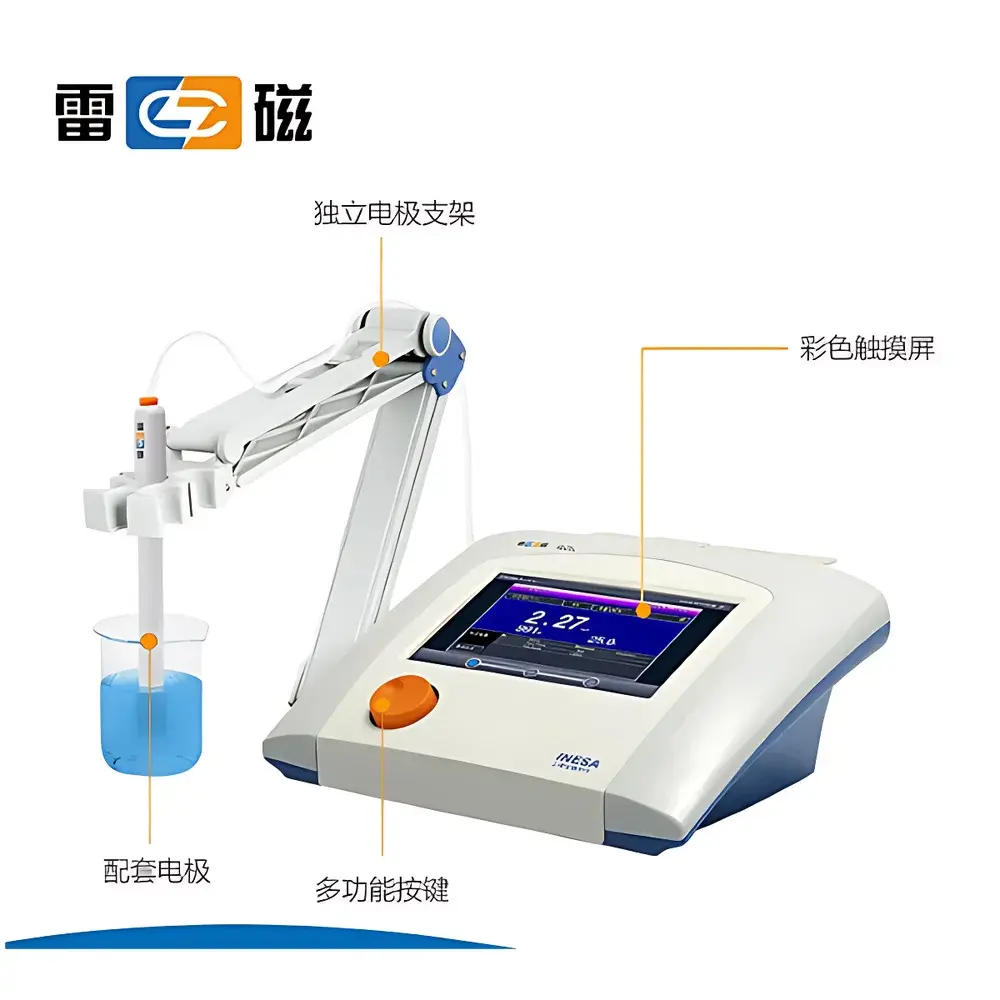
Leici JPSJ-606L Dissolved Oxygen Meter
| Brand | Leici |
|---|---|
| Origin | Shanghai, China |
| Instrument Type | Laboratory Benchtop DO Meter |
| Measurement Principle | Polarographic Electrochemical Probe |
| Measurement Range | 0–90.00 mg/L |
| Accuracy | ±0.10 mg/L |
| Repeatability | ≤0.15 mg/L |
| Detection Limit | ±0.10 mg/L (at 0 mg/L) |
| Temperature Compensation | Automatic (NTC sensor integrated) |
| Atmospheric Pressure Compensation | Built-in barometric sensor |
| Calibration Modes | Zero-oxygen (sodium sulfite), Full-scale (air-saturated water or Winkler standard), Salt Correction Support |
| Connectivity | RS-232, USB port for PC and USB flash drive |
| Data Storage | 1000 measurement records with timestamp, electrode ID, calibration history, user ID, and environmental parameters |
| GLP Compliance | Yes — full audit trail including calibration logs, user login events, and data modification timestamps |
Overview
The Leici JPSJ-606L Dissolved Oxygen Meter is a high-precision, laboratory-grade benchtop instrument engineered for reliable and traceable dissolved oxygen (DO) quantification in aqueous samples across environmental monitoring, wastewater treatment, aquaculture, and academic research laboratories. It employs the polarographic electrochemical principle—utilizing a Clark-type membrane-covered amperometric sensor—to generate a diffusion-limited current proportional to the partial pressure of molecular oxygen dissolved in the sample. This method delivers stable, low-drift measurements under variable salinity and temperature conditions when coupled with real-time compensation algorithms. The instrument is designed to meet the operational rigor of ISO 5814:2012 (Water quality — Determination of dissolved oxygen — Electrochemical probe method) and supports alignment with EPA Method 360.1 and ASTM D888 for field-validated laboratory DO analysis.
Key Features
- Intelligent endpoint detection: configurable read modes—including auto-read (stability-based), timed-read (user-defined interval), fixed-interval batch acquisition, and manual trigger—ensuring optimal response for both static and dynamic sample matrices.
- Integrated environmental compensation: automatic temperature correction via built-in NTC thermistor and real-time atmospheric pressure adjustment using an onboard barometric sensor, minimizing systematic error in altitude-variable or seasonal testing environments.
- Comprehensive calibration suite: dual-point calibration with zero-oxygen (sodium sulfite solution) and full-scale (air-saturated water or certified Winkler standard) protocols; optional salinity correction (0–50 g/kg NaCl) for estuarine, marine, or brackish water applications.
- Electrode lifecycle management: automatic calibration reminder based on elapsed time or number of measurements; electrode status logging (including membrane age, electrolyte refill date, and polarization history) embedded in each stored record.
- Modular connectivity: native RS-232 interface for integration with automated samplers (e.g., peristaltic or XYZ robotic systems) enabling unattended calibration cycles and multi-sample DO profiling; USB host port supports direct export to PC or FAT32-formatted USB drives without proprietary software.
Sample Compatibility & Compliance
The JPSJ-606L is validated for use with liquid-phase aqueous samples ranging from ultrapure deionized water to high-conductivity industrial effluents and saline seawater. Its polarographic probe design tolerates moderate suspended solids and biofilm formation when maintained per manufacturer-recommended cleaning and membrane replacement intervals (typically every 3–6 months depending on usage intensity). The system fully complies with Good Laboratory Practice (GLP) requirements as defined in OECD Series on Principles of Good Laboratory Practice and conforms to data integrity expectations outlined in FDA 21 CFR Part 11 when operated with enabled user authentication and electronic signature protocols. All calibration events, measurement metadata, and operator actions are immutably timestamped and archived within the internal database.
Software & Data Management
- Method-driven operation: up to 10 user-defined test methods can be stored—each specifying default units (mg/L or % saturation), temperature compensation mode, salinity setting, and auto-read criteria.
- Full data governance: 1000 measurement entries retained locally with full context—sample ID, operator code, electrode serial number, calibration certificate reference, ambient pressure/temperature, and raw sensor current (nA).
- Traceability tools: hierarchical user access control (admin/operator/guest), password-protected method editing, and irreversible audit log recording all configuration changes and data deletions.
- Export flexibility: CSV-formatted files generated directly via USB export or RS-232 transmission; compatible with LIMS ingestion, Excel-based statistical analysis (e.g., ANOVA, trendline regression), and regulatory submission packages.
Applications
The JPSJ-606L serves critical roles in municipal wastewater treatment plant (WWTP) process control—monitoring aeration basin DO setpoints and denitrification zone hypoxia thresholds. It supports compliance reporting under EU Urban Wastewater Treatment Directive (91/271/EEC) and U.S. Clean Water Act NPDES permits. In freshwater ecology studies, it enables longitudinal profiling of diel DO cycling in eutrophic lakes and reservoirs. Academic labs employ it for BOD5 incubation validation (ISO 5815-1:2019), bioreactor optimization, and sediment-water interface flux experiments using stirred-cell configurations. Its robustness and GLP-aligned architecture also make it suitable for contract environmental testing laboratories undergoing CNAS (China) or UKAS (UK) accreditation assessments.
FAQ
What calibration standards are required for routine operation?
Air-saturated distilled water (for 100% saturation point) and freshly prepared 0.5% sodium sulfite solution (for zero-oxygen point) are recommended per ISO 5814. Certified Winkler titration standards may be used for full-scale verification.
Does the instrument support direct connection to a LIMS?
Yes—via RS-232 serial output using ASCII-based command protocol; custom driver development or middleware (e.g., LabVantage, Thermo Fisher SampleManager) can map fields to LIMS sample attributes and result tables.
How often must the DO probe membrane be replaced?
Under typical laboratory use (≤10 measurements/day), replace the Teflon membrane and electrolyte every 90 days; more frequent replacement is advised for high-salinity, high-H2S, or particulate-laden samples.
Can historical calibration data be exported separately from measurement records?
Yes—calibration logs (date/time, standard values, slope/mV readings, operator ID) are stored independently and exportable as a dedicated CSV file via USB.
Is firmware upgrade supported in the field?
Firmware updates are delivered as signed .bin files via Leici’s authorized service portal and installed via USB drive—no external programmer or service engineer required.







