
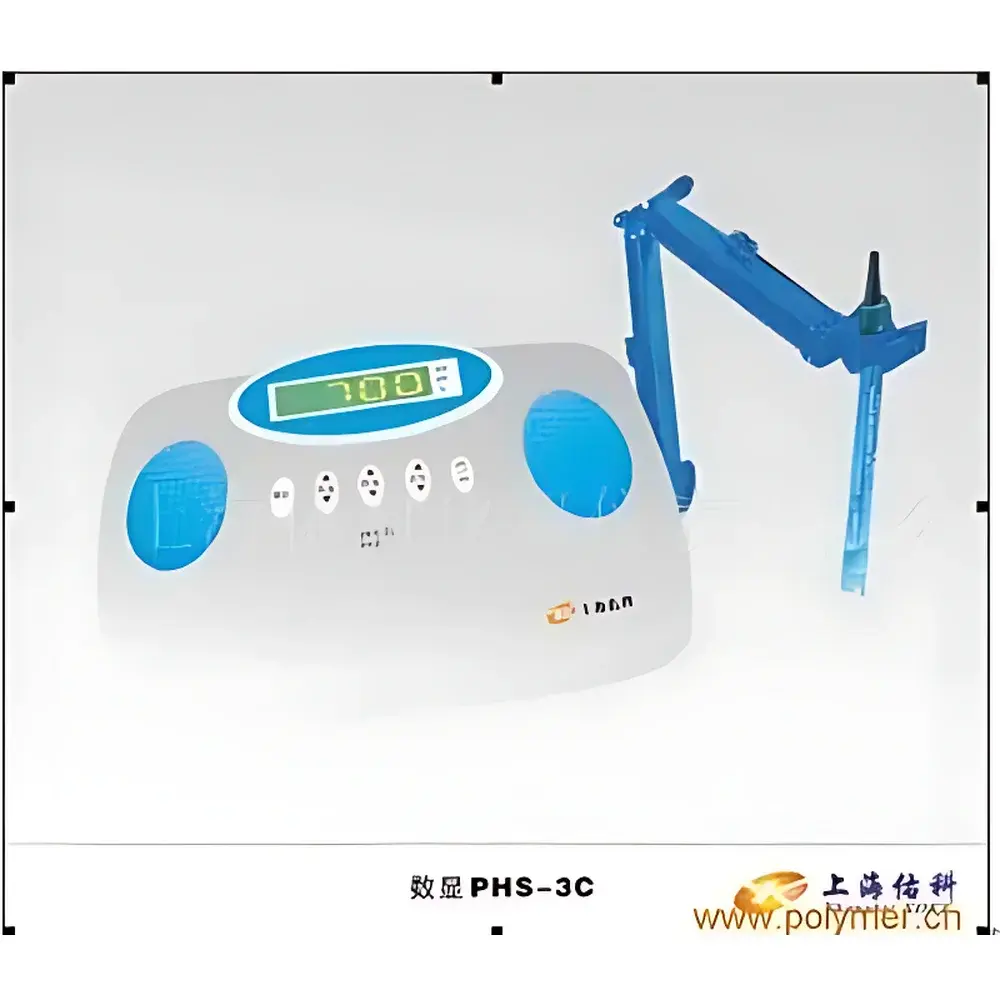
Leici PHS-3C Benchtop pH Meter
| Brand | Leici |
|---|---|
| Origin | Shanghai, China |
| Model | PHS-3C |
| Instrument Type | Benchtop |
| Parameter Types | pH and mV |
| Measurement Accuracy | ±0.1 pH |
| pH Range | 0.00–14.00 pH |
| pH Resolution | 0.01 pH |
| mV Range | −1999–+1999 mV |
| mV Resolution | 1 mV |
| Input Impedance | ≥1 × 10¹² Ω |
| Stability | ≤0.01 pH per 3 h |
| Temperature Compensation Range | 0–60 °C |
| Sample Temperature Range | 5–60 °C |
| Calibration Options | One-point or two-point (using NIST-traceable buffer solutions) |
| Electrode Compatibility | E-201-C pH combination electrode |
| Display | 3½-digit LED |
Overview
The Leici PHS-3C is a precision benchtop pH meter engineered for routine laboratory pH and redox potential (mV) measurements in quality control, academic research, environmental monitoring, and industrial process support. It operates on the fundamental principle of potentiometric measurement: the instrument detects the electromotive force (EMF) generated across a pH-sensitive glass membrane relative to a stable reference electrode—typically integrated into the E-201-C combination electrode. This EMF is linearly proportional to hydrogen ion activity in aqueous solution, enabling quantitative pH determination per the Nernst equation. Designed to meet international metrological requirements for Class 0.01 pH instruments (per IEC 62257-3 and GB/T 11165–2022), the PHS-3C delivers traceable, reproducible readings under controlled ambient and sample temperature conditions.
Key Features
- Benchtop architecture with robust ABS housing and anti-slip rubber feet for stable operation on laboratory workbenches.
- 3½-digit LED display with high-contrast numeric readout—optimized for readability under variable lighting conditions without glare or parallax error.
- Manual temperature compensation (MTC) functionality spanning 0–60 °C, allowing users to input measured solution temperature for real-time slope correction based on the theoretical Nernstian response (−59.16 mV/pH at 25 °C).
- Flexible calibration architecture supporting both single-point (e.g., pH 7.00) and two-point (e.g., pH 4.01 and 7.00, or 7.00 and 10.01) calibration protocols using NIST-traceable standard buffer solutions.
- High-input-impedance amplifier circuitry (≥1 × 10¹² Ω) minimizes loading effects on high-resistance electrodes, ensuring signal fidelity and reducing drift during extended measurements.
- Stability specification of ≤0.01 pH per 3 hours meets ISO/IEC 17025 internal verification criteria for routine analytical instrumentation used in accredited laboratories.
Sample Compatibility & Compliance
The PHS-3C is validated for use with aqueous and low-ionic-strength solutions within the operational temperature range of 5–60 °C. It is compatible with Leici’s E-201-C pH combination electrode—a double-junction, Ag/AgCl reference system with low-resistance ceramic junction and refillable KCl electrolyte reservoir. The instrument complies with national standards GB/T 11165–2022 (General Requirements for pH Meters) and JJG 119–2018 (Verification Regulation for pH Meters). While not certified for FDA 21 CFR Part 11 compliance out-of-the-box, its calibration logs, manual entry timestamps, and user-defined buffer assignments support GLP-aligned documentation when integrated into laboratory SOPs.
Software & Data Management
As a standalone analog-digital hybrid instrument, the PHS-3C does not feature embedded data logging, USB connectivity, or PC interface capabilities. All measurements are displayed in real time and must be manually recorded. However, its calibration history—including date, buffer values, slope (%), and offset (mV)—can be documented externally to satisfy audit requirements under ISO/IEC 17025 Clause 7.7 (Ensuring Validity of Results) and GMP Annex 11 principles for non-automated systems. Users are advised to maintain calibration logs in bound notebooks or LIMS-integrated spreadsheets with version-controlled templates.
Applications
- Quality assurance testing of pharmaceutical excipients and final dosage forms per USP guidelines.
- pH verification of culture media and buffer preparations in microbiology and cell biology labs.
- Environmental water analysis (surface water, wastewater effluent, drinking water) aligned with EPA Method 150.1 and ISO 10523.
- Academic teaching laboratories for foundational electrochemistry experiments involving buffer preparation, titration endpoint detection, and electrode characterization.
- Industrial process monitoring in food & beverage production (e.g., dairy fermentation, brewing, juice acidification) where regulatory pH thresholds apply.
FAQ
What calibration buffers are recommended for the PHS-3C?
NIST-traceable pH 4.01, 7.00, and 10.01 buffer solutions at 25 °C are recommended. Two-point calibration is strongly advised for measurements outside pH 6–8.
Can the PHS-3C measure ORP (oxidation-reduction potential)?
Yes—it supports direct mV measurement from −1999 to +1999 mV with 1 mV resolution, suitable for redox electrode use when paired with appropriate reference systems.
Is automatic temperature compensation (ATC) supported?
No—the PHS-3C requires manual entry of solution temperature; ATC functionality is not implemented.
What is the expected service life of the E-201-C electrode when used with this meter?
Under proper storage (in 3 M KCl solution), regular cleaning, and avoidance of protein/fat fouling, typical electrode service life ranges from 6 to 12 months in moderate-use environments.
Does the instrument include GLP/GMP-compliant audit trail features?
No—audit trails require external documentation. However, its stability, calibration repeatability, and defined error limits support integration into GLP/GMP workflows via procedural controls.
Related Products




