
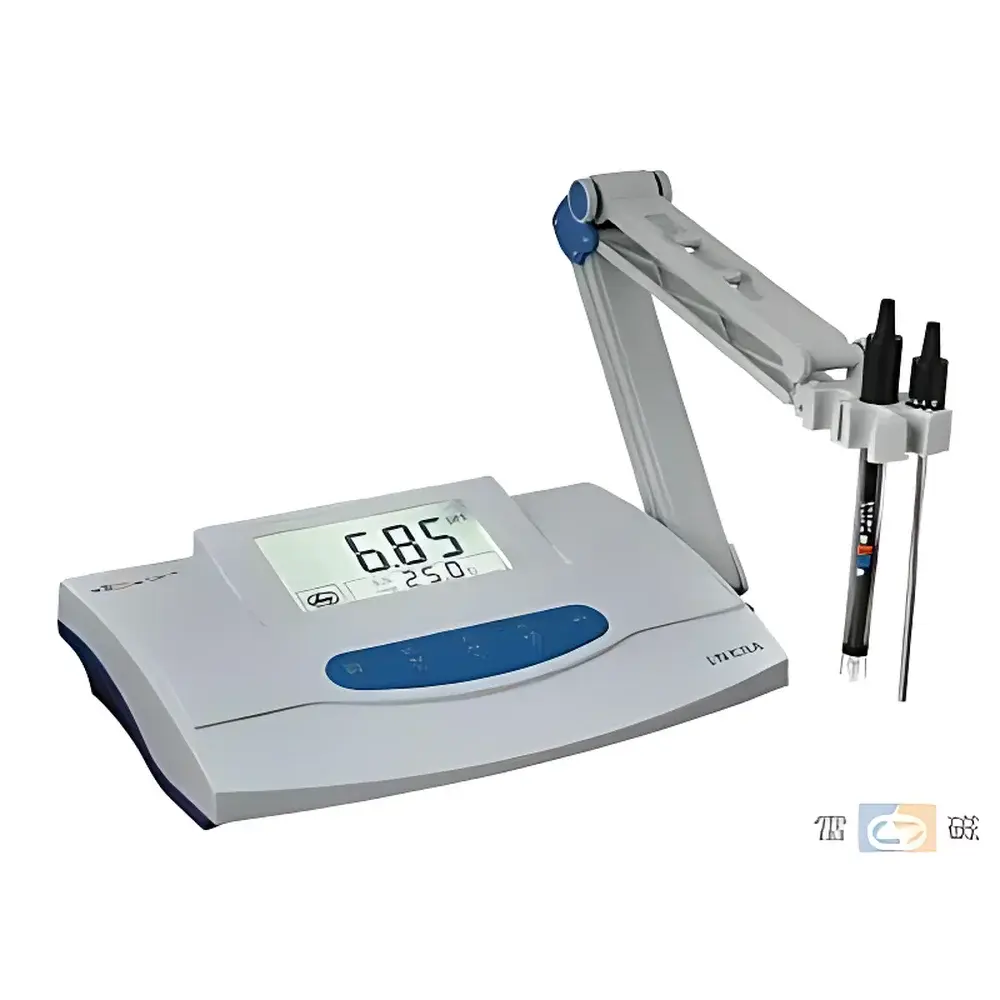
Leici PHS-3E Portable pH/mV/Temperature Meter
| Brand | Leici |
|---|---|
| Origin | Shanghai, China |
| Model | PHS-3E |
| Instrument Type | Portable |
| Measurement Parameters | pH, mV (ORP), Temperature |
| pH Accuracy | ±0.01 pH ±1 digit |
| pH Range | −2.00 to 18.00 pH |
| mV Range | −1999 to +1999 mV |
| Temperature Range | 0.0 to 99.9 °C |
| pH Resolution | 0.01 pH |
| mV Resolution | 1 mV |
| Temperature Resolution | 0.1 °C |
| Temperature Compensation | Automatic or Manual (0.0–99.9 °C) |
| Calibration | Two-point calibration with auto-recognition of standard buffers (pH 4.00, 6.86, 9.18) |
| Display | LCD segment display |
| Power Supply | AC 220 V ±10 %, 50 Hz |
| Dimensions (W×D×H) | 300 × 220 × 90 mm |
| Weight | 1.3 kg |
| Electrode Compatibility | E-201-C combination pH electrode |
Overview
The Leici PHS-3E is a benchtop-portable electrochemical meter engineered for routine pH, redox potential (mV/ ORP), and temperature measurements in academic teaching labs, quality control environments, and field-deployable applications requiring reliable, multi-parameter capability. It operates on the fundamental principle of potentiometric measurement: the Nernst equation governs the voltage difference between a pH-sensitive glass electrode and a stable reference electrode, which is converted into a pH value after temperature compensation and calibration. Designed to meet ISO 8655-5 and GB/T 11165–2005 (Chinese national standard for laboratory pH meters), the PHS-3E delivers Class 0.01 accuracy per IEC 62375:2010 — suitable for non-regulated and GLP-aligned workflows where traceability and repeatability are essential but full 21 CFR Part 11 compliance is not mandated.
Key Features
- High-contrast LCD segment display with dual-line readout for simultaneous pH/mV and temperature values
- Auto-buffer recognition for three certified standard solutions (pH 4.00, 6.86, and 9.18 at 25 °C), minimizing user error during calibration
- Two-point calibration protocol with slope calculation and offset verification, supporting both manual and automatic temperature compensation (ATC/ MTC)
- Integrated measurement of pH (−2.00 to 18.00), mV (−1999 to +1999), and temperature (0.0 to 99.9 °C) with independent resolution settings
- Dual-electrode architecture: compatible with Leici’s E-201-C combination pH electrode and T-818-B-6 thermistor-based temperature probe — optimized for aqueous and low-ionic-strength samples
- Stability performance of ≤0.01 pH ±1 digit over 3 hours, verified under controlled ambient conditions (25 °C, 50% RH)
- Robust ABS housing (W 300 × D 220 × H 90 mm; mass 1.3 kg) with CE-marked AC power supply (220 V ±10 %, 50 Hz)
Sample Compatibility & Compliance
The PHS-3E is validated for use with aqueous solutions, buffer standards, process streams, and environmental water samples (e.g., surface water, wastewater effluent, and nutrient media). It supports calibration traceability to NIST-traceable pH standards when used with certified reference materials (CRM) from suppliers such as Merck, Hanna Instruments, or Mettler Toledo. While not inherently compliant with FDA 21 CFR Part 11 due to absence of electronic audit trail or user access controls, the instrument satisfies foundational requirements for ISO/IEC 17025-accredited laboratories performing pH testing under Clause 6.4 (Equipment) and Clause 7.7 (Ensuring Validity of Results). It conforms to GB/T 11165–2005 and JJG 119–2018 (Chinese metrological verification regulations), and its electrical safety complies with IEC 61010-1:2010.
Software & Data Management
The PHS-3E operates as a standalone, firmware-driven instrument without embedded data logging or USB/Bluetooth connectivity. All measurements are displayed in real time and must be manually recorded. For laboratories requiring documentation integrity, integration with external LIMS or ELN systems is achieved via visual transcription or optional third-party analog-to-digital interface modules (not supplied). Calibration records—including date, buffer IDs, slope (%), asymmetry potential (mV), and temperature—must be maintained in hard-copy lab notebooks or digital registers aligned with GLP principles. No proprietary software is provided; however, raw output is compatible with spreadsheet-based QA/QC tracking templates compliant with ISO 9001:2015 Clause 8.5.2.
Applications
- Academic instruction in general chemistry and analytical laboratories for teaching electrode theory, calibration methodology, and Nernstian behavior
- QC testing of pharmaceutical excipients, buffer solutions, and purified water (PW) per USP conductivity and pH correlation protocols
- Environmental monitoring of freshwater bodies, soil leachates, and treated effluents per EPA Method 150.1 and ISO 10523
- Food and beverage production line checks for rinse water, brine solutions, and fermentation broth pH stability
- Electroplating bath control where ORP monitoring complements pH for redox-coupled process optimization
- Research support in materials science for colloidal dispersion stability assessment via zeta potential proxy (pH-dependent)
FAQ
What calibration buffers are supported by the PHS-3E?
The instrument automatically recognizes three standard pH buffers: 4.00, 6.86, and 9.18 at 25 °C. Custom buffer values cannot be programmed.
Does the PHS-3E support automatic temperature compensation (ATC)?
Yes — ATC is enabled when a compatible temperature probe (e.g., T-818-B-6) is connected; otherwise, manual temperature entry (0.0–99.9 °C) is required.
Can the PHS-3E measure non-aqueous samples?
It is designed for aqueous media only. Measurements in organic solvents or high-alcohol content solutions may yield unstable readings and risk electrode damage.
Is the E-201-C electrode included with the meter?
No — the E-201-C pH combination electrode and T-818-B-6 temperature probe are sold separately unless specified in a bundled configuration.
What is the recommended recalibration frequency?
Per ISO/IEC 17025:2017, recalibration is required before each batch of measurements, after electrode cleaning, following prolonged storage, or when drift exceeds ±0.02 pH from previous calibration verification.





