
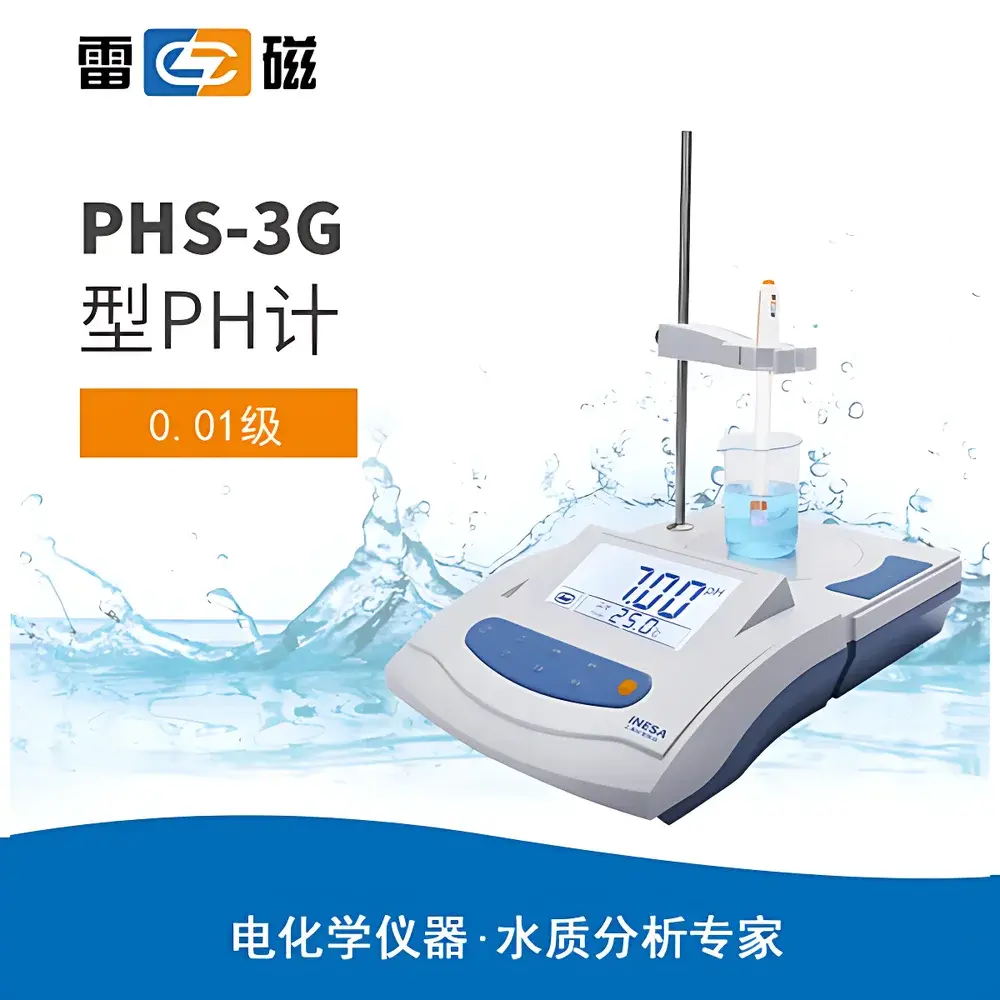
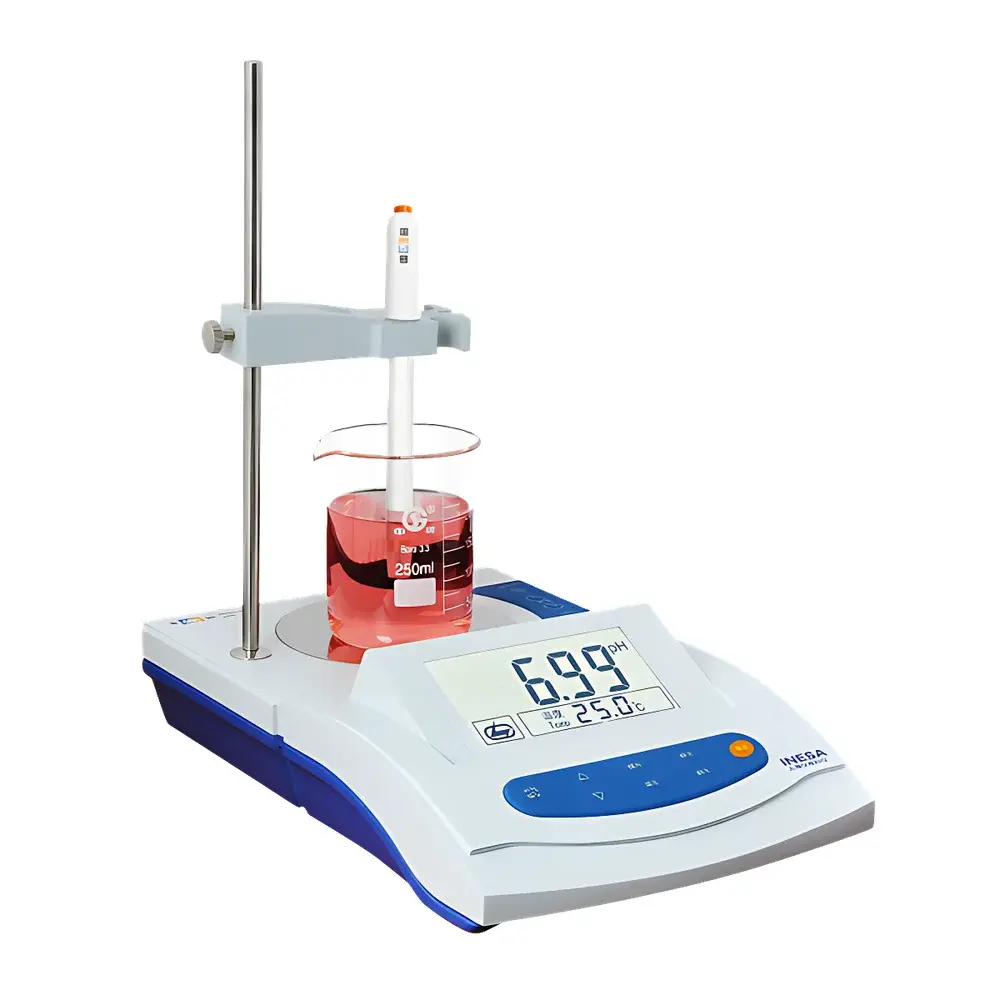
Leici PHS-3G Benchtop pH Meter
| Brand | Leici |
|---|---|
| Origin | Shanghai, China |
| Instrument Type | Benchtop |
| Measurement Parameters | pH and mV (ORP) |
| pH Accuracy | ±0.01 pH |
| pH Range | −2.00 to 19.99 pH |
| mV Range | −1999 to +1999 mV |
| pH Resolution | 0.01 pH |
| mV Resolution | 1 mV |
| Basic Error | ±0.01 pH, ±0.1% FS (mV) |
| Temperature Compensation | Manual, 0.0–60.0 °C |
| Calibration Buffers | pH 4.00, 6.86, and 9.18 |
| Display | Backlit LCD |
| Built-in Stirrer | Yes |
| Dimensions (W×D×H) | 210 × 310 × 95 mm |
| Weight | 2 kg |
| Power Supply | AC 220 V ±10%, 50 Hz ±1 Hz |
Overview
The Leici PHS-3G is a benchtop pH meter engineered for precision electrochemical measurement in routine laboratory environments. It operates on the fundamental principle of potentiometric pH determination: measuring the potential difference between a glass pH electrode and a reference electrode immersed in an aqueous sample, then converting that voltage into a pH value using the Nernst equation. Designed to meet ISO 8655-4 and GB/T 11165–2022 (Chinese national standard for pH meters), the PHS-3G delivers reliable, repeatable results at 0.01-pH resolution across an extended range (−2.00 to 19.99 pH), enabling analysis of highly acidic, neutral, and strongly alkaline solutions — including non-aqueous or low-ionic-strength samples when paired with appropriate electrodes. Its dual-parameter capability supports both pH and millivolt (ORP) measurements, making it suitable for redox titrations, corrosion studies, and disinfection process monitoring.
Key Features
- Built-in magnetic stirrer with adjustable speed control — eliminates external stir plates and ensures homogeneous sample mixing during calibration and measurement.
- Backlit LCD display with large, high-contrast characters (128 × 64 pixels) — optimized for readability under variable ambient lighting conditions in QC labs and teaching facilities.
- Automatic recognition of three standard IUPAC-recommended calibration buffers (pH 4.00, 6.86, and 9.18) — reduces operator error and accelerates setup for 1- or 2-point calibrations.
- Manual temperature compensation (0.0–60.0 °C) — allows precise correction of electrode slope drift without requiring integrated temperature probes, supporting compatibility with legacy or specialized electrodes.
- Rugged ABS housing and compact footprint (210 × 310 × 95 mm) — designed for stable placement on crowded lab benches while maintaining mechanical stability during stirring operations.
- Compliance-ready architecture — supports GLP documentation workflows through clear parameter logging, calibration timestamping, and unambiguous error indication (e.g., “CAL ERROR”, “ELECTRODE DRIFT”)
Sample Compatibility & Compliance
The PHS-3G is validated for use with standard combination pH electrodes (BNC connector) and ORP electrodes meeting DIN 19262 and ASTM D1293 specifications. It accommodates aqueous, buffered, and semi-aqueous samples typical in environmental testing (e.g., wastewater, soil extracts), food & beverage QA (e.g., dairy, brewing, juice processing), and academic chemistry labs. While not certified for FDA 21 CFR Part 11 compliance out-of-the-box, its deterministic calibration sequence, non-volatile memory retention (up to 10 calibration records), and traceable error reporting support audit readiness under ISO/IEC 17025 and GMP-aligned internal procedures. All electrical safety design conforms to GB 4793.1–2019 (equivalent to IEC 61010-1).
Software & Data Management
The PHS-3G operates as a standalone instrument with no proprietary PC software dependency. All calibration data, measurement values, and system status are retained in non-volatile memory. Each calibration event logs date/time, buffer IDs used, slope (%), and offset (mV) — accessible via front-panel navigation. For laboratories requiring electronic record archiving, analog output (0–20 mA or 0–5 V optional via accessory module) enables integration with SCADA systems or data loggers compliant with ISA-88 and ISA-95 frameworks. Exported records meet minimum ALCOA+ criteria (Attributable, Legible, Contemporaneous, Original, Accurate) when manually transcribed into LIMS or ELN platforms.
Applications
- Quality control of pharmaceutical excipients and active pharmaceutical ingredients (APIs) per USP and EP 2.2.3.
- pH monitoring during fermentation processes in biotechnology and biofuel production.
- Calibration verification of field-deployable pH sensors used in municipal water distribution networks.
- Teaching fundamental electrochemistry concepts — Nernst equation validation, liquid junction potential effects, and electrode response kinetics.
- Environmental compliance testing of industrial effluents per EPA Method 150.1 and China’s HJ 1147–2020 standard.
FAQ
Does the PHS-3G support automatic temperature compensation (ATC)?
No — it features manual temperature entry only. ATC requires a separate temperature probe connected via dedicated input; this model does not include that interface.
Can the built-in stirrer be disabled during measurement?
Yes — the stirrer is independently controlled via a dedicated toggle switch and can be deactivated before reading stabilization without powering down the instrument.
What electrode types are compatible with the PHS-3G?
Any BNC-terminated pH or ORP electrode with standard Ag/AgCl reference systems; recommended models include Leici E-201-C, Orion 9102BN, or Metrohm 6.0234.000.
Is the calibration history exportable to a computer?
Not directly via USB or RS-232 — data must be manually recorded or captured via analog output using third-party DAQ hardware.
How often should the instrument be recalibrated?
Per ISO/IEC 17025:2017 Clause 7.7, recalibration is required before each analytical batch, after electrode replacement, or following exposure to extreme pH, high salt, or protein-rich matrices.
Related Products




