
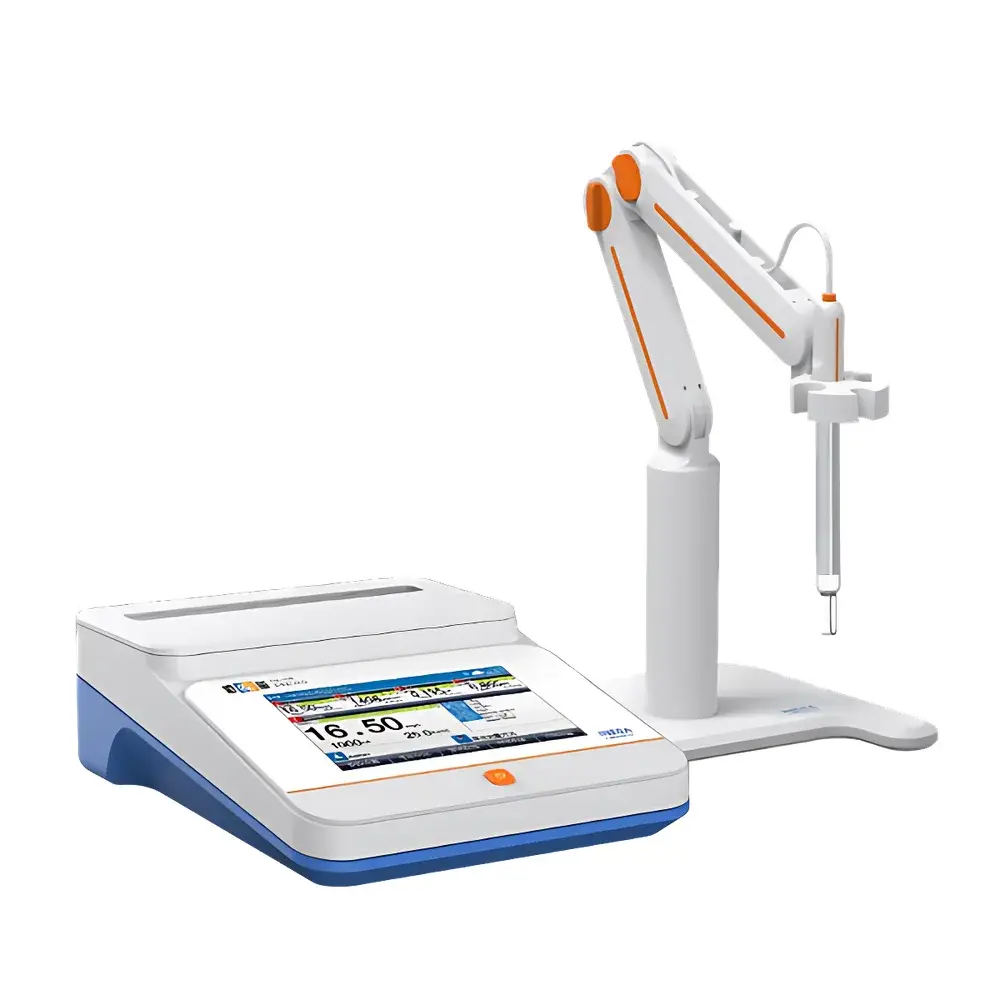
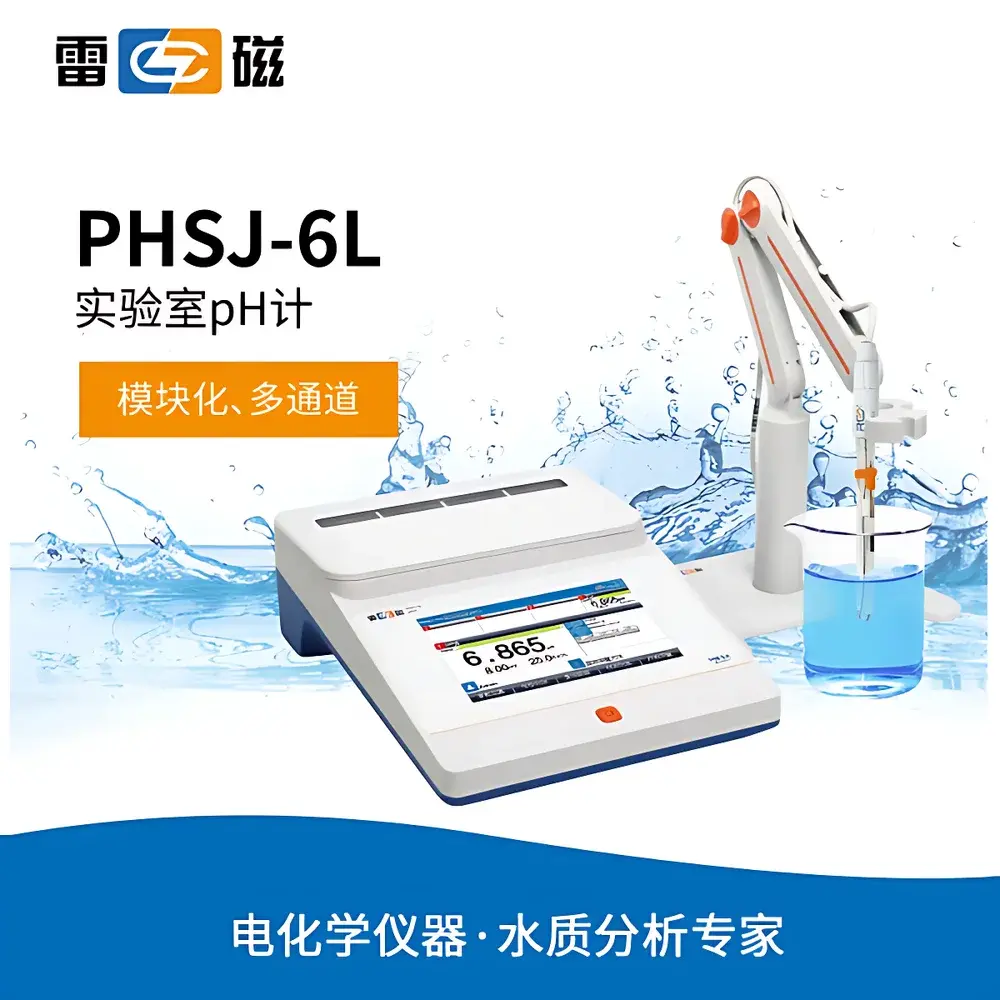
Leici PHSJ-6L Benchtop pH/ORP/mV Meter
| Brand | Leici |
|---|---|
| Origin | Shanghai, China |
| Manufacturer Type | Manufacturer |
| Product Category | Domestic |
| Model | PHSJ-6L |
| Instrument Type | Benchtop |
| Parameter Types | Multi-parameter |
| Measurement Accuracy | 0.001 pH / ±0.002 pH |
| Measurement Range | (−2.000 to 20.000) pH |
| Resolution | 0.001 pH |
| Temperature Range | (−10.0 to 135.0) °C |
| Temperature Resolution | 0.1 °C |
| Temperature Accuracy | ±0.1 °C (electronic unit) |
| Calibration Standards Supported | GB, DIN, NIST, USA, MERK, JIS |
| Protection Rating | IP54 |
| Channels | 4 modular slots (expandable to 4 pH modules) |
| Data Storage Capacity | 1000 pH measurements, 100 calibration records, 1000 standard verification logs |
| Interface | RS-232, USB, optional barcode scanner & autosampler integration |
| Compliance | GLP-compliant |
Overview
The Leici PHSJ-6L is a high-precision, multi-channel benchtop pH/ORP/mV meter engineered for regulated laboratory environments requiring traceable, reproducible electrochemical measurements. Based on potentiometric measurement principles—utilizing the Nernst equation to quantify hydrogen ion activity—the PHSJ-6L delivers Class 0.001 pH performance with dual-range mV capability (±2000.00 mV) and integrated temperature compensation (−10.0 to 135.0 °C). Its modular architecture supports up to four independent measurement channels, enabling parallel analysis of pH, redox potential (ORP), and millivolt signals across diverse sample matrices without cross-channel interference. Designed in accordance with international metrological standards—including ISO/IEC 17025 guidance for calibration validity and IEC 61000-4 electromagnetic compatibility—the instrument meets foundational requirements for analytical rigor in QC labs, pharmaceutical R&D, environmental testing, and academic research.
Key Features
- 7-inch high-resolution color TFT touchscreen with intuitive icon-driven navigation and bilingual interface (English/Chinese)
- IP54-rated enclosure for dust resistance and limited water splashing protection—suitable for general lab use without dedicated fume hood placement
- Modular channel design: accepts up to four hot-swappable pH measurement modules; automatic recognition ensures plug-and-play configuration
- Advanced endpoint detection algorithms: supports auto-read, timed-read, interval-read, and manual capture modes with configurable stability criteria
- Comprehensive electrode diagnostics: real-time slope calculation, asymmetry potential assessment, and response time monitoring per electrode
- Triple-level user authentication with password enforcement, role-based permissions (Administrator/Operator/Viewer), and encrypted audit trail logging
- Firmware-upgradable architecture enabling future protocol expansion—including custom method scripting and regulatory reporting templates
Sample Compatibility & Compliance
The PHSJ-6L accommodates standard glass combination electrodes, refillable reference electrodes, and solid-state sensors compatible with BNC or DIN connectors. It supports calibration against internationally recognized buffer standards—including NIST-traceable solutions (pH 1.68, 4.01, 6.86, 9.18, 12.45), DIN 19267 buffers, and GB/T 27500–2011 Chinese national standards—ensuring cross-laboratory comparability. All calibration events, standard verifications, and measurement sessions are timestamped and digitally signed within the internal database, fulfilling core GLP documentation requirements. The system complies with FDA 21 CFR Part 11 for electronic records and signatures when used with validated software configurations, and supports full GMP audit trail export (CSV/PDF) including operator ID, method version, electrode serial number, ambient conditions, and raw sensor output.
Software & Data Management
Data integrity is enforced through embedded database management supporting 1000 pH measurements, 100 full calibration sets, and 1000 buffer verification logs—all stored with metadata (date/time, operator, electrode ID, temperature, calibration slope/offset). Export options include USB mass storage (CSV, PDF), RS-232 serial printing (configurable layout), and PC synchronization via Leici’s certified communication suite (Windows-compatible, TLS-secured). Integration with Laboratory Information Management Systems (LIMS) is achieved through standardized ASCII command protocols over RS-232 or TCP/IP (via optional Ethernet module). U盘-based method import/export enables centralized SOP deployment across instrument fleets, while barcode scanning support accelerates sample ID entry during high-throughput workflows.
Applications
- Pharmaceutical quality control: dissolution testing, excipient pH screening, and buffer preparation verification per USP and EP 2.2.3
- Environmental monitoring: wastewater effluent pH compliance (EPA Method 150.1), soil slurry analysis, and acid rain studies
- Food & beverage safety: titratable acidity validation, fermentation process control, and shelf-life stability testing
- Academic research: enzyme kinetics assays requiring precise proton activity tracking, corrosion inhibitor evaluation via ORP profiling
- Chemical manufacturing: catalyst bath monitoring, electroplating bath maintenance, and reagent grade verification
FAQ
Does the PHSJ-6L meet FDA 21 CFR Part 11 requirements?
Yes—when deployed with validated firmware (v3.2+), enabled audit trail logging, and configured with user authentication and electronic signature protocols, it satisfies electronic record and signature controls as defined in Subpart B.
Can the instrument store calibration data for multiple electrodes independently?
Yes—each electrode is assigned a unique identifier; calibration parameters (slope, offset, date, buffer set) are stored per electrode ID and recalled automatically upon connection.
Is temperature compensation fully automatic during pH measurement?
Yes—integrated Pt1000 or NTC thermistor input enables real-time temperature correction using either linear or non-linear (NIST) algorithms, selectable per method.
What file formats are supported for data export?
CSV (tabular), PDF (formatted reports with header/footer), and XML (for LIMS ingestion); all include embedded metadata and digital signature hashes.
How is data security maintained during USB transfer?
USB export requires administrator-level authorization; exported files are write-protected and contain SHA-256 checksums to prevent tampering post-export.
Related Products





