
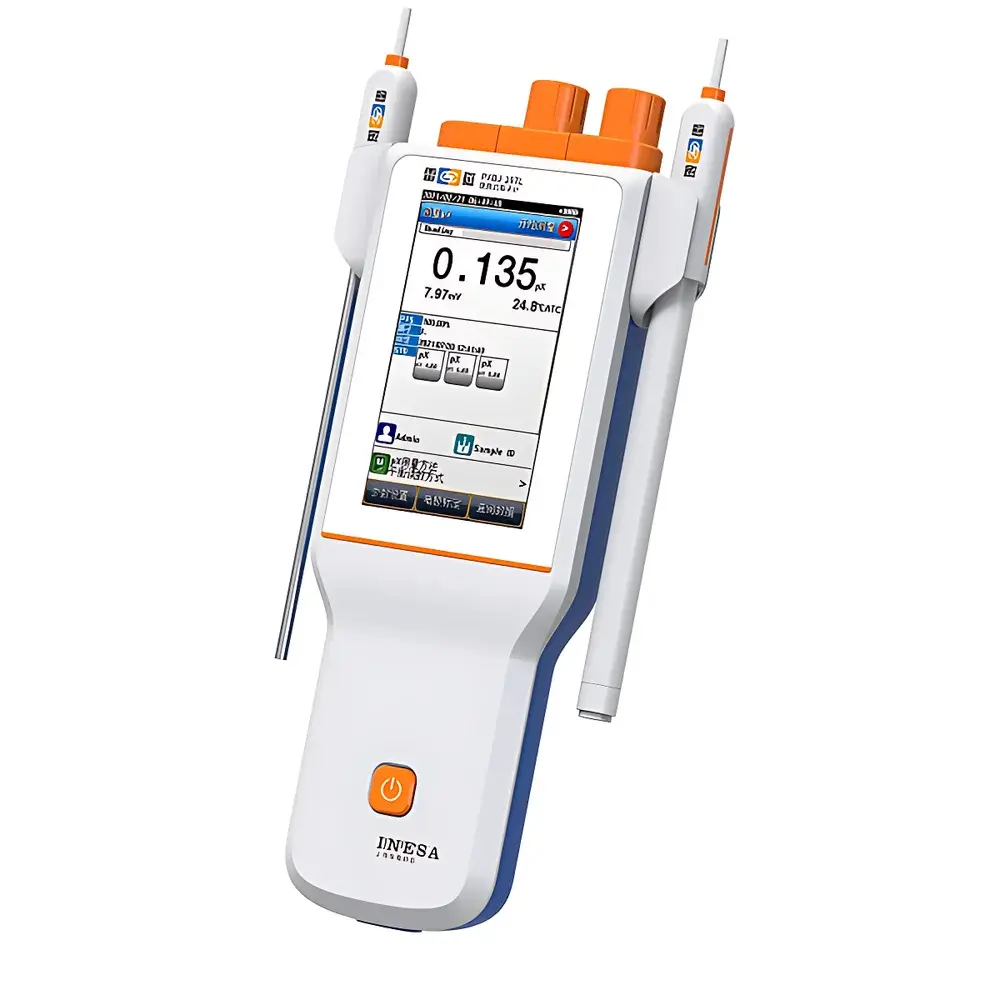
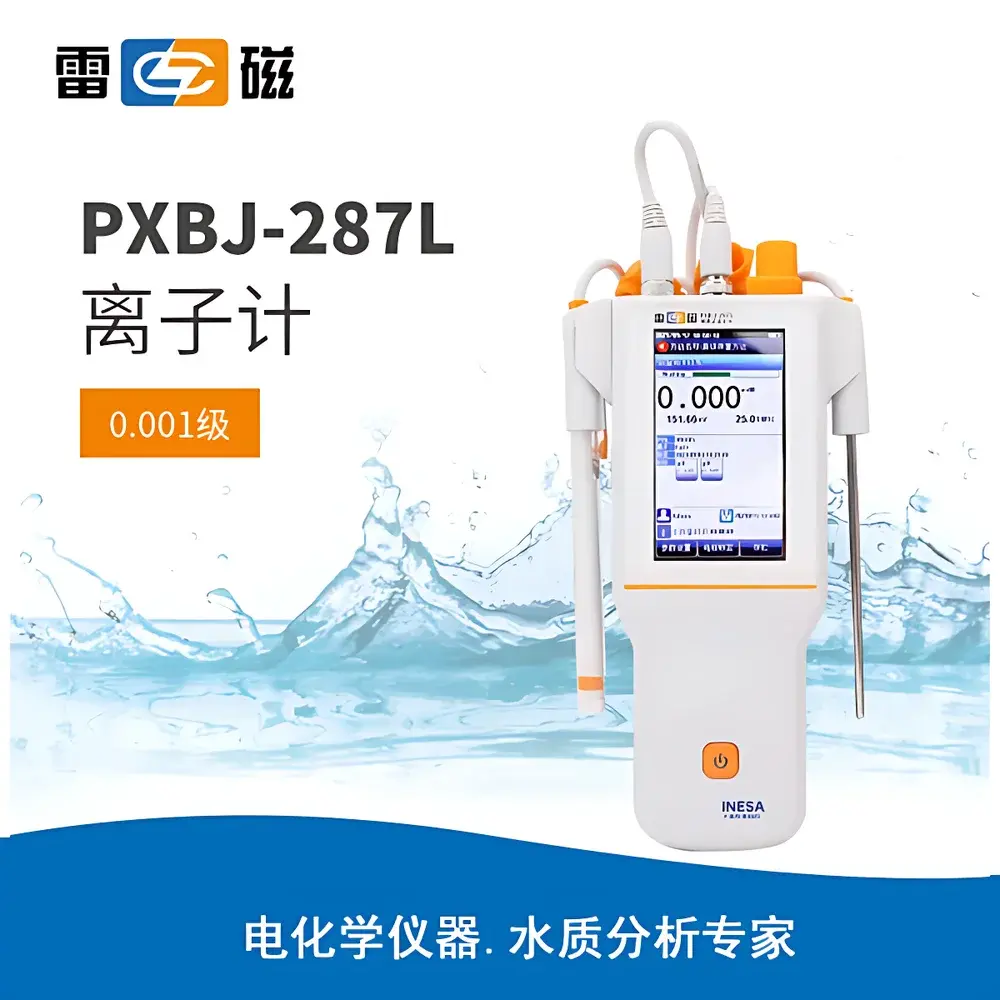
Leici PXBJ-287L Portable Ion Analyzer
| Brand | Leici |
|---|---|
| Origin | Shanghai, China |
| Manufacturer Type | Direct Manufacturer |
| Regional Category | Domestic (China) |
| Model | PXBJ-287L |
| Price Range | USD 700–1,400 |
| Instrument Type | Portable |
| Ion Measurement Range | (−2.000 to 20.000) pX |
| Measurement Accuracy | ±0.002 pX |
| Temperature Range | (−10.0 to 135.0) °C / (14.0 to 275.0) °F |
| pH Range | (−2.000 to 20.000) pH |
| mV Range | (−2000.00 to 2000.00) mV |
| Resolution | 0.001 pX / 0.001 pH / 0.01 mV |
| Temperature Resolution | 0.1 °C / 0.1 °F |
| IP Rating | IP65 |
| Battery | Rechargeable Li-ion |
| Dimensions | 90 × 255 × 40 mm |
| Weight | 0.5 kg |
Overview
The Leici PXBJ-287L Portable Ion Analyzer is a high-precision, field-deployable electrochemical instrument engineered for direct potentiometric measurement of ion activity in aqueous solutions. Based on the Nernst equation principle, it delivers trace-level quantification of monovalent and multivalent ions—including F−, Cl−, NO3−, NH4+, K+, Na+, and others—via selective ion-sensitive electrodes (ISEs). Its 0.001 pX resolution and ±0.002 pX electronic accuracy meet Class 0.001 analytical requirements per IEC 61000-4-30 and ISO/IEC 17025 calibration traceability frameworks. Designed for environmental fieldwork, wastewater compliance verification, and drinking water quality screening, the PXBJ-287L operates across extreme ambient conditions (−10.0 to 135.0 °C), with automatic temperature compensation (ATC) and dual-unit display (°C/°F). Its compact form factor (90 × 255 × 40 mm, 0.5 kg), IP65-rated enclosure, and integrated lithium-ion battery support continuous operation for >12 hours under typical field duty cycles.
Key Features
- High-resolution 5.0-inch color TFT touchscreen with intuitive icon-driven navigation and bilingual (English/Chinese) UI support
- Selectable resolution modes: pX (0.001 / 0.01 / 0.1), mV (0.01 / 0.1 / 1), and temperature (0.1 °C/°F)
- Multi-point calibration capability: up to 8-point pX/pH calibration; 1-point ORP calibration; auto-recognition of six standard buffer sets (GB, DIN, NIST, USA, MERK, JIS)
- Smart electrode management: automatic ISE identification, calibration history logging, and expiration alerting
- Advanced endpoint detection: supports auto-read, timed-read, interval-read, and manual acquisition modes with configurable stability criteria
- Comprehensive ion concentration reporting: seamless switching among μg/L, mg/L, g/L, mol/L, mmol/L, and pX units with four-digit scientific notation
- Robust data integrity architecture: GLP-compliant audit trail, user-level permission control (admin/operator/guest), password protection, and factory reset safeguards
Sample Compatibility & Compliance
The PXBJ-287L is validated for use with liquid samples meeting standard aqueous matrix specifications (TDS < 5000 mg/L, turbidity < 5 NTU, suspended solids < 100 mg/L). It accommodates standard combination ISEs (e.g., LaF3-based fluoride electrodes) and reference electrodes compliant with ASTM D1129 and ISO 10523. The instrument’s firmware implements mandatory calibration validation protocols aligned with US EPA Method 300.0 (for anions) and APHA Standard Methods 4500-F− and 4500-Cl−. All stored measurements include timestamp, operator ID, electrode serial number, calibration status, and environmental metadata—ensuring full traceability for regulatory submissions under ISO 14001, ISO 22000, or local environmental agency reporting mandates.
Software & Data Management
- On-device storage capacity: 1000 datasets per parameter type (pX, pH, mV, temperature), each containing full calibration logs and raw sensor output
- Data visualization: real-time trend curves, histogram distribution plots, and statistical summaries (mean, SD, RSD, min/max)
- Export interfaces: USB-C host port for PC synchronization via Leici LabLink software (Windows/macOS); UVC-compliant USB drive read/write; Bluetooth 5.0 BLE for wireless transmission to mobile devices or cloud gateways
- LIMS integration: supports ASTM E1384-compliant HL7 and CSV export formats; compatible with major laboratory information management systems via configurable API endpoints
- Firmware extensibility: over-the-air (OTA) updates enable method library expansion, new ISE support, and regulatory module additions without hardware modification
Applications
The PXBJ-287L serves critical roles in environmental monitoring, municipal water utilities, industrial effluent compliance, and academic research. Field technicians deploy it for rapid assessment of fluoride contamination in groundwater (per WHO Guideline Value: 1.5 mg/L), chloride ingress in coastal aquifers, ammonium spikes in wastewater influent streams, and nitrate leaching in agricultural runoff. In regulatory laboratories, it supports routine verification of disinfection byproduct precursors and fulfills reporting obligations under EU Drinking Water Directive (2020/2184) Annex I parameters. Its GRAN plot functionality enables precise determination of unknown ion concentrations in complex matrices where liquid junction potentials or ionic strength variations impair conventional direct-read methods.
FAQ
What ion-selective electrodes are natively supported?
Preconfigured modes include F−, Cl−, NO3−, NH4+, K+, Na+, and Ca2+; users may define custom ISE response slopes and selectivity coefficients via the Electrode Manager interface.
Does the device comply with FDA 21 CFR Part 11 requirements?
While not certified as standalone Part 11-compliant, its audit trail, electronic signature support (via password-locked user accounts), and immutable data export formats satisfy foundational ALCOA+ principles required for GxP-aligned workflows when deployed within validated LIMS environments.
How is temperature compensation applied during pX measurement?
Automatic compensation uses either built-in Pt1000 thermistor input or external ATC probe; the algorithm applies the full Nernstian temperature coefficient (dE/dT = −(2.303RT/zF)) dynamically per measured temperature, eliminating manual correction tables.
Can calibration standards be customized beyond the six built-in buffer groups?
Yes—users may create and save up to 10 custom buffer sets with defined nominal values, tolerances, and expiration dates; all calibrations are digitally signed and time-stamped for audit readiness.
What is the expected service life of the rechargeable battery under continuous field use?
Rated for ≥500 charge cycles; typical field usage (2 hrs/day, 5 days/week) yields ≥24 months of operational reliability before capacity degradation exceeds 20%.
Related Products







