
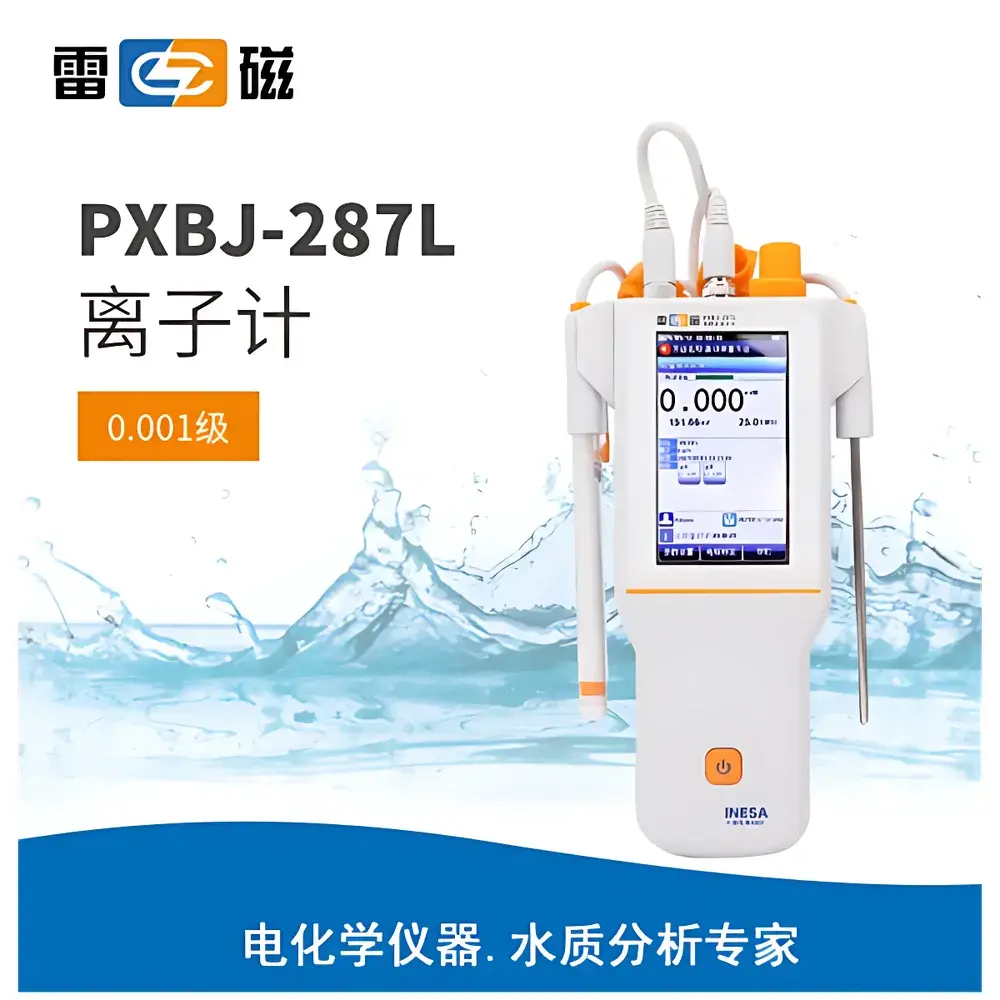
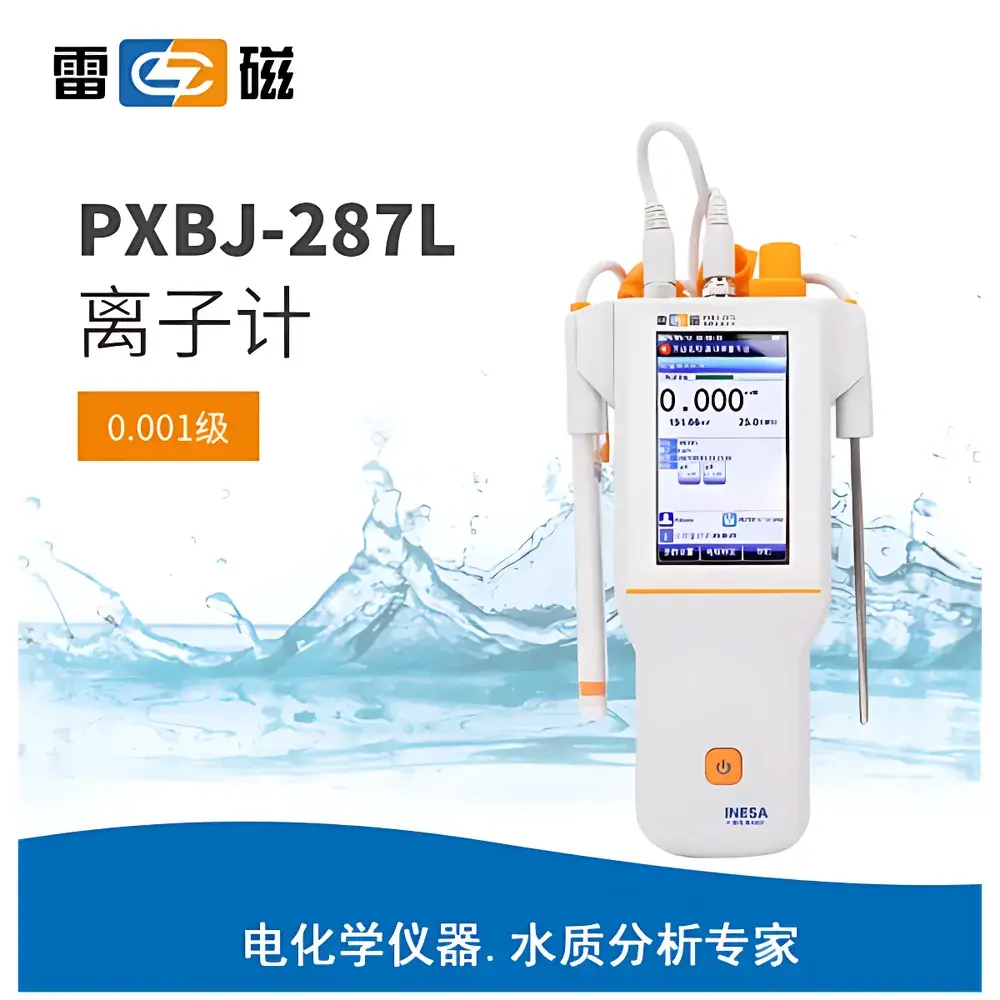
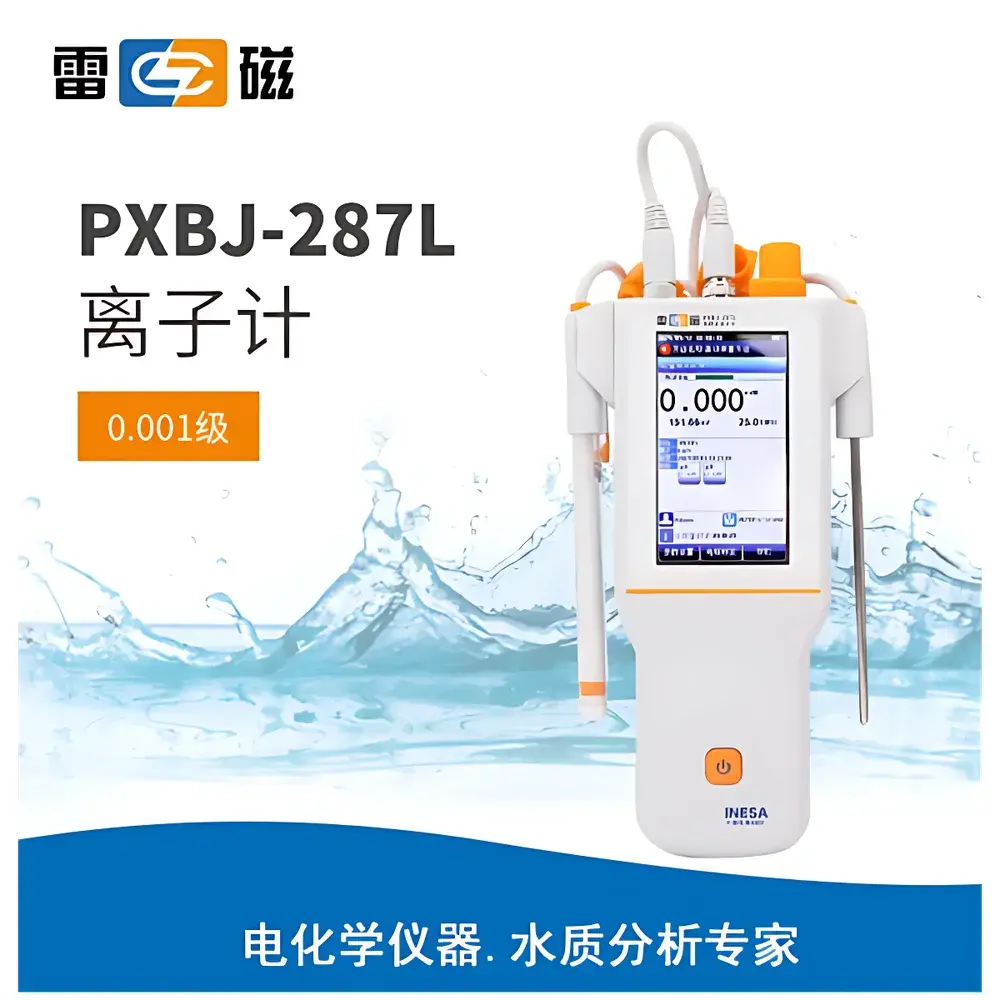
Leici PXBJ-287L Portable Ion Meter
| Brand | Leici |
|---|---|
| Origin | Shanghai, China |
| Model | PXBJ-287L |
| Instrument Type | Portable |
| Ion Measurement Range | (−2.000 to 20.000) pX |
| Resolution | 0.001 pX |
| Temperature Range | (−10.0 to 135.0) °C / (14.0 to 275.0) °F |
| IP Rating | IP65 |
| Calibration Points | 1–8 for pH/pX, 1 for ORP |
| Data Storage Capacity | 1,000 datasets per parameter type |
| Connectivity | USB, Bluetooth 4.2, U-disk support, LIMS-compatible via dedicated software |
| Power | Rechargeable Li-ion battery with PC/mobile power bank charging capability |
Overview
The Leici PXBJ-287L Portable Ion Meter is a field-deployable, microprocessor-controlled potentiometric analyzer engineered for precise, on-site quantification of monovalent and multivalent ions—including F⁻, Cl⁻, NO₃⁻, NH₄⁺, K⁺, Na⁺, and Ca²⁺—in aqueous environmental samples. It operates on the Nernst equation principle, measuring the potential difference between a selective ion electrode (e.g., LaF₃-based fluoride electrode) and a reference electrode under controlled temperature conditions. Designed specifically for regulatory-compliant water quality monitoring in municipal wastewater treatment plants, drinking water distribution networks, surface water surveillance stations, and industrial effluent discharge points, the PXBJ-287L delivers laboratory-grade accuracy in a rugged, handheld form factor. Its dual-mode measurement architecture supports both direct concentration readout and advanced electrochemical techniques including standard addition, sample addition, and Gran plot analysis—enabling reliable quantification even in complex matrices with variable ionic strength.
Key Features
- High-resolution 5.0-inch color TFT touchscreen with adjustable backlight and intuitive icon-driven navigation
- Multi-language interface supporting English and Chinese, with user-configurable display language
- Selectable resolution modes: pX (0.001/0.01/0.1), mV (0.01/0.1/1), and temperature (0.1 °C/°F)
- Integrated intelligent electrode diagnostics: automatic recognition of ISE type, real-time slope and offset validation, and calibration status flagging
- IP65-rated enclosure ensuring dust-tight operation and resistance to low-pressure water jets—suitable for outdoor deployment in rain or high-humidity environments
- Comprehensive calibration management: auto-recognition of six international buffer standards (GB, DIN, NIST, USA, MERK, JIS); customizable buffer groups; automated calibration reminder and drift alarm
- Advanced endpoint detection algorithm with configurable stability criteria (±0.01 pX over 3–30 s) for automated reading initiation
- Eight preloaded ion modes with built-in selectivity coefficients; user-definable ion profiles with custom stoichiometry and charge valence assignment
Sample Compatibility & Compliance
The PXBJ-287L is validated for use with natural waters (rivers, lakes, groundwater), treated effluents, potable water, and industrial process streams within pH 2–12 and TDS ≤ 5,000 mg/L. It complies with ASTM D1293 (pH of water), ISO 10523 (water quality — determination of pH), and EPA Method 300.1 (determination of anions by ion-selective electrodes). Its firmware architecture conforms to GLP data integrity requirements: each measurement record includes timestamp, operator ID, electrode serial number, calibration history, ambient temperature, and raw mV output. Audit trails are immutable and exportable in CSV or XML format, supporting FDA 21 CFR Part 11 compliance when paired with validated LIMS integration protocols.
Software & Data Management
Data acquisition and post-processing are enabled via Leici’s proprietary PC software (compatible with Windows 10/11), which provides full traceability through hierarchical user accounts with role-based permissions (administrator, analyst, reviewer). Each dataset includes metadata fields for sampling location (GPS-tagged via optional Bluetooth module), matrix description, and QA/QC flags. Statistical functions include mean, SD, RSD, linear regression (for calibration curves), and outlier detection using Grubbs’ test. Export formats include PDF reports (with digital signature support), Excel-ready CSV, and structured XML for seamless ingestion into enterprise LIMS platforms. Firmware updates are delivered via encrypted USB flash drive or over-the-air Bluetooth transfer, preserving configuration integrity during version upgrades.
Applications
- Regulatory monitoring of fluoride in drinking water per WHO guideline values (1.5 mg/L) and US EPA MCL (4.0 mg/L)
- Ammonium nitrogen tracking in activated sludge systems to optimize nitrification/denitrification cycles
- Chloride ingress assessment in concrete pore water for corrosion risk evaluation in infrastructure projects
- Field validation of ion chromatography results during method verification studies
- Emergency response testing for cyanide or nitrate contamination following agricultural runoff or industrial spills
- Educational use in university environmental chemistry labs for teaching potentiometric titration principles
FAQ
What ion-selective electrodes are compatible with the PXBJ-287L?
The instrument supports all Leici-certified solid-state and liquid-membrane ISEs with BNC or mini-DIN connectors, including F⁻, Cl⁻, NO₃⁻, NH₄⁺, K⁺, Na⁺, Ca²⁺, and CN⁻ electrodes. Third-party electrodes may be used if they meet ±2 mV zero-point stability and ≥95% Nernstian slope specifications.
Does the device support temperature compensation for non-aqueous samples?
No. The PXBJ-287L is calibrated and validated exclusively for aqueous solutions. Temperature compensation algorithms assume water’s dielectric constant and activity coefficient behavior; use in organic solvents or high-viscosity media is not supported.
How is data security maintained during Bluetooth transmission?
All wireless data transfers utilize AES-128 encryption with authenticated pairing. Session keys are regenerated per connection, and no measurement data is cached on the mobile device after successful upload to the host system.
Can calibration curves be imported from external sources?
Yes—via USB or PC software, users may import pre-validated calibration tables (CSV format) containing slope, intercept, and confidence intervals for multi-point calibrations, enabling rapid method deployment across instrument fleets.
Is the battery replaceable by the end user?
The lithium-ion battery is field-replaceable using standard Torx T5 tools and requires no soldering. Replacement kits include thermal fuse verification and factory recalibration certificate.







