
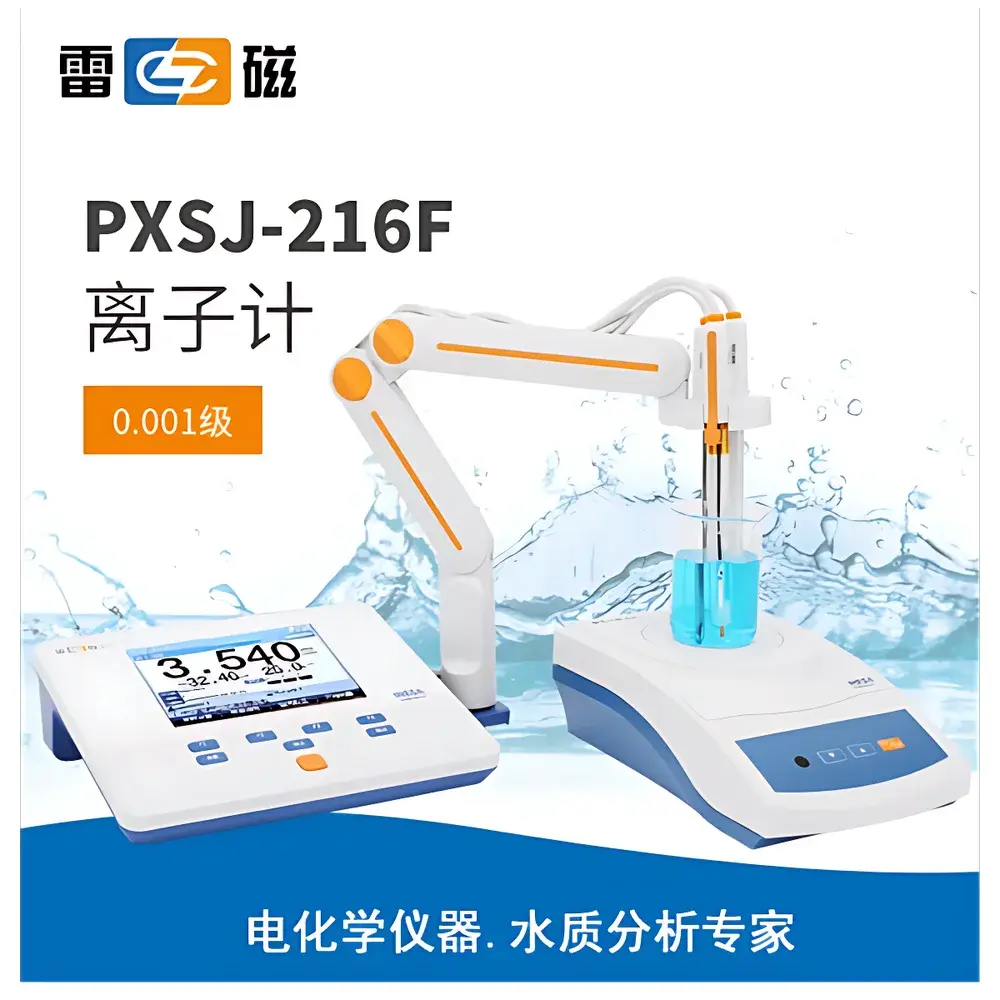
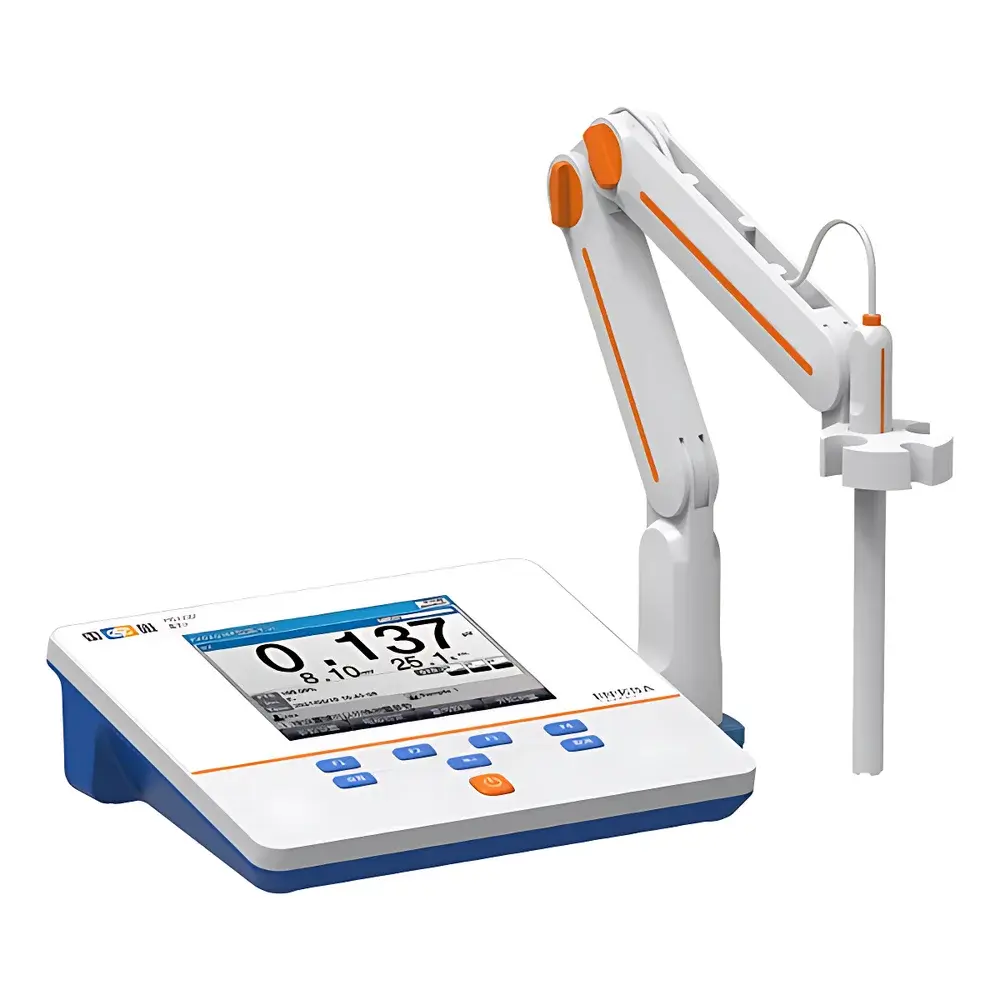
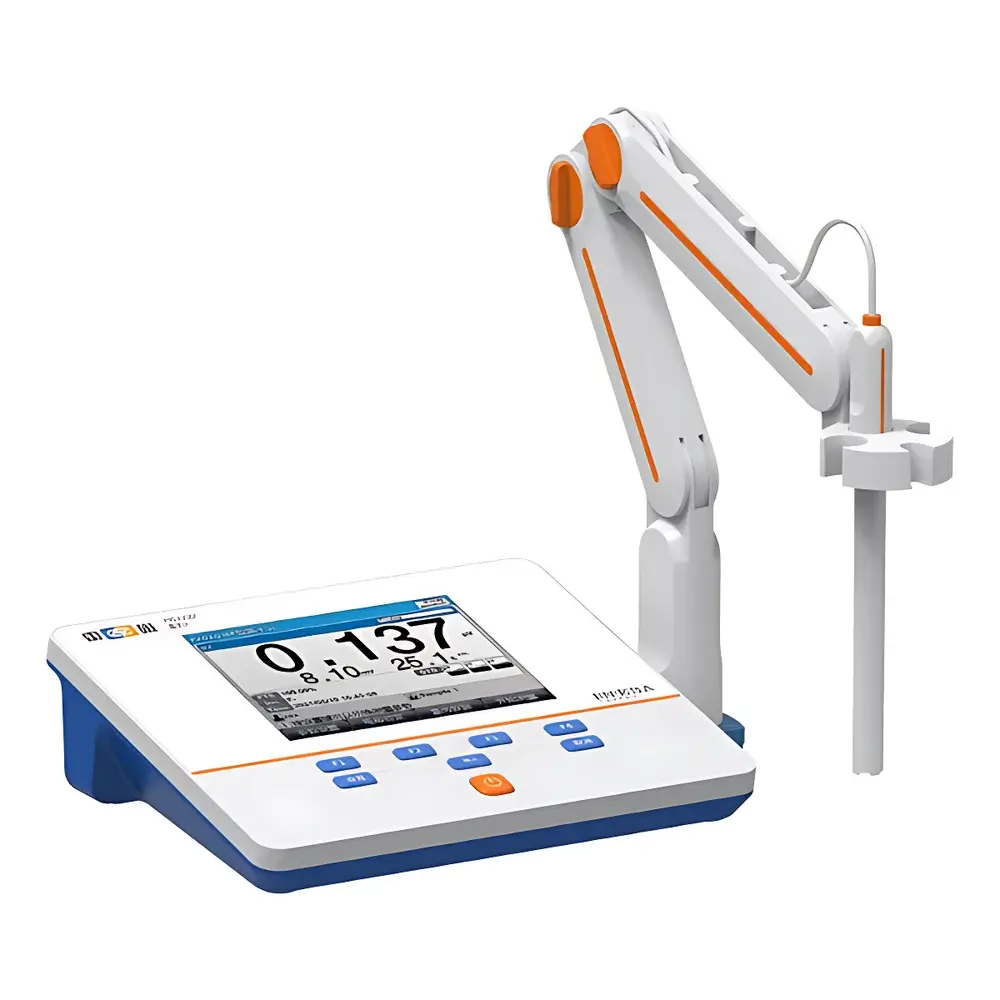
Leici PXSJ-216F Benchtop Multi-Ion Analyzer
| Brand | Leici |
|---|---|
| Origin | Shanghai, China |
| Model | PXSJ-216F |
| Instrument Type | Benchtop |
| Ion Measurement Range | (−2.000 to 20.000) pX |
| Resolution | 0.001 pX |
| Temperature Range | (−10.0 to 135.0) °C / (14.0 to 275.0) °F |
| Protection Rating | IP54 |
| Data Storage Capacity | 500 measurement sets |
| Calibration Points | 1–5 point pH calibration |
| Supported Ion Modes | Na⁺, K⁺, NH₄⁺, Cl⁻, F⁻ (user-definable) |
| Concentration Units | μg/L, mg/L, g/L, mol/L, mmol/L, pX |
| Measurement Methods | Direct concentration, Standard addition, Sample addition, Gran plot |
| Interface | RS-232, USB |
Overview
The Leici PXSJ-216F is a high-precision benchtop multi-ion analyzer engineered for quantitative determination of specific ionic species in aqueous environmental, industrial, and laboratory samples. Based on potentiometric ion-selective electrode (ISE) measurement principles, the instrument measures the electromotive force (EMF) generated at the interface between an ion-selective membrane and the sample solution, converting it into logarithmic concentration units (pX) or absolute concentration values via Nernst equation-based calibration. Designed for compliance with standard water quality testing protocols—including those referenced in ISO 10523 (water quality — determination of pH), ASTM D1293 (electrical conductivity and pH of water), and EPA Method 300.0 (determination of anions by ion chromatography)—the PXSJ-216F serves as a core analytical tool in municipal water treatment labs, environmental monitoring stations, and university research facilities conducting trace-level ion quantification in surface water, groundwater, wastewater effluent, and soil leachates.
Key Features
- High-resolution color LCD display with intuitive graphical interface for real-time parameter visualization and navigation
- Selectable resolution modes: 0.001/0.01/0.1 pX for ion activity and 0.01/0.1/1 mV for potential readings—enabling method-specific optimization
- Dual temperature unit support (°C/°F) with automatic or manual temperature compensation across −10.0 °C to 135.0 °C
- Intelligent endpoint detection algorithms supporting auto-read, timed-read, interval-read, and manual sampling modes
- Five preloaded buffer groups (GB, DIN, NIST, USA, MERK) with user-defined buffer creation and management capabilities
- IP54-rated enclosure ensuring dust resistance and protection against low-pressure water jets—suitable for shared lab environments
- Integrated firmware upgrade path enabling future protocol expansion, new ion mode implementation, and regulatory-compliant feature updates
Sample Compatibility & Compliance
The PXSJ-216F accommodates a broad range of aqueous matrices including drinking water, seawater dilutions, acid digests, and buffered calibration standards. Its compatibility with commercially available ISEs—including fluoride, chloride, ammonium, sodium, and potassium electrodes—ensures flexibility across common environmental analytes. The system supports both single-point and multi-point calibration workflows, with built-in validation checks for electrode slope and asymmetry potential. All measurement records include timestamp, operator ID (via optional login), electrode serial number, calibration history, and environmental conditions—meeting GLP documentation requirements for audit-ready data integrity. While not certified for FDA 21 CFR Part 11 out-of-the-box, its structured data export (CSV via USB/RS-232) and immutable record timestamps enable integration into validated LIMS environments under site-specific SOPs.
Software & Data Management
Data handling is governed by a robust internal memory architecture storing up to 500 complete measurement sets—including raw EMF values, calculated concentrations, calibration coefficients, and metadata. Export is supported via RS-232 connection to industry-standard serial printers (with configurable print templates) or USB link to Windows-based PCs using Leici’s dedicated communication software. This software facilitates batch export, report generation (PDF/CSV), spectral overlay for comparative analysis, and audit log review. All stored entries are write-protected after acquisition; deletion requires explicit confirmation and is logged with date/time stamp—reinforcing traceability in regulated settings.
Applications
- Regulatory monitoring of fluoride in municipal drinking water per WHO and EPA guidelines
- Ammonium quantification in wastewater influent/effluent for nitrification process control
- Sodium and potassium profiling in agricultural runoff and irrigation water quality assessment
- Chloride monitoring in cooling tower systems to prevent corrosion and scaling
- Research-grade ion activity measurements in geochemical leaching experiments and sediment porewater analysis
- Educational use in analytical chemistry laboratories for teaching Nernstian behavior, selectivity coefficients, and standard addition methodology
FAQ
Does the PXSJ-216F support automatic electrode recognition?
No—it does not feature plug-and-play electrode ID chips. Users manually select the active ion mode and enter electrode-specific parameters (e.g., slope, intercept) during calibration.
Can the instrument perform Gran plot analysis for weakly dissociated ions?
Yes—Gran titration functionality is embedded for determining endpoints in low-conductivity or complex-matrix samples where direct endpoint detection is unreliable.
Is the device compatible with non-Leici ISEs?
Yes—provided the electrode outputs a stable DC potential within ±2000 mV and meets standard BNC or DIN connector specifications.
What is the maximum allowable total dissolved solids (TDS) concentration for accurate measurement?
For optimal accuracy, TDS should remain below 10,000 mg/L; higher ionic strength may require activity coefficient correction or matrix-matched calibration.
How is compliance with ISO/IEC 17025 addressed in routine operation?
While the instrument itself is not accredited, its calibration traceability (via NIST-traceable buffers), documented uncertainty budgets (slope ±0.5%, pX resolution ±0.001), and full data audit trail support laboratory-developed validation protocols aligned with ISO/IEC 17025 clause 7.7.







