
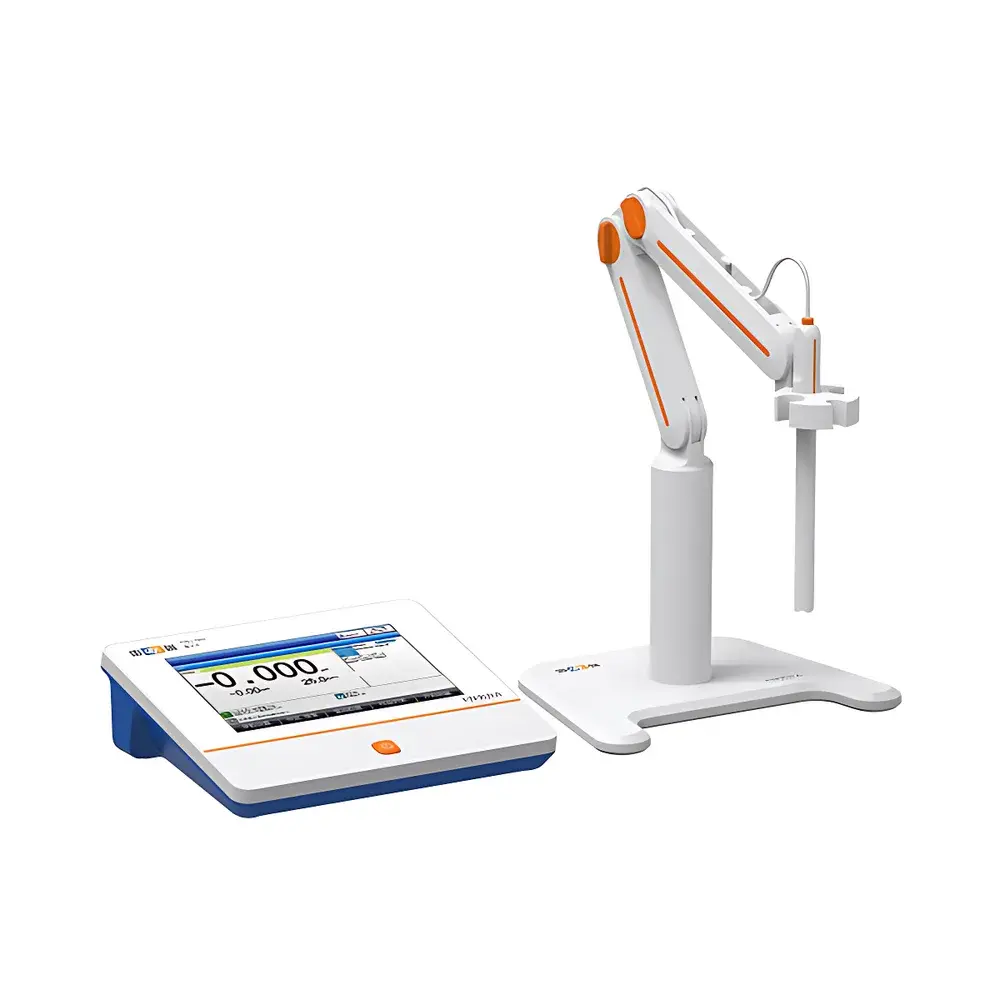
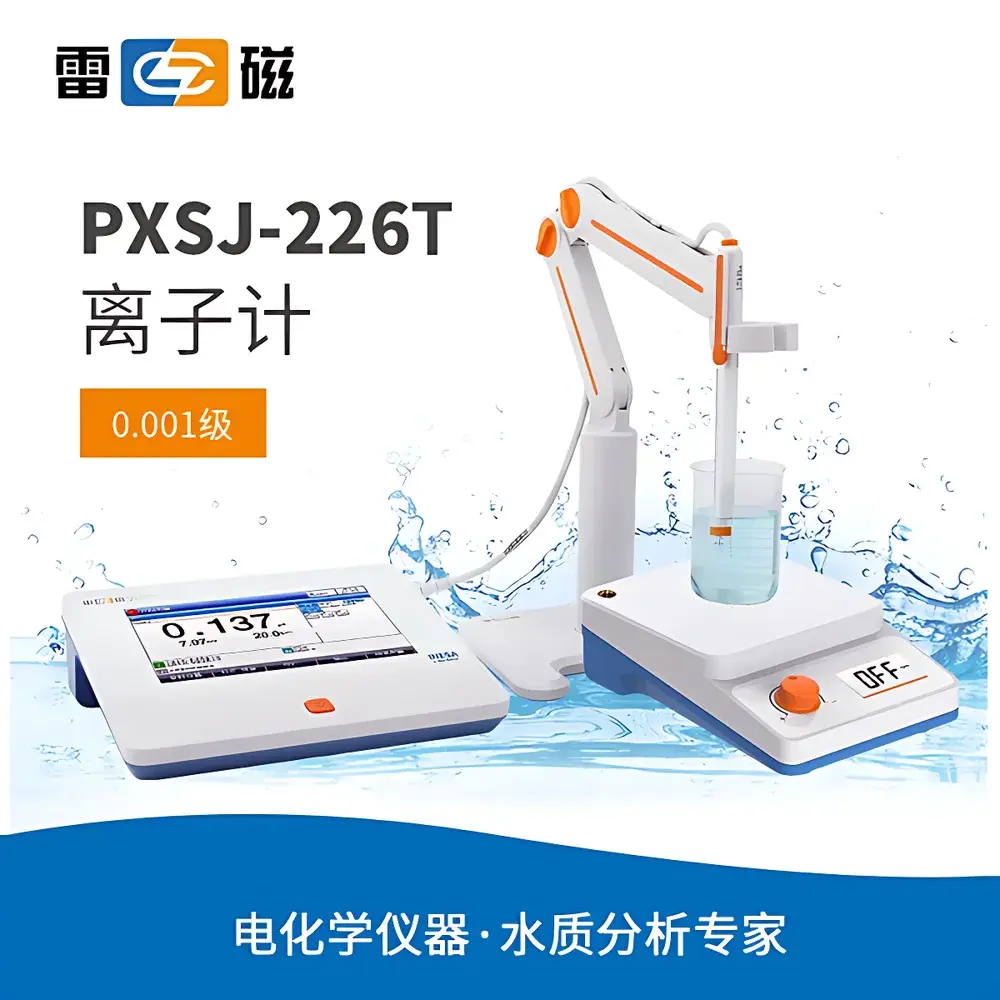
Leici PXSJ-226T Benchtop Ion Analyzer
| Brand | Leici |
|---|---|
| Origin | Shanghai, China |
| Manufacturer Type | Original Equipment Manufacturer (OEM) |
| Product Type | Benchtop Ion Analyzer |
| Ion Measurement Range | 1.00 × 10⁻⁹ to 9.99 × 10⁹ (selectable units: mol/L, mmol/L, g/L, mg/L, µg/L, ppm) |
| Detection Limit | Equivalent to measurement range |
| Response Time | ≤5 s |
| Accuracy Class | 0.001 |
| Temperature Range | −10.0 to 135.0 °C (14.0 to 275.0 °F) |
| mV Range | −2000.00 to +2000.00 mV |
| pH/pX Range | −2.000 to 20.000 |
| pH/pX Resolution | 0.001 |
| mV Resolution | 0.01 mV |
| Temperature Resolution | 0.1 °C/°F |
| Input Power | AC 100–240 V → DC 24 V |
| Dimensions | 220 × 195 × 68 mm |
| Weight | 0.95 kg |
Overview
The Leici PXSJ-226T Benchtop Ion Analyzer is a high-precision potentiometric measurement system engineered for quantitative determination of monovalent and multivalent ions—including F⁻, Cl⁻, NO₃⁻, NH₄⁺, K⁺, Na⁺, and others—in aqueous environmental, industrial, and regulatory laboratory settings. It operates on the principle of ion-selective electrode (ISE) potentiometry, where the measured electromotive force (EMF), in millivolts, is logarithmically related to the activity of the target ion according to the Nernst equation. The instrument integrates dual-channel analog signal conditioning, high-stability reference electrode compensation, and real-time temperature correction via integrated Pt1000 or thermistor probes. Designed for compliance-critical workflows, its architecture supports trace-level detection down to 1.00 × 10⁻⁹ mol/L with full traceability, making it suitable for drinking water analysis (e.g., fluoride monitoring per WHO and EPA Method 300.0), wastewater effluent verification, and raw material quality control in pharmaceutical manufacturing.
Key Features
- High-resolution 7-inch color TFT touchscreen interface with intuitive icon-based navigation and dual-language support (English/Chinese)
- Selectable resolution modes: pX (0.001/0.01/0.1 pX), mV (0.01/0.1/1 mV), and temperature (0.1 °C/°F)
- Comprehensive electrode management: automatic ISE/pH/ORP diagnostics, calibration history logging, and electrode health assessment
- Intelligent endpoint recognition algorithms supporting auto-read, timed-read, interval-read, and manual acquisition modes
- Multi-point calibration capability: up to six-point calibration for pH and pX electrodes; one-point calibration for ORP sensors
- IP54-rated enclosure for dust resistance and limited water splashing protection—suitable for shared lab environments
- Integrated temperature compensation using either built-in sensor or external probe (−10.0 to 135.0 °C)
- Support for standardized buffer groups (NIST, DIN, GB, JIS, MERK, USA) and user-defined calibration solution libraries
Sample Compatibility & Compliance
The PXSJ-226T accommodates standard 12-mm diameter ion-selective electrodes and combination pH/ISE probes, including double-junction Ag/AgCl reference systems for minimized liquid junction potential drift. It is validated for use with aqueous matrices across pH 2–12 and ionic strength up to 0.1 mol/L. All measurement data adhere to Good Laboratory Practice (GLP) and Good Manufacturing Practice (GMP) requirements: audit trails record operator ID, timestamp, calibration parameters, electrode serial numbers, and environmental conditions. Data integrity meets FDA 21 CFR Part 11 criteria when used with password-controlled user roles (administrator, analyst, viewer), electronic signatures, and immutable storage. The instrument complies with ISO/IEC 17025:2017 clause 7.7 for measurement traceability and supports third-party verification against ASTM D1293 (pH of water) and ISO 10523 (water quality — pH determination).
Software & Data Management
Internal firmware enables storage of up to 1,000 complete measurement records, each containing raw EMF values, temperature, electrode IDs, calibration coefficients, and metadata. Data export is supported via USB mass storage (CSV/Excel-compatible), RS-232 serial output (for direct thermal printer integration), and PC connectivity through Leici’s proprietary communication software. The software provides statistical functions (mean, SD, RSD, confidence intervals), trend visualization, and customizable report templates compliant with ISO/IEC 17025 reporting clauses. LIMS integration is achieved via ASCII-based protocol over RS-232 or USB virtual COM port. Firmware updates are performed securely via USB drive, preserving all user configurations and calibration histories.
Applications
- Environmental monitoring: Fluoride in groundwater (EPA 300.0), nitrate in surface water (ISO 10304-1), chloride in seawater intrusion studies
- Pharmaceutical QC: Sodium and potassium content in parenteral solutions per USP and EP 2.2.16
- Foods & beverages: Ammonium in dairy products, nitrite in cured meats (AOAC 973.32)
- Power generation: Chloride monitoring in boiler feedwater per ASTM D4582
- Academic research: Ion transport kinetics, membrane selectivity studies, and equilibrium constant determination via Gran plot analysis
FAQ
What ion-selective electrodes are compatible with the PXSJ-226T?
The instrument supports all commercially available BNC-terminated ISEs and combination electrodes meeting IUPAC-recommended impedance specifications (<10¹² Ω). Leici-certified electrodes (e.g., F-101 for fluoride, Cl-101 for chloride) are recommended for optimal accuracy.
Does the PXSJ-226T meet regulatory requirements for auditable data?
Yes. It implements role-based access control, time-stamped audit logs, electronic signature capability, and non-erasable data storage—fully aligned with GLP, GMP, and 21 CFR Part 11 expectations for regulated laboratories.
Can the instrument perform Gran plot analysis for weak electrolytes?
Yes. The built-in GRAN method module calculates equivalence points and dissociation constants from titration curves using linear regression of transformed EMF vs. volume data.
Is temperature compensation automatic and configurable?
Yes. Automatic temperature compensation (ATC) is enabled by default using either internal or external probe input; manual override and fixed-T modes are also available.
How is calibration validity enforced?
The system enforces scheduled recalibration via configurable alerts, supports mandatory re-calibration after specified time intervals or measurement counts, and validates calibration slopes against user-defined acceptance criteria (e.g., ±5% deviation from theoretical Nernstian slope).
Related Products







