
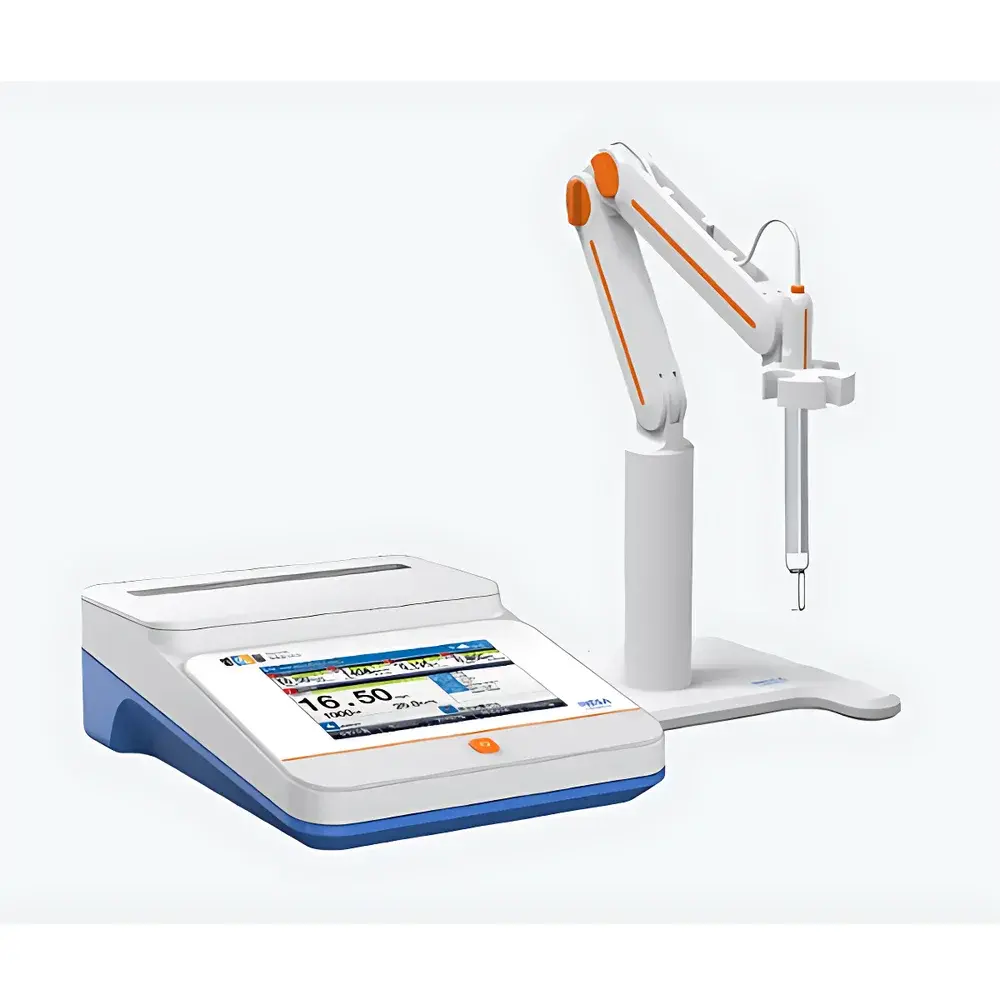
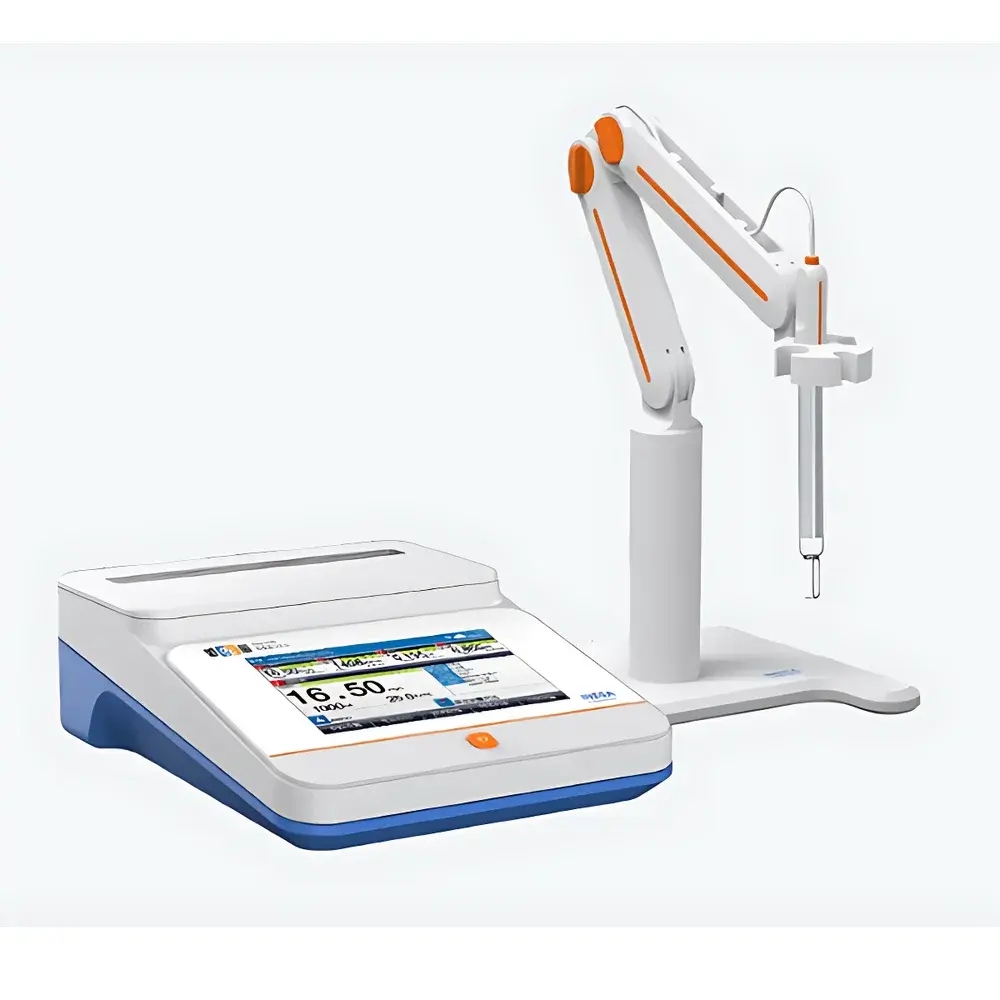
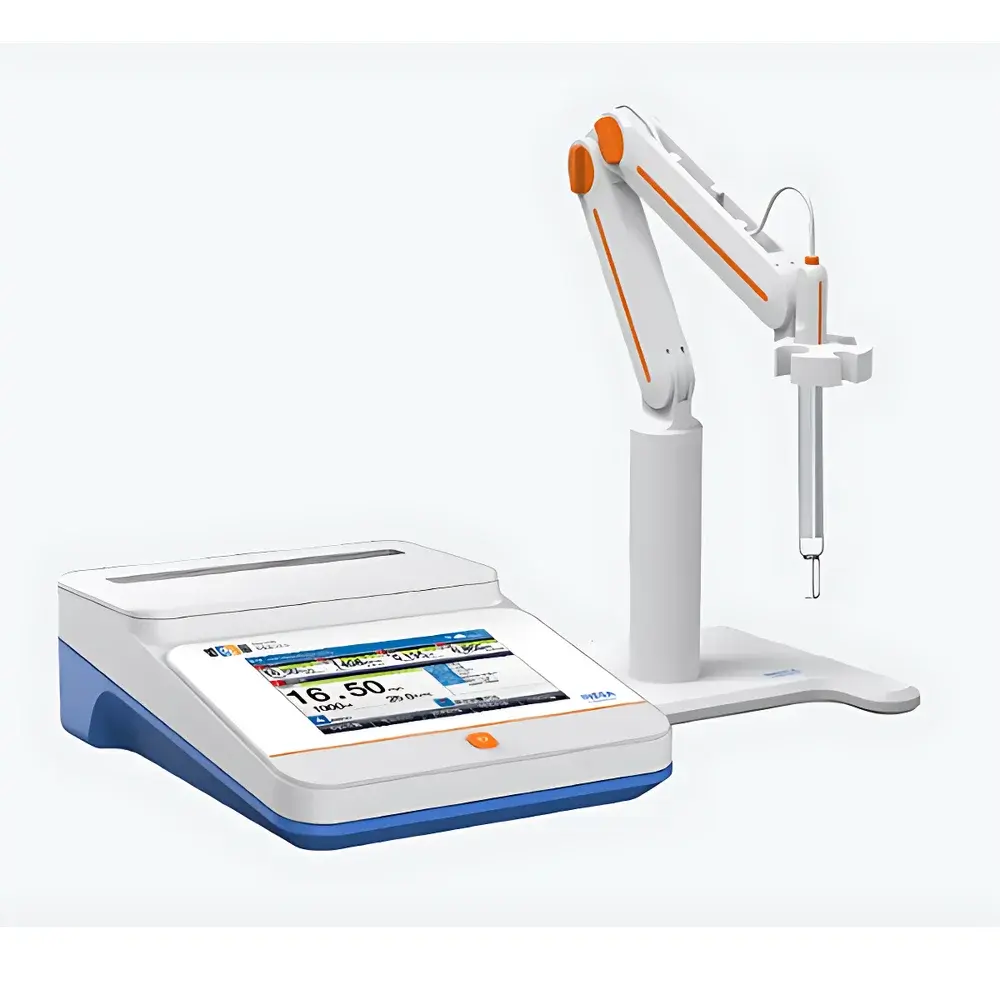
Leici PXSJ-227L Benchtop Multi-Ion Analyzer
| Brand | Leici |
|---|---|
| Origin | Shanghai, China |
| Model | PXSJ-227L |
| Instrument Type | Benchtop |
| Ion Measurement Accuracy | 4 significant digits (scientific notation) |
| Temperature Range | −5.0 to 130.0 °C |
| Ion Modes Supported | H⁺, Na⁺, K⁺, NH₄⁺, Cl⁻, F⁻ (preloaded) |
| Calibration | Auto 1–6 point |
| Measurement Modes | Direct concentration, standard addition, sample addition, Gran plot method |
| Data Storage | 1,000 datasets per mode |
| Compliance | GLP-compliant data traceability |
| Connectivity | RS-232/USB for PC and USB flash drive |
Overview
The Leici PXSJ-227L is a high-precision benchtop multi-ion analyzer engineered for rigorous quantitative ion concentration measurement in environmental, municipal, industrial, and academic water quality laboratories. It operates on the principle of potentiometric ion-selective electrode (ISE) detection—leveraging Nernstian response characteristics of membrane-based ISEs to determine activity-based concentrations of target ions in aqueous solutions. Designed for regulatory-grade analysis, the instrument delivers stable, reproducible measurements across a wide dynamic range—from sub-ppb (μg/L) levels for fluoride in drinking water to high-concentration chloride assays in wastewater effluents. Its integrated temperature sensor enables real-time automatic temperature compensation (ATC), ensuring thermodynamic accuracy without manual correction. The PXSJ-227L meets fundamental requirements for routine compliance testing under ISO 10523 (water quality — determination of pH), ISO 10304-1 (determination of anions by ion chromatography—part 1: method using suppressed conductivity detection), and supports method validation frameworks aligned with EPA Method 300.0 and ASTM D6919 for halide and alkali metal ion quantification.
Key Features
- Potentiometric ISE platform with auto-ranging mV-to-concentration conversion, supporting up to six calibration points per ion mode with residual error diagnostics.
- Intelligent endpoint recognition algorithms—including auto-read, timed-read, interval-read, and manual-triggered acquisition—to accommodate variable sample equilibration kinetics.
- Comprehensive ion mode library preconfigured for H⁺, Na⁺, K⁺, NH₄⁺, Cl⁻, and F⁻; additional ion profiles can be created and saved using user-defined Nernst slope and intercept parameters.
- Multi-unit concentration display: μg/L, mg/L, g/L, mol/L, mmol/L, and pX (−log₁₀[ion])—all convertible in real time without recalibration.
- Advanced analytical methodologies: direct concentration mode, standard addition (single/multi-point), sample addition, and Gran plot titration for low-level or matrix-interfered samples.
- Integrated electrode health monitoring with calibration alert system, electrode ID logging, and usage history tracking to support audit-ready GLP workflows.
Sample Compatibility & Compliance
The PXSJ-227L is optimized for aqueous liquid samples with total dissolved solids (TDS) ≤ 50,000 mg/L and pH 2–12 (within ISE operational limits). It accommodates standard combination electrodes (e.g., Ag/AgCl reference + ion-selective membrane) and separate half-cell configurations. Sample vessels include standard 100 mL beakers, 50 mL polypropylene cups, and flow-through cells compatible with optional autosamplers. The instrument complies with Good Laboratory Practice (GLP) requirements through mandatory electronic audit trails: every calibration event, measurement, user login, parameter change, and data export is timestamped, user-identified, and immutably logged. Data integrity adheres to principles outlined in FDA 21 CFR Part 11 (when used with validated software and access controls), and firmware supports password-protected user roles (Administrator, Analyst, Viewer) with configurable permissions.
Software & Data Management
Internal non-volatile memory stores up to 1,000 complete measurement records per ion mode—including raw mV readings, temperature, calibration coefficients, electrode IDs, operator tags, and timestamps. Data export is supported via USB mass storage (FAT32-formatted drives) and RS-232 serial connection to Windows-based laboratory information management systems (LIMS) or spreadsheet applications. The device accepts method templates stored on USB media, enabling rapid deployment of standardized test protocols across multiple instruments. All stored datasets support post-acquisition statistical analysis: mean, SD, RSD, min/max, and linear regression (for Gran plots). No proprietary software installation is required for basic data transfer; CSV-formatted exports ensure interoperability with third-party analytics platforms.
Applications
- Drinking water compliance: Fluoride (F⁻) monitoring per WHO guidelines (1.5 mg/L max) and chloride (Cl⁻) verification against ISO 7888.
- Wastewater treatment: Ammonium (NH₄⁺) tracking in nitrification/denitrification processes and sodium (Na⁺) assessment for ion exchange regeneration control.
- Environmental field labs: On-site pH and ion profiling of surface water, groundwater, and leachate from landfill monitoring wells.
- Pharmaceutical manufacturing: Conductivity-corrected ion assays in purified water (PW) and water for injection (WFI) per USP .
- Academic research: Teaching potentiometric theory, validating ISE selectivity coefficients (Kijpot), and developing novel ion-selective membranes.
FAQ
Does the PXSJ-227L support automatic electrode calibration verification?
Yes—the instrument performs residual error calculation after each multi-point calibration and flags deviations exceeding ±2 mV from theoretical Nernst slope, prompting re-calibration.
Can custom ion modes be exported and shared between instruments?
Yes—user-defined ion configurations (including slope, intercept, unit defaults, and buffer sets) are saved as .ION files on USB drives and loaded onto other PXSJ-227L units.
Is GLP-compliant data archiving possible without a PC connection?
Yes—all audit trail entries, including operator ID, date/time stamps, and calibration metadata, are stored internally and printable directly via connected thermal printer.
What temperature sensor types are supported for ATC?
The built-in Pt1000 RTD sensor is fixed; external temperature probes are not supported—ATC relies exclusively on the integrated sensor calibrated to ±0.2 °C accuracy.
How does the Gran plot method function on this platform?
The instrument acquires sequential mV readings during incremental standard addition, applies linear regression to the transformed Gran function (E × 10E/S vs. added volume), and calculates unknown concentration from the x-intercept—fully automated with graphical preview.







