
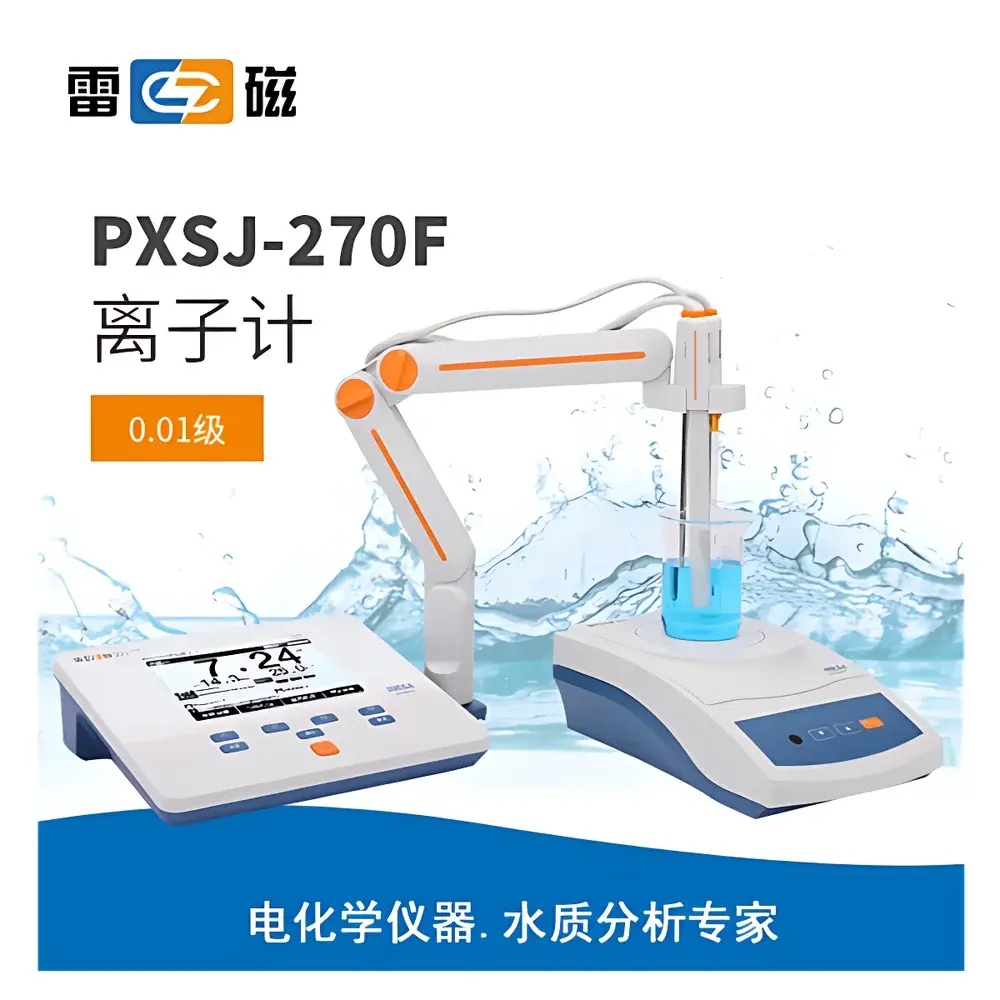
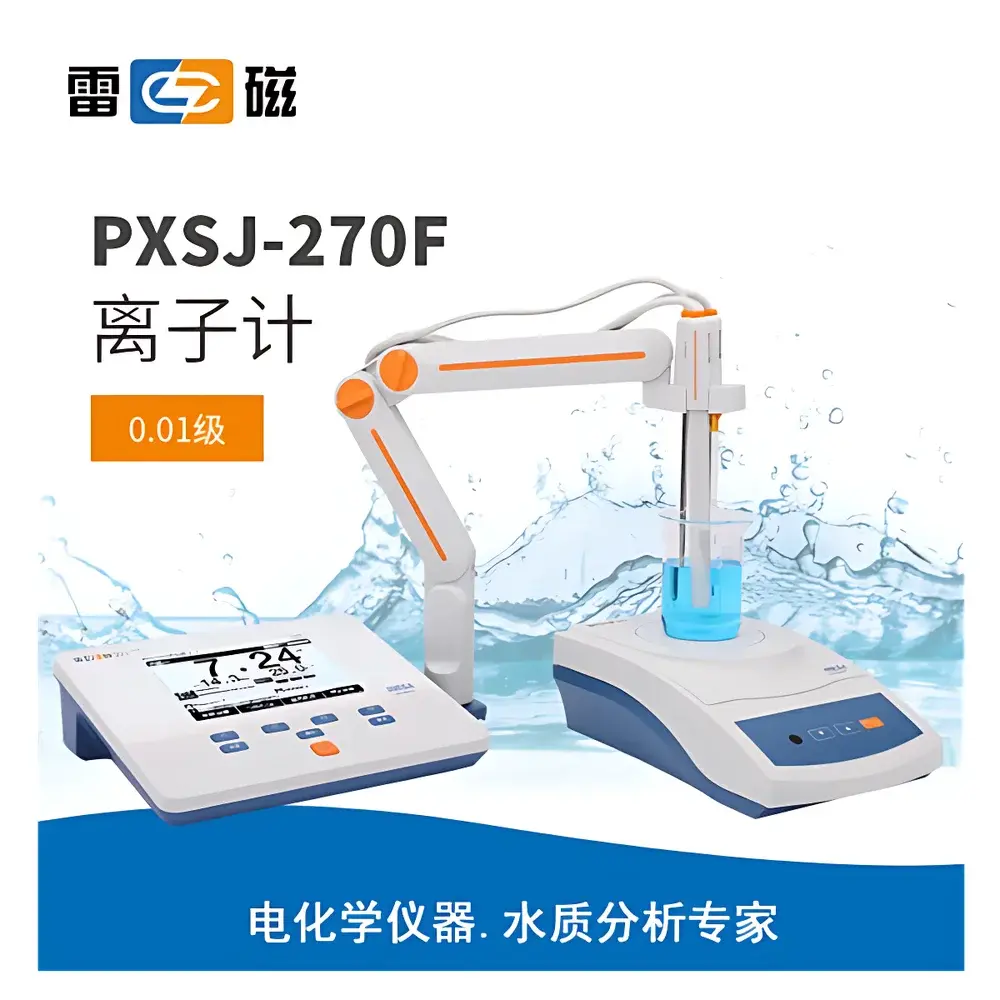
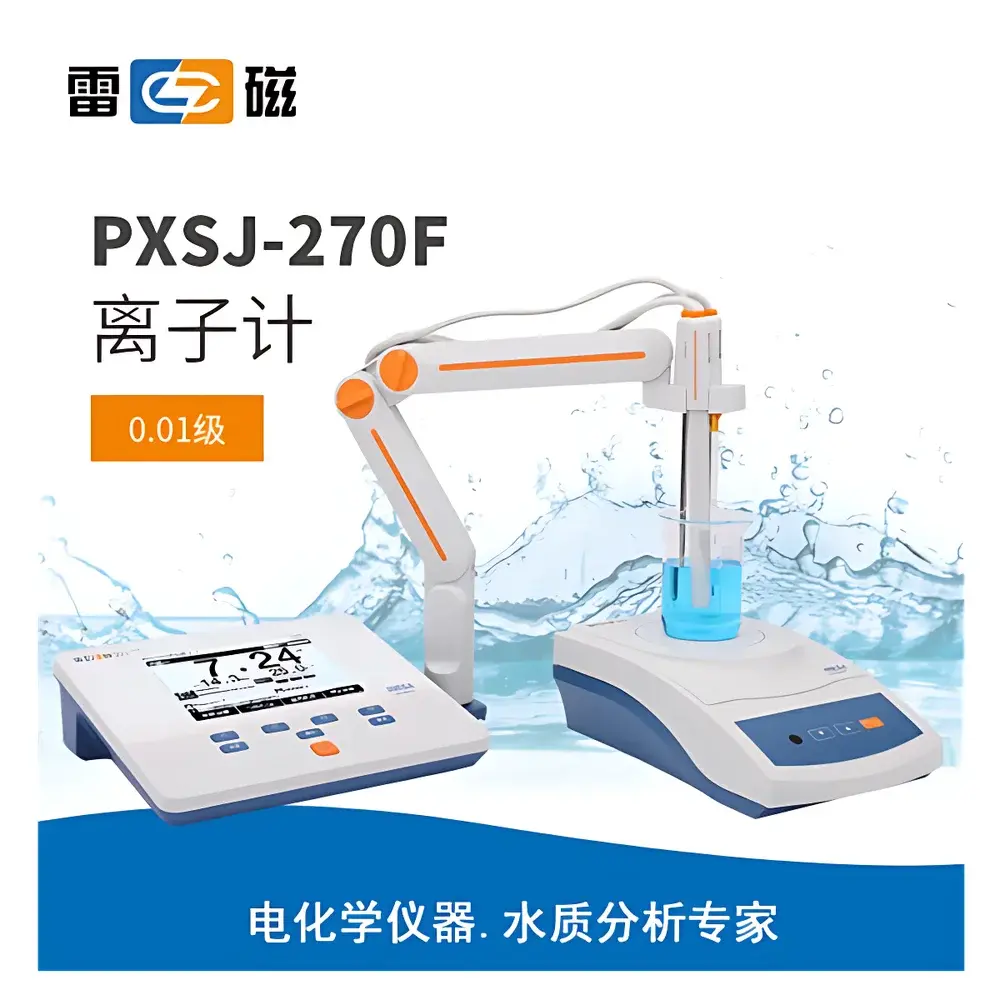
Leici PXSJ-270F Benchtop Ion Analyzer
| Brand | Leici |
|---|---|
| Origin | Shanghai, China |
| Model | PXSJ-270F |
| Instrument Type | Benchtop |
| Ion Measurement Range | (−2.00 to 20.00) pX |
| Measurement Accuracy | ±0.01 pX |
| Temperature Range | (−5.0 to 110.0) °C / (23.0 to 230.0) °F |
| Resolution Options | 0.01 pX / 0.1 pX |
| Temperature Unit Selection | °C or °F |
| Protection Rating | IP54 |
| Data Storage Capacity | 500 datasets |
| Connectivity | RS-232, USB |
| Compliance | GLP-compliant data management |
Overview
The Leici PXSJ-270F Benchtop Ion Analyzer is a precision potentiometric instrument engineered for quantitative determination of specific ion activities in aqueous solutions using ion-selective electrodes (ISEs). Based on the Nernst equation principle, it measures the potential difference between an ISE and a reference electrode to calculate ion concentration expressed in pX units (pX = −log10[Xn±]), enabling trace-level detection across environmental, municipal water, industrial effluent, and laboratory research applications. Designed for routine and regulatory-grade water quality analysis, the PXSJ-270F supports direct concentration readout without manual calculation, integrating temperature compensation, multi-point calibration, and intelligent endpoint detection to ensure measurement reproducibility under variable field or lab conditions.
Key Features
- High-resolution 4.3-inch LCD display with adjustable contrast for clear visibility under ambient lighting conditions
- Dual-resolution mode: selectable 0.01 pX or 0.1 pX resolution for pX measurements; 0.1 mV or 1 mV for millivolt readings
- Flexible temperature compensation: automatic or manual mode with dual-unit support (°C/°F) and range from −5.0 to 110.0 °C
- Intelligent endpoint recognition: configurable reading modes including auto-read, timed-read, interval-read, and manual-triggered acquisition
- Robust hardware architecture: IP54-rated enclosure for dust resistance and limited water splashing protection—suitable for shared lab environments and mobile field labs
- Comprehensive electrode management: built-in recognition of GB, DIN, and NIST pH buffer sets; supports custom buffer definition and group-based calibration management
- Integrated accessory suite: includes magnetic stirrer, fluoride ISE, double-junction Ag/AgCl reference electrode, Pt1000 temperature sensor, electrode stand, and dust cover
Sample Compatibility & Compliance
The PXSJ-270F is optimized for aqueous samples with low to moderate ionic strength, including drinking water, surface water, wastewater, leachates, and process streams. It accommodates standard glass-body and solid-state ISEs compatible with common ions such as F−, Cl−, NO3−, NH4+, K+, Na+, and Ca2+. Its design conforms to general requirements for potentiometric ion analysis per ISO 10523 (water quality — determination of pH), ISO 10304-1 (ion chromatography), and ASTM D1293 (electrical conductivity and pH of water). While not certified for regulated clinical or pharmaceutical use, its GLP-aligned data handling—including timestamped entries, operator ID fields (via optional software), and audit-ready export—supports compliance with internal QA/QC protocols and regional environmental monitoring frameworks.
Software & Data Management
Data integrity is maintained through embedded GLP-compliant logging: each measurement stores sample ID, electrode type, calibration history, temperature, date/time stamp, and user-defined notes. Up to 500 complete datasets are retained in non-volatile memory. Export is supported via RS-232 serial interface (compatible with industry-standard dot-matrix and thermal printers) or USB port using Leici’s dedicated PC communication software. The software enables CSV export, report generation with customizable templates, batch calibration verification, and version-controlled firmware updates—ensuring long-term maintainability and alignment with evolving laboratory informatics standards. All data transfers preserve metadata structure required for traceability audits.
Applications
- Regulatory compliance testing for fluoride in municipal drinking water per WHO and EPA guidelines
- Monitoring chloride ingress in concrete pore water for infrastructure corrosion assessment
- Wastewater treatment plant effluent screening for ammonium and nitrate concentrations
- Soil leachate analysis in environmental site assessments (ESA)
- Calibration validation of online ISE sensors used in continuous water quality monitoring systems
- Academic teaching labs for fundamental electrochemistry and ion activity concepts
FAQ
Does the PXSJ-270F support FDA 21 CFR Part 11 compliance?
No—the instrument does not include electronic signature capability, role-based access control, or audit trail encryption required for Part 11. It meets GLP documentation needs but is not validated for GxP-regulated submissions.
Can third-party ion-selective electrodes be used with this analyzer?
Yes, provided they output a stable DC millivolt signal within ±2000 mV range and feature BNC or compatible connectors. Electrode compatibility must be verified against manufacturer specifications for slope and impedance.
Is automatic temperature compensation (ATC) mandatory during ion measurement?
ATC is recommended for quantitative accuracy, especially when measuring samples outside 20–25 °C. Manual compensation is permissible if temperature is stabilized and recorded independently.
What is the maximum allowable total dissolved solids (TDS) concentration for reliable ISE performance?
For optimal Nernstian response, TDS should remain below 5000 mg/L. Higher ionic strength may require ionic strength adjuster (ISA) addition or activity coefficient correction.
How frequently should the reference electrode be refilled or replaced?
The double-junction reference electrode requires KNO3 electrolyte replenishment every 2–4 weeks under daily use; junction clogging or drift >2 mV/h indicates replacement necessity.







