
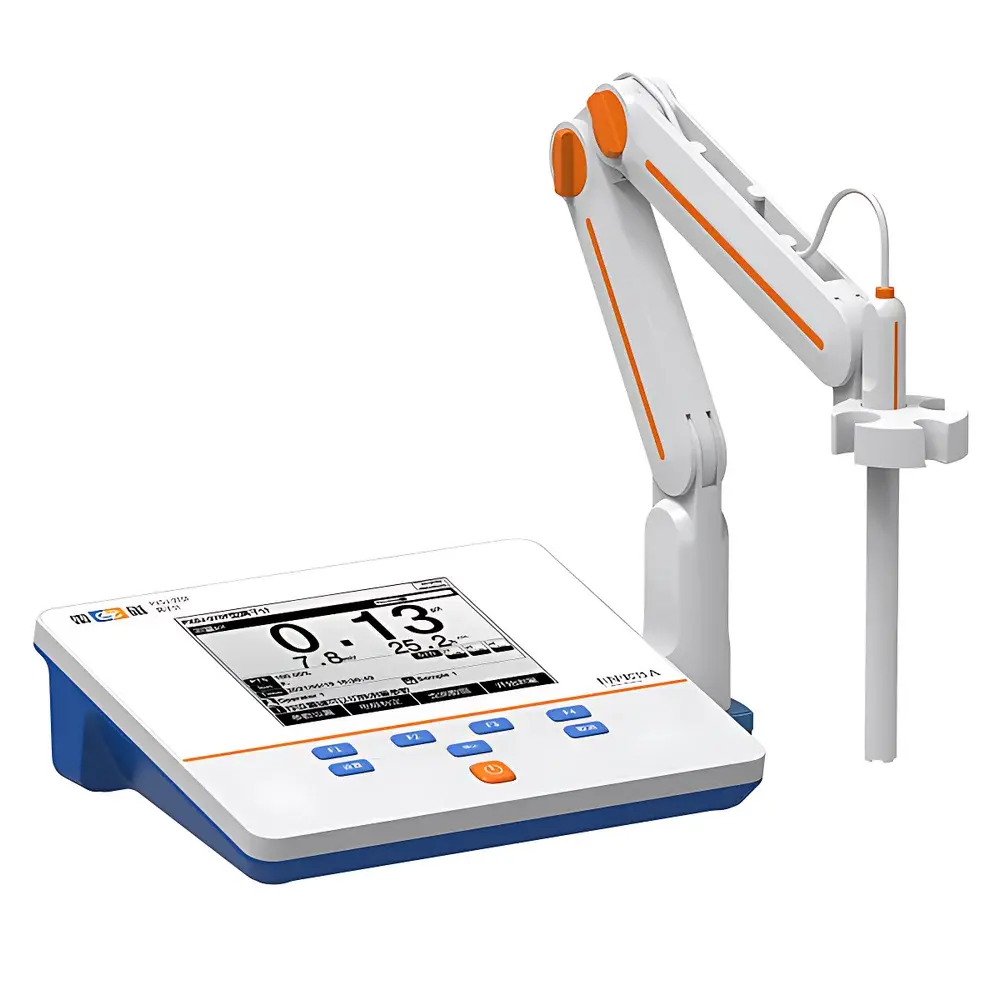
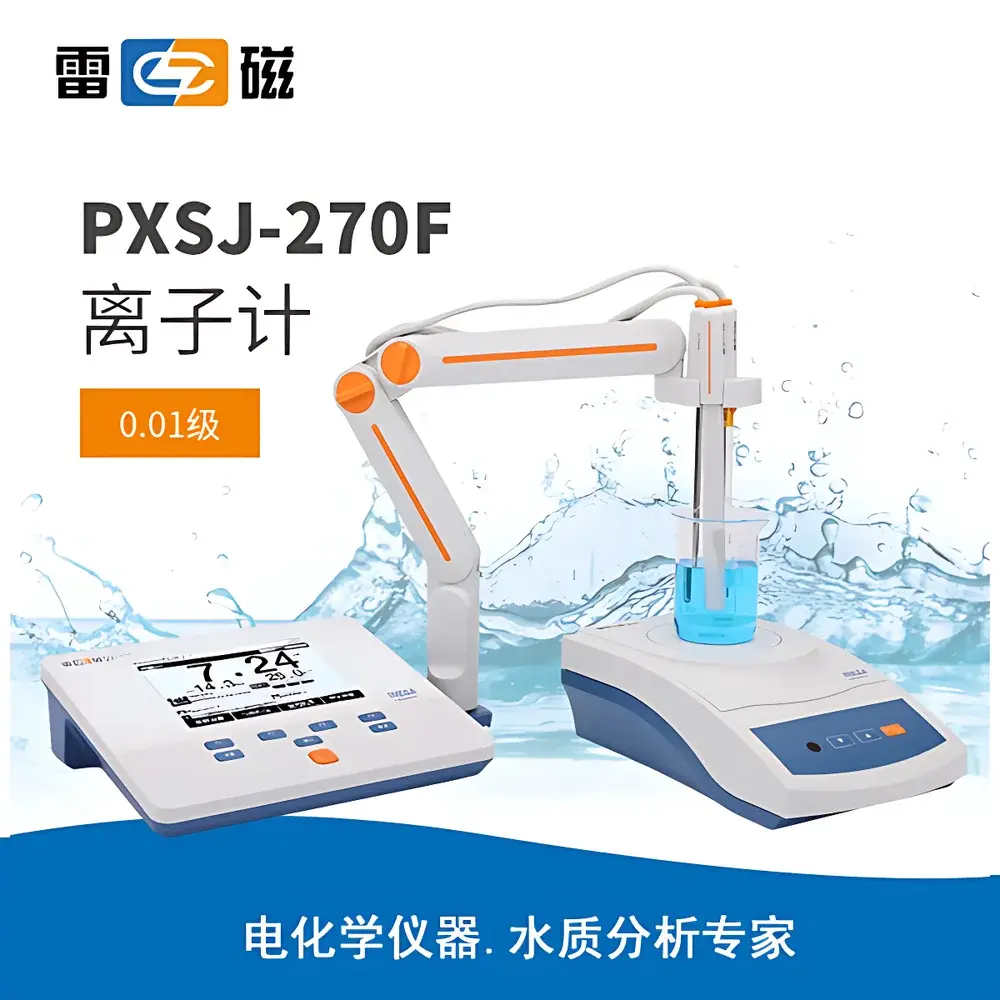
Leici PXSJ-270F Benchtop Ion Analyzer
| Brand | Leici |
|---|---|
| Origin | Shanghai, China |
| Manufacturer Type | Direct Manufacturer |
| Regional Classification | Domestic (China) |
| Model | PXSJ-270F |
| Price Range | USD 150–750 (est.) |
| Instrument Category | Multi-Ion Analyzer |
| Form Factor | Benchtop |
| pX Measurement Range | (−2.00 to 20.00) pX |
| pX Accuracy | ±0.01 pX |
| Temperature Range | (−5.0 to 110.0) °C / (23.0 to 230.0) °F |
| pH Range | (−2.00 to 20.00) pH |
| pH Accuracy | ±0.01 pH |
| mV Range | (−2000.0 to +2000.0) mV |
| mV Resolution | 0.1 mV |
| Ion Concentration Units | mol/L, mmol/L, g/L, mg/L, μg/L |
| Data Storage Capacity | 500 datasets |
| Connectivity | RS-232, USB |
| IP Rating | IP54 |
| Compliance | GLP-compliant data logging with audit trail support |
Overview
The Leici PXSJ-270F Benchtop Ion Analyzer is a high-precision potentiometric instrument engineered for quantitative determination of monovalent and multivalent ions in aqueous solutions using ion-selective electrode (ISE) methodology. Based on the Nernst equation, the analyzer measures the potential difference between a selective indicator electrode (e.g., fluoride, chloride, sodium, potassium, or ammonium ISEs) and a stable reference electrode, converting the resulting electromotive force (EMF) into concentration values expressed in pX, mV, or standardized units (mol/L, mg/L, etc.). Designed specifically for routine water quality analysis in environmental monitoring laboratories, municipal water treatment facilities, and industrial process control environments, the PXSJ-270F delivers laboratory-grade accuracy in a robust, user-configurable benchtop platform. Its dual-mode operation supports both direct concentration measurement and standard addition methods, enabling reliable quantification across wide dynamic ranges — from trace-level (μg/L) fluoride in drinking water to high-concentration (g/L) chloride in brine effluents.
Key Features
- High-resolution 4.3-inch LCD display with adjustable contrast for clear visualization under varied ambient lighting conditions
- Selectable resolution modes: 0.01 pX / 0.1 pX and 0.1 mV / 1 mV — optimized for both high-precision calibration and rapid screening applications
- Integrated temperature compensation with dual-unit selection (°C/°F) and auto/manual modes, ensuring thermodynamic consistency per IUPAC-recommended Nernst slope correction
- Intelligent endpoint detection algorithm supporting auto-read, timed-read, interval-read, and manual sampling protocols — minimizing operator-dependent variability
- Comprehensive electrode management: automatic recognition of GB, DIN, and NIST pH buffer sets; customizable buffer group definition; up to five-point pH calibration with slope and offset diagnostics
- Preloaded ion modes for F⁻, Cl⁻, NO₃⁻, Br⁻, I⁻, CN⁻, NH₄⁺, K⁺, Na⁺, Ca²⁺, and Ag⁺ — with support for user-defined ion parameters including selectivity coefficients and membrane response slopes
- IP54-rated enclosure providing dust resistance and limited water ingress protection — suitable for shared lab environments with moderate humidity and splash exposure
Sample Compatibility & Compliance
The PXSJ-270F is validated for use with standard aqueous matrices including potable water, surface water, wastewater, leachates, and low-ionic-strength industrial process streams. It accommodates standard double-junction reference electrodes and solid-state or liquid-membrane ISEs compliant with ISO 10523, ISO 7870-2, and ASTM D1293. The instrument’s firmware implements GLP-compliant data handling: each stored measurement includes timestamp, electrode ID, calibration history, temperature, operator ID (if configured), and environmental metadata. Audit-trail functionality meets basic requirements for regulatory traceability under EPA Method 300.1 and ISO/IEC 17025-accredited testing workflows. While not FDA 21 CFR Part 11 certified out-of-the-box, its secure USB/RS-232 data export enables integration into validated LIMS or ELN systems where electronic signature and change-control policies are externally enforced.
Software & Data Management
Data acquisition and reporting are managed via embedded firmware with non-volatile memory supporting 500 full measurement records. Each entry includes raw EMF, compensated pX/pH/mV values, temperature, unit selection, and calibration status flags. Retrieval options include chronological browsing, parameter-filtered search, and graphical trend visualization (e.g., ion concentration vs. time). Export is supported through two physical interfaces: RS-232 (compatible with Epson-compatible serial printers for real-time hardcopy reports) and USB (requiring Leici’s proprietary PC communication software for CSV/TXT batch transfer). The software suite provides optional report templates aligned with ISO 17025 Annex A.3 documentation requirements — including uncertainty estimation placeholders and calibration certificate cross-referencing fields.
Applications
- Regulatory compliance testing for fluoride in municipal drinking water (WHO Guideline Value: 1.5 mg/L)
- Chloride monitoring in cooling tower water to assess corrosion risk (ASTM D4582)
- Ammonium-nitrogen tracking in wastewater influent/effluent streams (ISO 14253-1)
- Soil leachate analysis for nitrate and potassium in agricultural runoff studies
- Quality control of pharmaceutical excipients requiring low-sodium specification (USP )
- Educational use in analytical chemistry labs for ISE theory instruction and Nernstian behavior validation
FAQ
What ion-selective electrodes are compatible with the PXSJ-270F?
The instrument supports all Leici-branded ISEs and third-party electrodes with BNC connectors and standard reference junction configurations (e.g., double-junction Ag/AgCl). Compatible models include the PFB-101F (fluoride), PCL-101 (chloride), PNA-101 (sodium), and PKA-101 (potassium).
Does the PXSJ-270F support differential pulse or stripping voltammetry?
No — it is a potentiometric analyzer only. It does not perform amperometric or voltammetric measurements.
Can calibration data be exported separately from sample measurements?
Yes — calibration logs (including date, buffer IDs, slope %, offset mV, and R²) are stored as discrete records and can be filtered and exported independently via USB.
Is temperature probe calibration required before use?
The integrated Pt1000 sensor is factory-calibrated; however, users may perform verification using a NIST-traceable thermometer at two points (e.g., 25°C and 50°C) to confirm drift within ±0.2°C tolerance.
How often should the instrument undergo performance verification?
Per ISO/IEC 17025, daily system suitability checks using certified reference materials (e.g., 10.00 mg/L F⁻ CRM) are recommended prior to critical analyses; full verification against traceable standards every 3 months is advised for accredited operations.







