
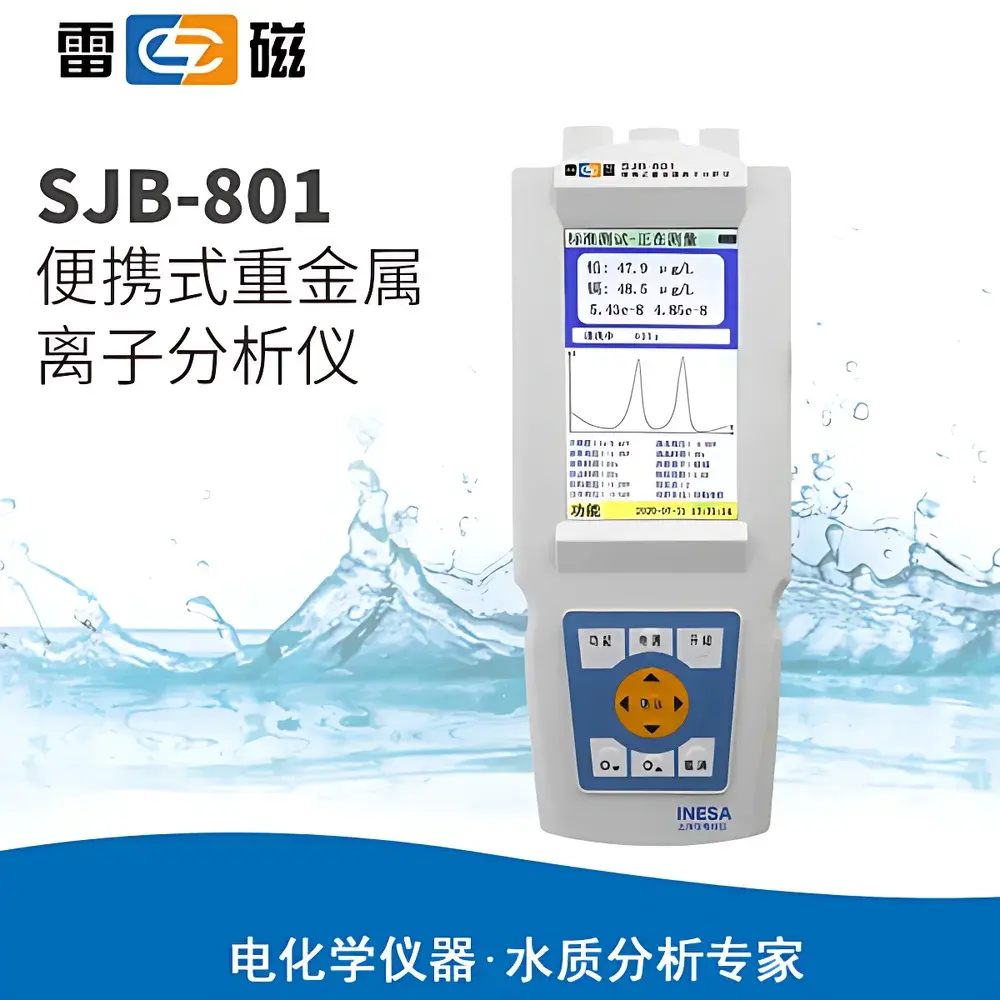
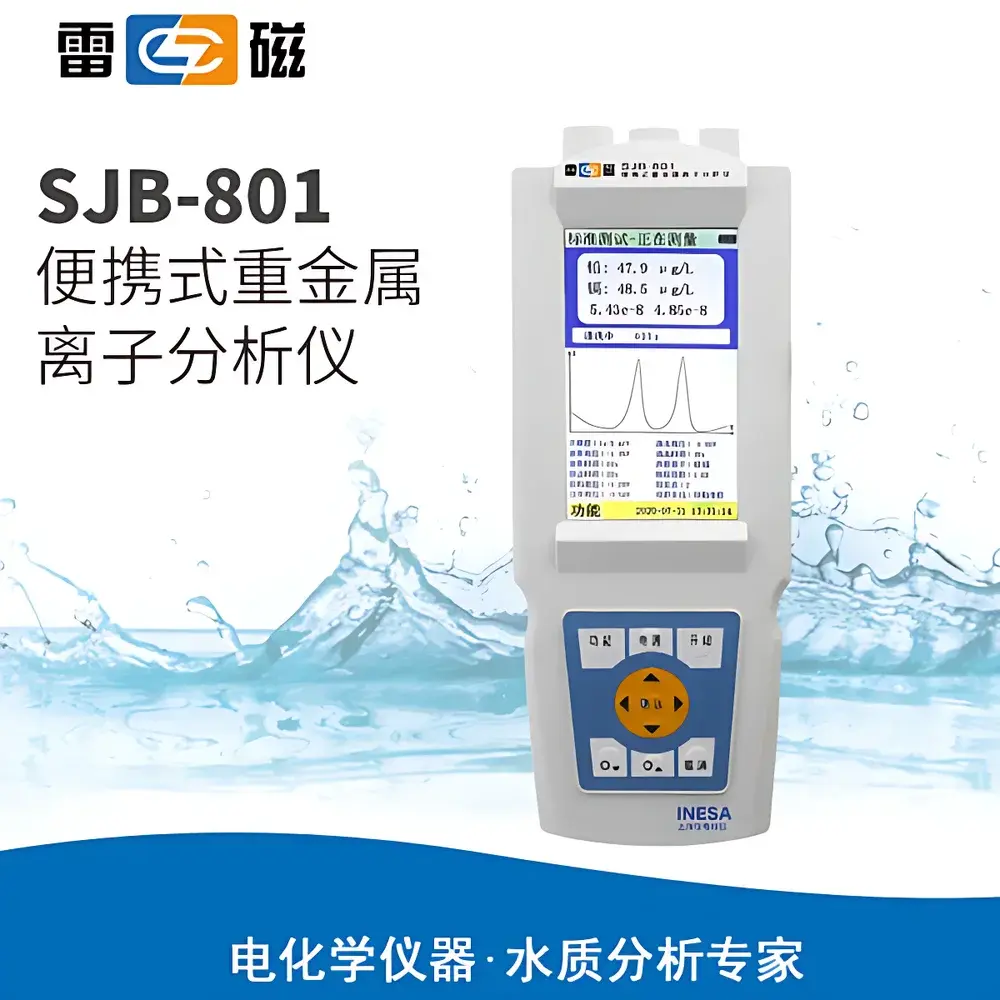
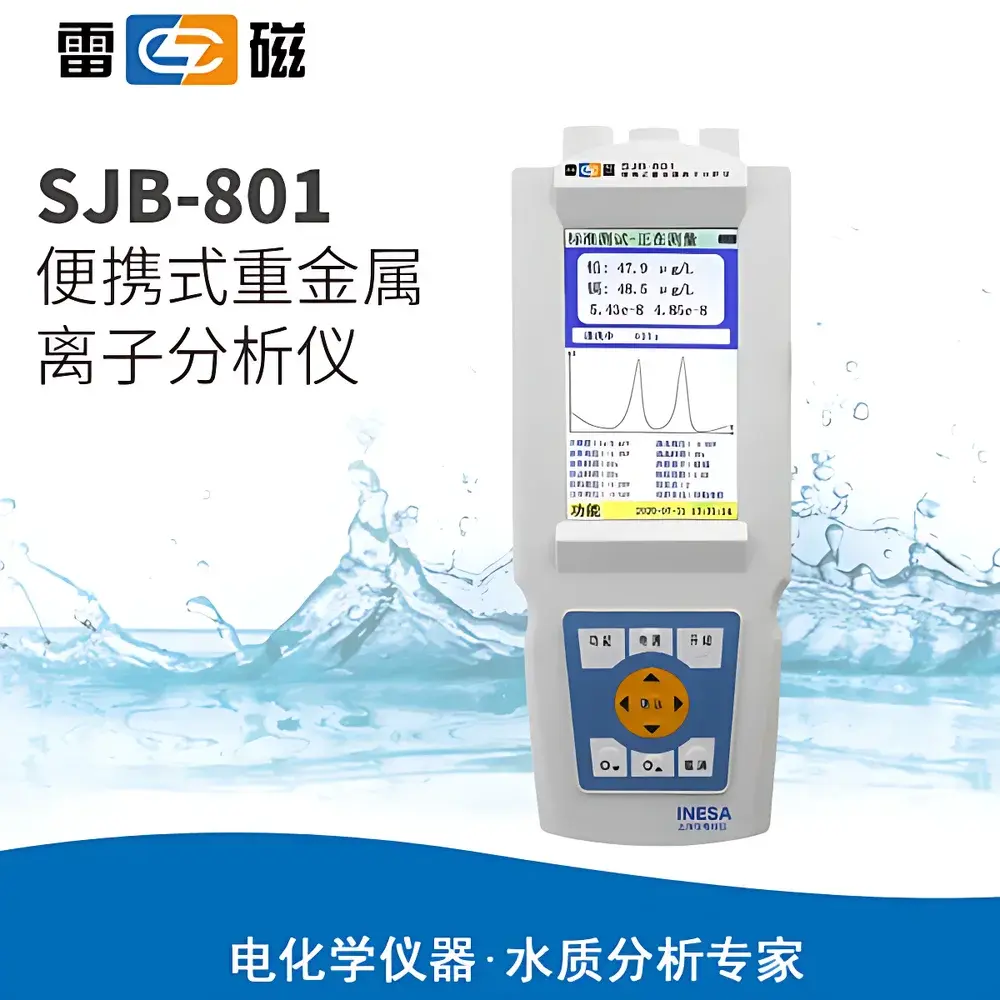
Leici SJB-801 Portable Heavy Metal Ion Analyzer
| Brand | Leici |
|---|---|
| Origin | Shanghai, China |
| Model | SJB-801 |
| Detection Principle | Anodic Stripping Voltammetry (ASV) |
| Detectable Ions | Pb²⁺, Cd²⁺, Cu²⁺, As³⁺, Hg²⁺, Zn²⁺, Se⁴⁺, Mn²⁺, Ni²⁺ |
| Display | 4.3-inch high-brightness color LCD |
| Data Storage | Up to 2000 measurement records |
| Compliance | GLP-compliant data management |
| Protection Rating | IP65 |
| Power Options | 4×AA Ni-MH rechargeable batteries |
| Communication | USB interface with REX data acquisition software |
| Data Export | SD card support |
| Method Library | Pre-loaded ASV methods for 9 heavy metal ions |
| Electrode System | Proprietary disposable or reusable screen-printed electrodes (SPE) or mercury-film electrodes |
Overview
The Leici SJB-801 Portable Heavy Metal Ion Analyzer is an electrochemical field-deployable instrument engineered for rapid, on-site quantification of trace heavy metal ions in aqueous matrices. It operates on the principle of anodic stripping voltammetry (ASV), a well-established electroanalytical technique characterized by pre-concentration of target metal ions onto a working electrode surface under controlled negative potential, followed by oxidative stripping and current measurement during a linear potential sweep. This method delivers detection limits comparable to laboratory-based atomic absorption spectroscopy (AAS) and inductively coupled plasma mass spectrometry (ICP-MS) for key toxic metals—including Pb²⁺, Cd²⁺, Cu²⁺, As³⁺, Hg²⁺, Zn²⁺, Se⁴⁺, Mn²⁺, and Ni²⁺—while maintaining portability, operational simplicity, and robustness in non-laboratory environments. The SJB-801 is designed for routine monitoring in resource-constrained settings where access to centralized analytical labs is limited or time-sensitive decisions are required.
Key Features
- 4.3-inch high-resolution color LCD with intuitive menu-driven interface—no specialized training required for basic operation.
- Real-time process visualization: automatic electrode cleaning, calibration sequence, and measurement progress displayed with countdown timers and dynamic current-potential curves.
- Integrated ASV method library: nine pre-validated protocols stored onboard; method selection requires only one touch—no manual parameter entry needed.
- Firmware-upgradable architecture: new ion-specific ASV methods can be deployed via USB or SD card without hardware modification.
- GLP-compliant data handling: each record includes timestamp, operator ID (optional), electrode ID, calibration status, raw voltammogram, and quantitative result; full audit trail supported.
- IP65-rated enclosure: dust-tight and protected against low-pressure water jets—suitable for outdoor use in rain, dust, or high-humidity conditions.
- Multi-mode power system: operable via 4×AA Ni-MH rechargeable batteries (≥8 h continuous use), USB 5 V DC input (compatible with standard smartphone chargers), external power banks, or vehicle-mounted USB adapters.
Sample Compatibility & Compliance
The SJB-801 is validated for direct analysis of filtered aqueous samples—including surface water, groundwater, wastewater effluents, leachates, and drinking water—with minimal pretreatment (e.g., pH adjustment to 4.0–5.0 for optimal ASV response). It complies with core principles of Good Laboratory Practice (GLP) per OECD Series on Principles of GLP, supporting traceable data integrity through mandatory metadata tagging and secure local storage. While not certified to ISO/IEC 17025 as a standalone testing facility, its performance aligns with ASTM D3559 (for Pb), ASTM D3590 (for Cd), and EPA Method 7000B (Anodic Stripping Voltammetry) for field screening applications. All electrode consumables—including screen-printed carbon/metal composite electrodes and mercury-film variants—are manufactured under Leici’s quality-controlled supply chain to ensure batch-to-batch reproducibility.
Software & Data Management
Data acquisition and post-processing are enabled via the proprietary REX software suite (Windows-compatible), which provides real-time instrument control, method configuration, and voltammogram overlay analysis. Raw data (current vs. potential) and processed results (.csv, .txt) are exportable for secondary validation or regulatory reporting. Internal memory retains up to 2000 complete datasets with embedded calibration history; SD card expansion supports long-term archiving and offline transfer. USB communication enables bidirectional synchronization—uploading updated methods or downloading batches for LIMS integration. Audit logs record all user-initiated actions (e.g., calibration, deletion, firmware update), satisfying basic 21 CFR Part 11 requirements for electronic records in environmental QA/QC workflows.
Applications
- Environmental field monitoring: rapid assessment of heavy metal contamination at industrial discharge points, mining sites, and remediation zones.
- Drinking water safety verification: on-the-spot screening for Pb and Cd in distribution networks or after pipe replacement events.
- Soil and sediment leachate analysis: combined with EPA Method 1311 (TCLP) extraction for preliminary risk ranking.
- Emergency response: deployment during chemical spills or natural disasters where immediate exposure assessment is critical.
- Academic and applied research: teaching electrochemistry fundamentals or developing novel ASV sensor configurations.
FAQ
What sample preparation is required prior to analysis?
Minimal preparation: samples must be filtered (0.45 µm), adjusted to pH 4.0–5.0 using acetate buffer, and deoxygenated with nitrogen or argon for 5 minutes prior to measurement.
Can the SJB-801 quantify total metal content or only dissolved fractions?
It measures bioavailable (dissolved, labile) ionic species only; total metal determination requires acid digestion prior to analysis.
Is mercury electrode use compliant with modern environmental regulations?
Yes—mercury-film electrodes are used in microgram quantities, fully contained within disposable cartridges; waste disposal follows IATA Class 9 guidelines for mercury-containing devices.
How frequently must the instrument be calibrated?
Calibration is recommended before each sampling session or every 8 hours of continuous use; multi-point standard addition is supported for matrix-matched correction.
Does the device support remote firmware updates over cellular networks?
No—firmware updates require physical connection via USB or SD card; no embedded Wi-Fi or LTE module is included.




