
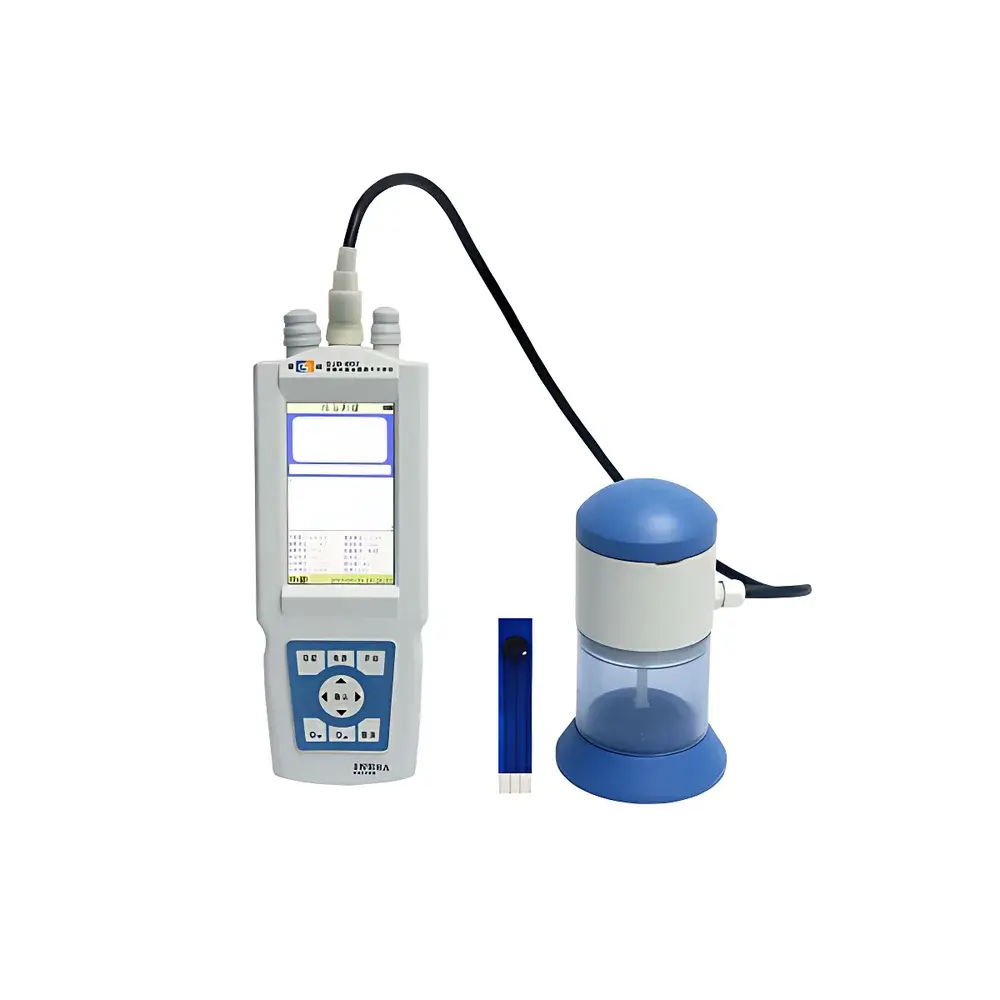
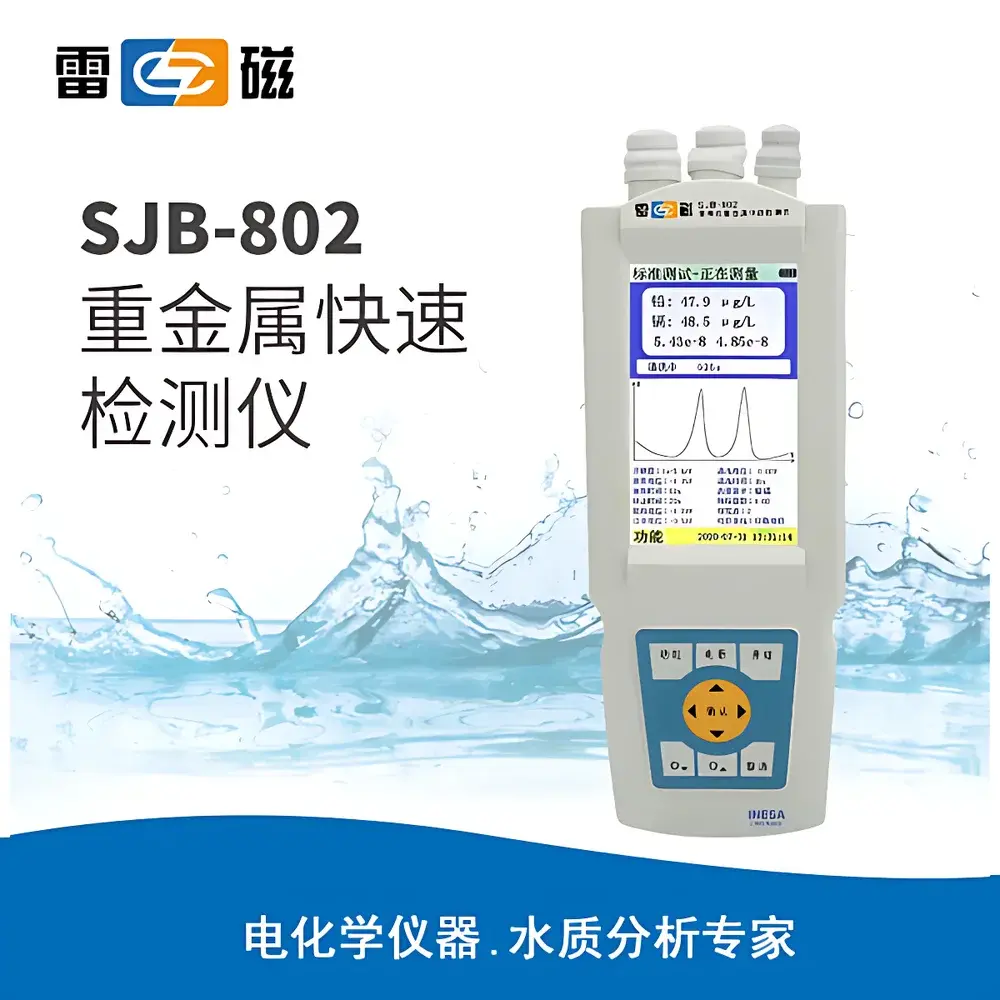
Leici SJB-802 Portable Heavy Metals Analyzer
| Brand | Leici |
|---|---|
| Origin | Shanghai, China |
| Manufacturer Type | Direct Manufacturer |
| Regional Classification | Domestic (China) |
| Model | SJB-802 |
| Price Range | USD 14,000–28,000 |
| Instrument Type | Portable |
| Detection Principle | Anodic Stripping Voltammetry (ASV) |
| Detectable Metals | Dual- and Multi-parameter (Pb, Cd, Cu, As, Hg, Zn, Se, Mn, Ni, Cr) |
| Accuracy/Precision | ≤ ±5% or ±3.0 µg/L (for Hg) |
Overview
The Leici SJB-802 Portable Heavy Metals Analyzer is an engineered field-deployable electrochemical instrument designed for rapid, on-site quantification of trace heavy metal ions in aqueous environmental matrices—including surface water, groundwater, wastewater effluents, and drinking water sources. It operates on the principle of Anodic Stripping Voltammetry (ASV), a well-established electroanalytical technique that combines pre-concentration of target metal ions onto a working electrode surface under controlled negative potential, followed by oxidative stripping and current measurement during a linear potential scan. This method delivers laboratory-grade sensitivity and selectivity without requiring centralized lab infrastructure. The SJB-802 supports dual electrochemical configurations: a robust three-electrode system (working, reference, counter) for high-precision routine analysis, and disposable screen-printed electrodes (SPEs) for rapid, low-maintenance deployment—enabling seamless transition between regulatory compliance screening and exploratory field surveys.
Key Features
- 4.3-inch high-resolution color LCD with intuitive menu-driven interface, supporting real-time visualization of calibration, cleaning, and measurement progress
- Automated electrode conditioning, rinsing, and surface renewal protocols to ensure inter-measurement reproducibility
- Intelligent sensitivity guidance: system alerts users when selected voltage or deposition parameters fall outside optimal ranges for target analytes
- Real-time voltammogram display during ASV scans—facilitating visual validation of peak shape, separation, and baseline stability
- Multi-mode operation: Fast Test (3-step protocol, <5 min per analysis), Standard Test (optimized for regulatory accuracy), and Standard Addition (matrix-matched calibration for complex samples)
- Built-in analytical methods for 10 priority metals: Pb, Cd, Cu, As, Hg, Zn, Se, Mn, Ni, Cr—with firmware-upgradable support for additional elements
- GLP-compliant data handling: timestamped storage of up to 2,000 measurement records with full audit trail; SD card export capability for raw voltammograms and metadata
- IP65-rated enclosure for dust and water jet resistance; operational across -10 °C to +50 °C ambient range
- Flexible power architecture: rechargeable Ni-MH AA batteries (4×), USB bus power, external mobile power banks, or automotive USB adapters
- Proprietary SPE cartridges—pre-fabricated, pre-characterized, and validated for ≥50 analyses per batch—eliminate electrode polishing, reconditioning, or mercury film plating
Sample Compatibility & Compliance
The SJB-802 is optimized for direct analysis of unfiltered or minimally filtered aqueous samples with total dissolved solids (TDS) < 2,000 mg/L and pH 2–9. It complies with fundamental performance criteria aligned with EPA Method 7000B (Anodic Stripping Voltammetry for Metals) and ISO 11969:2015 (Water quality — Determination of trace metals by ASV). While not certified for regulatory submission without site-specific validation, its demonstrated detection limits (e.g., 0.1 µg/L for Hg, 0.5 µg/L for Pb/Cd/As/Cu) meet or exceed WHO and EU Drinking Water Directive parametric thresholds for key contaminants. All stored data include instrument ID, operator ID, sample ID, date/time stamps, electrode type used, calibration history, and raw current-potential curves—supporting traceability requirements under GLP and pre-GMP environmental monitoring frameworks.
Software & Data Management
The instrument integrates natively with RexHM Heavy Metals Analysis Software (Windows-based), enabling bidirectional communication via standard USB 2.0. RexHM provides comprehensive post-acquisition tools: baseline correction, peak deconvolution for overlapping signals (e.g., Pb/Cd), multi-point calibration curve generation, QC flagging (e.g., signal-to-noise ratio 15%), and automated report generation compliant with ISO/IEC 17025 documentation templates. Data exports are available in CSV, PDF, and proprietary .rexhm formats—with embedded digital signatures for integrity verification. Firmware updates preserve historical method libraries and maintain backward compatibility with legacy SPE batches.
Applications
- Rapid response screening at industrial discharge points and municipal wastewater treatment plant outfalls
- Field validation of remediation effectiveness in contaminated sediment porewater or leachate monitoring wells
- Drinking water safety verification in remote or disaster-affected communities lacking lab access
- Academic research on metal speciation dynamics in estuarine and freshwater ecosystems
- Supply chain due diligence for electronics recycling facilities and battery manufacturing sites
- Regulatory pre-screening prior to confirmatory ICP-MS or AAS analysis—reducing lab turnaround time and cost
FAQ
What electrochemical configurations does the SJB-802 support, and when should each be used?
The instrument operates in two modes: three-electrode (glassy carbon or gold working electrode) for highest accuracy and lowest detection limits in clean matrices; and screen-printed electrodes for rapid, single-use measurements in turbid or organic-rich waters where electrode fouling is likely.
Is method validation required before regulatory use?
Yes. Users must perform initial method validation per ISO/IEC 17025 or local regulatory guidance—including spike recovery (85–115%), limit of detection (LOD) confirmation, and matrix interference testing—prior to reporting data for compliance purposes.
Can the SJB-802 quantify metals in solid or semi-solid samples?
No. It is designed exclusively for aqueous solutions. Solid samples (e.g., soils, sediments, sludges) require acid digestion and filtration prior to analysis.
How is data integrity ensured during field deployment?
All measurements include cryptographic hash signatures, immutable timestamps, and full parameter logging (deposition time, scan rate, stirring speed, temperature). SD card exports are write-protected after finalization to prevent tampering.
What maintenance is required for the three-electrode system?
Working electrodes require periodic mechanical polishing (using 0.3 µm and 0.05 µm alumina slurries) and electrochemical reactivation in 0.1 M H₂SO₄. Reference electrode filling solution (3 M KCl) must be replenished every 30 days or after 100 measurements.







