
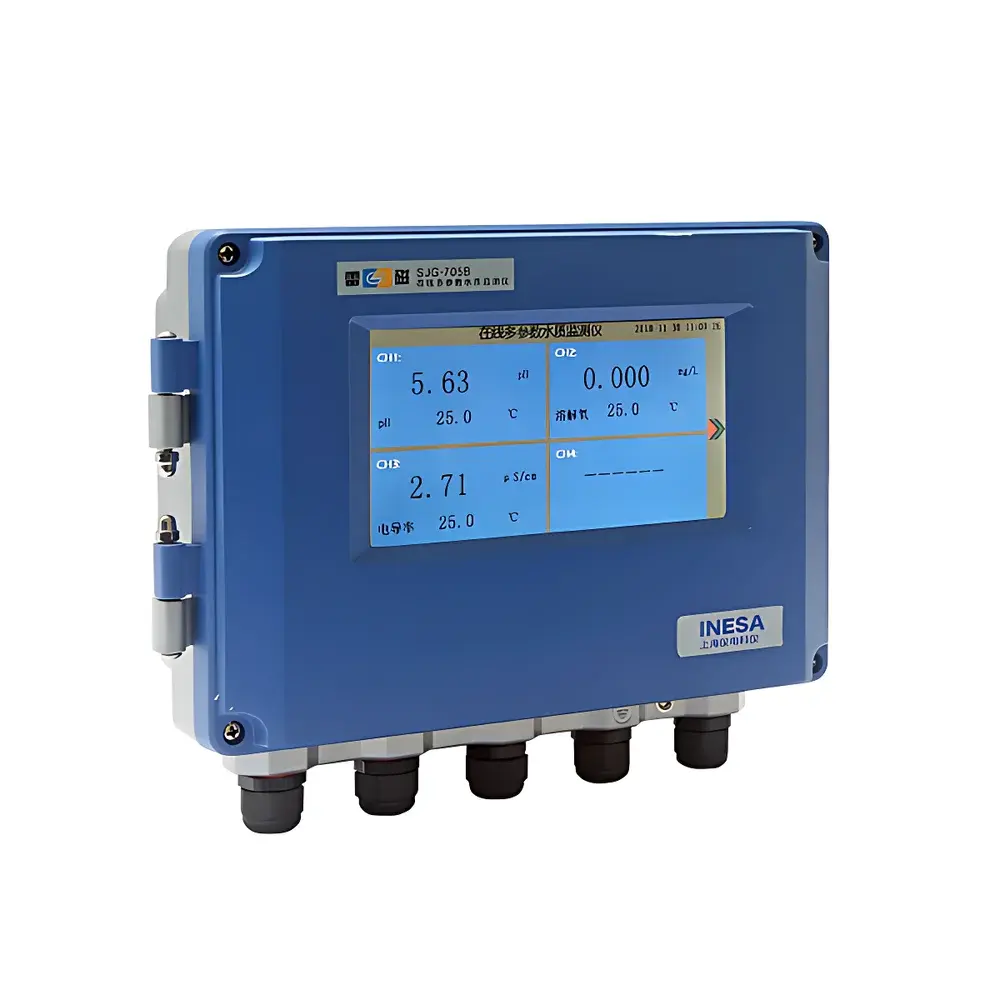
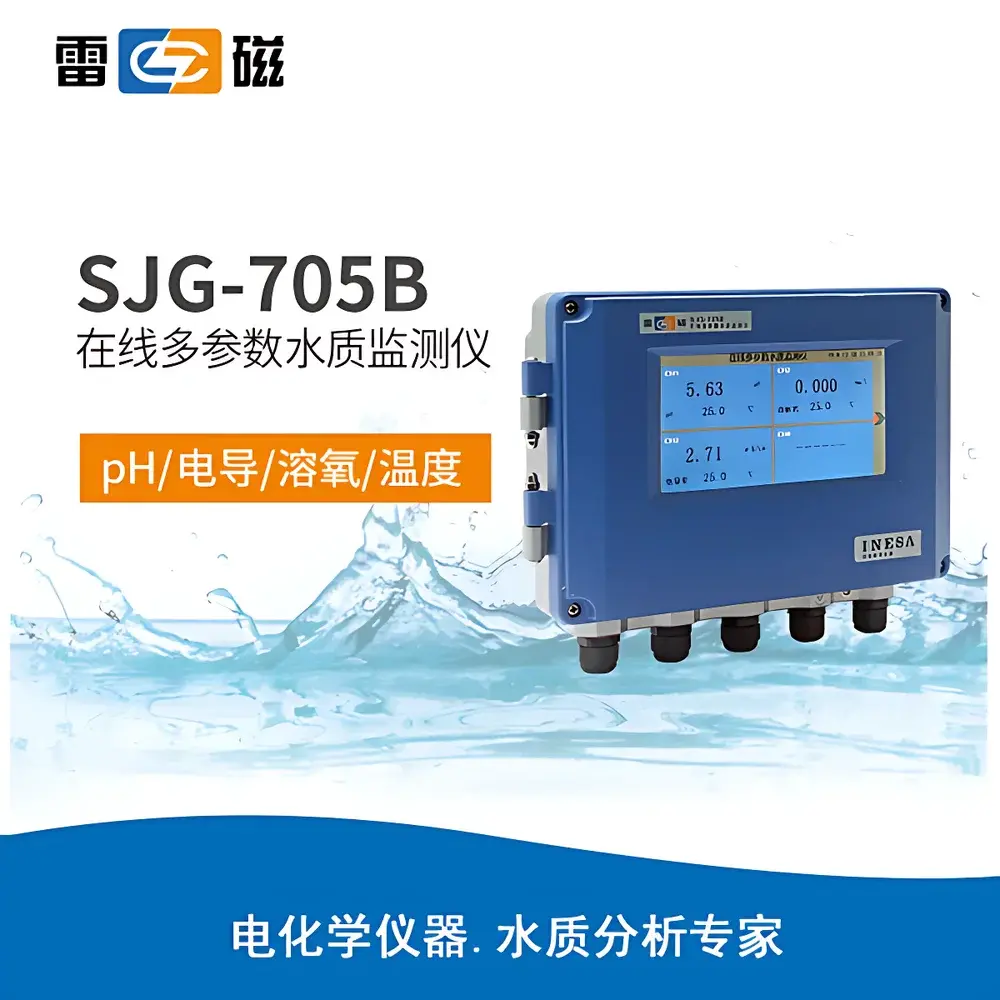
Leici SJG-705B Online Multiparameter Water Quality Monitor
| Brand | Leici |
|---|---|
| Origin | Shanghai, China |
| Manufacturer Type | Direct Manufacturer |
| Product Origin | Domestic (China) |
| Model | SJG-705B |
| Instrument Type | Online Monitor |
| Temperature Range | (−10.0 to 120.0) °C |
| pH Range | (0.00 to 14.00) pH |
| Dissolved Oxygen (DO) | Concentration (0.00–20.00) mg/L |
| Conductivity Ranges | 0.000–0.199 μS/cm |
| Turbidity Range | (0.00–1000.0) NTU |
Overview
The Leici SJG-705B Online Multiparameter Water Quality Monitor is an integrated, fixed-mount analytical platform engineered for continuous, real-time monitoring of five fundamental water quality parameters: pH, electrical conductivity (EC), dissolved oxygen (DO), turbidity, and temperature. Designed for deployment in municipal drinking water distribution systems, wastewater treatment influent/effluent streams, industrial process water loops, and environmental surface water stations, the SJG-705B operates on a robust electrochemical and optical sensing architecture. pH measurement employs a glass electrode with built-in temperature compensation (ATC); conductivity utilizes a four-electrode conductivity cell to minimize polarization effects and ensure stability across wide salinity ranges; DO is measured via Clark-type polarographic sensor with membrane-covered cathode and Ag/AgCl reference; turbidity relies on 90° scattered light detection per ISO 7027 principles, calibrated against formazin standards; temperature is acquired using a Pt1000 RTD probe with dual-point calibration traceability. All sensors are housed in a single ruggedized stainless-steel enclosure rated IP65 for indoor or sheltered outdoor mounting.
Key Features
- Simultaneous real-time measurement of pH, EC, DO, turbidity, and temperature — all with integrated automatic temperature compensation (ATC) for each parameter
- 7-inch high-resolution color TFT touchscreen interface with intuitive Chinese-language GUI, supporting multi-level user access control (operator, technician, administrator)
- Configurable upper/lower limit alarms for any of the four primary parameters (pH, EC, DO, turbidity), with relay outputs (NO/NC) for external actuation or SCADA integration
- Continuous measurement mode with adjustable sampling interval (1 s to 3600 s), enabling adaptive data resolution for dynamic environments
- Onboard non-volatile memory capable of storing ≥500,000 timestamped records (including raw sensor values, compensated results, and diagnostic flags)
- Dual serial communication interfaces: isolated RS-232 (for local configuration and diagnostics) and RS-485 (Modbus RTU protocol, up to 32 devices per bus) for seamless integration into centralized supervisory control systems
- Wall-mountable chassis (285 × 205 × 97 mm, 3 kg) with standardized 19-mm DIN rail compatibility and optional flow-through cell kit for pressurized pipeline applications
- Dedicated turbidity measurement chamber with quartz cuvette and LED light source optimized for low-drift performance under variable ambient lighting conditions
Sample Compatibility & Compliance
The SJG-705B is validated for use with potable water, surface water, groundwater, secondary-treated effluent, and low-salinity industrial process water (TDS < 20 g/L). It complies with national metrological verification regulations JJG 119–2018 (pH meters), JJG 376–2007 (conductivity analyzers), JJG 291–2018 (dissolved oxygen meters), and JJG 880–2006 (turbidimeters). Sensor modules meet IEC 60746-3 (electrochemical analyzers) and ISO 7027-1:2016 (turbidity). While not certified to FDA 21 CFR Part 11, its data logging architecture supports audit-ready operation when deployed under GLP-aligned laboratory or utility QA/QC protocols — including time-stamped event logs, user authentication, and immutable record storage.
Software & Data Management
Data export is supported via USB flash drive (CSV format) or RS-485 Modbus RTU polling by third-party SCADA/HMI systems (e.g., Ignition, Siemens Desigo, Wonderware). The embedded firmware includes configurable data averaging (1–60 point moving average), linearization tables for conductivity range switching, and automatic zero/span validation prompts. Historical datasets retain full metadata: sensor ID, calibration date, operator tag, and environmental ambient temperature. Optional Leici WaterLink™ PC software (Windows 10/11) enables graphical trend analysis, report generation (PDF/Excel), alarm history review, and remote firmware updates via secure HTTPS-based OTA channel.
Applications
- Municipal drinking water quality assurance at entry points, reservoirs, and critical distribution nodes
- Wastewater treatment plant compliance monitoring (e.g., discharge consent limits per GB 18918–2002)
- Cooling tower and boiler feedwater system surveillance to prevent scaling and corrosion
- Aquaculture pond management for DO and pH optimization
- Environmental monitoring networks tracking seasonal variations in rivers, lakes, and wetlands
- Pharmaceutical facility purified water (PW) and water-for-injection (WFI) loop support — where conductivity and TOC are primary indicators (note: TOC not measured; SJG-705B serves as complementary baseline monitor)
FAQ
What calibration protocols does the SJG-705B support?
It supports two-point pH calibration (using NIST-traceable buffers), multi-range conductivity standardization (KCl solutions at 1413 µS/cm, 12.88 mS/cm), DO zero/saturation calibration (Na₂SO₃ solution and air-saturated water), and turbidity zero adjustment with DI water plus span verification using AMCO AEPA-1 standards.
Is the instrument suitable for seawater or high-salinity brine?
No — the conductivity range maxes out at 19.9 mS/cm (~20 ppt salinity), and the DO sensor membrane is not optimized for chloride-rich matrices. For marine applications, consider dedicated oceanographic-grade sensors with titanium housings and anti-fouling coatings.
Can the SJG-705B operate unattended for extended periods?
Yes — with stable AC power (220 V ±10%, 50 Hz), it maintains operational integrity for >6 months between maintenance cycles. Recommended quarterly verification includes electrode cleaning, membrane replacement (DO), and turbidity window inspection.
Does it support analog 4–20 mA output?
Not natively — output is digital-only (RS-232/RS-485). However, external Modbus-to-4–20 mA converters (e.g., Moxa EDS-205A) can be integrated without signal degradation.
How is temperature compensation applied across parameters?
Each sensor module incorporates independent Pt1000 RTD feedback; pH uses Nernstian slope correction, EC applies ISO 7888 polynomial, DO uses Stern–Volmer thermal compensation, and turbidity applies empirical drift offset correction — all executed in real time within the embedded microcontroller.
Related Products







