
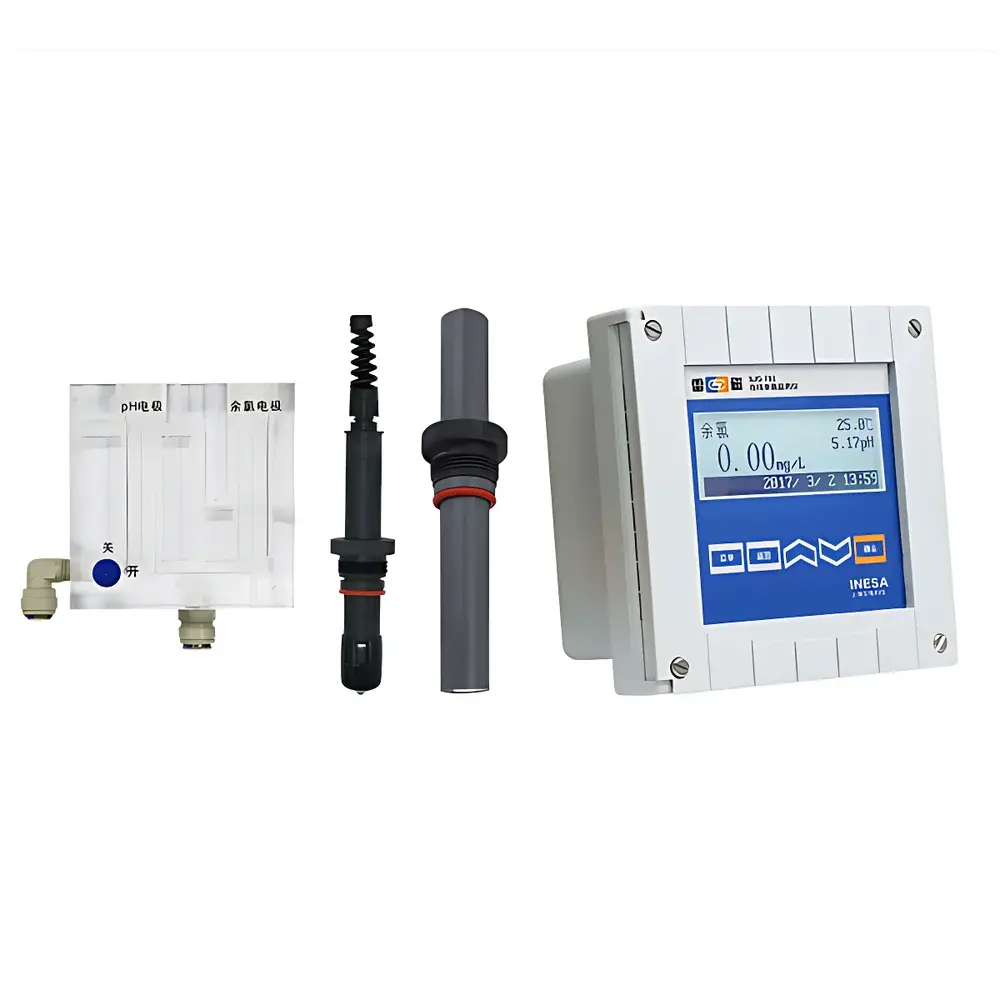
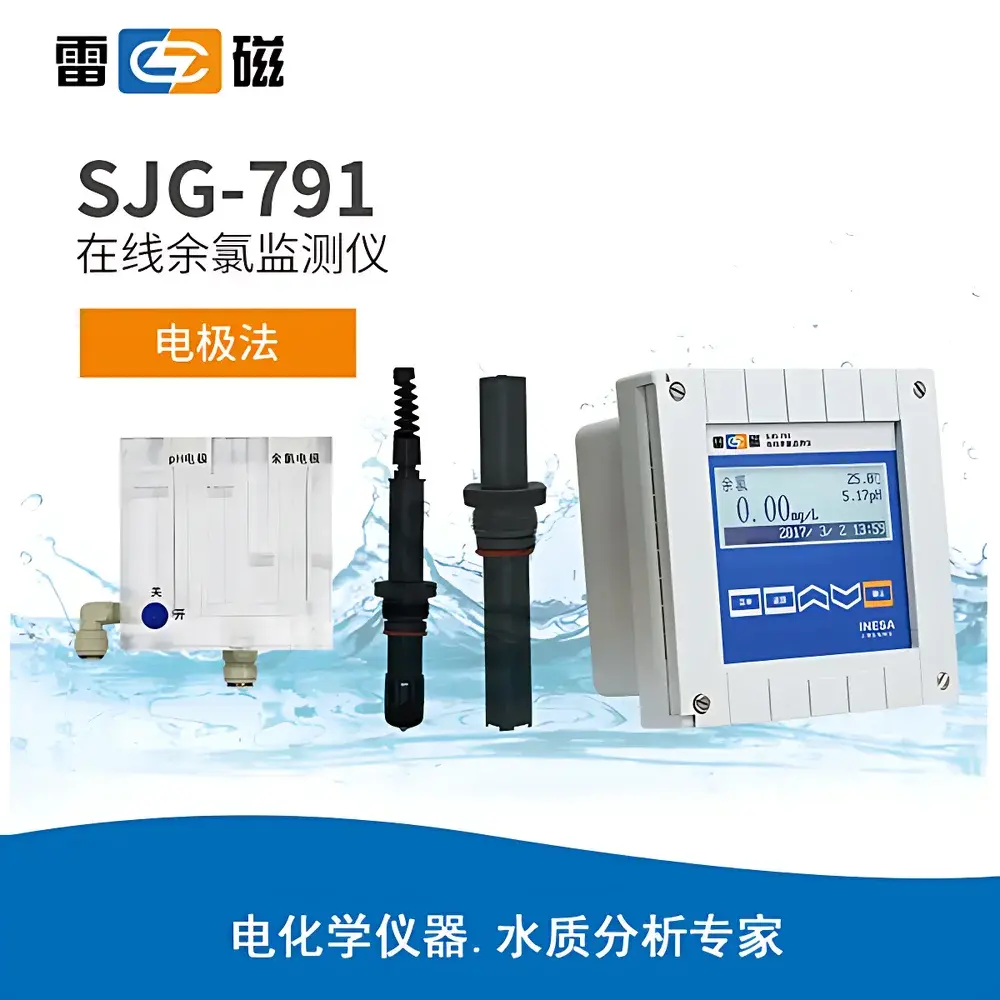
Leici SJG-791 Online Residual Chlorine Analyzer
| Brand | Leici |
|---|---|
| Origin | Shanghai, China |
| Manufacturer Type | Direct Manufacturer |
| Product Category | Domestic |
| Model | SJG-791 |
| Instrument Type | Online Analyzer |
| Measurement Principle | Electrochemical Amperometric Sensor |
| Measured Parameter | Free Residual Chlorine |
| Range | 0.00–20.00 mg/L |
| Accuracy | ±10% (≥0.5 mg/L) or ±0.05 mg/L (<0.5 mg/L) |
| Resolution | 0.01 mg/L (Cl₂), 0.01 pH, 0.1 °C |
| pH Range | 0.00–14.00 pH |
| Temperature Range | 0.0–60.0 °C |
| pH Accuracy | ±0.05 pH |
| Temp Accuracy | ±0.5 °C |
| Electronic Unit Stability | ±1% FS/24 h |
| 90% Response Time | 2 min |
| Enclosure Rating | IP65 |
| Power Supply | AC 220 V ±10%, 50 Hz |
| Dimensions | 166 × 166 × 110 mm |
| Weight | 2 kg |
| Output | Dual isolated 4–20 mA DC outputs (configurable for Cl₂ or pH) |
| Data Storage | 2000 measurement records |
| Auto Compensation | pH and temperature compensation for residual chlorine |
| Alarm Function | Configurable high/low limits with hysteresis |
| Power Failure Protection | Yes |
Overview
The Leici SJG-791 Online Residual Chlorine Analyzer is an industrial-grade electrochemical monitoring system engineered for continuous, real-time quantification of free residual chlorine in potable water, municipal drinking water distribution systems, wastewater effluent streams, swimming pool circulation loops, and critical healthcare facility water networks. It operates on the amperometric principle—utilizing a membrane-covered, three-electrode sensor that selectively detects hypochlorous acid (HOCl) and hypochlorite ion (OCl⁻) in aqueous solution through controlled potential electrolysis. The instrument integrates simultaneous pH and temperature measurement to enable dynamic, algorithmic compensation of chlorine activity, ensuring trace-level accuracy across variable water matrices. Designed for unattended operation in harsh environments, the SJG-791 complies with core functional requirements outlined in ISO 7888 (water quality — determination of residual chlorine), ASTM D1253 (standard test method for residual chlorine in water), and supports audit-ready data integrity practices aligned with GLP and small-scale GMP water system validation protocols.
Key Features
- Triple-parameter concurrent display: residual chlorine (mg/L), pH (0.00–14.00), and temperature (0.0–60.0 °C) on a high-contrast dot-matrix LCD screen
- Real-time, automatic pH and temperature compensation algorithms—applied directly to raw amperometric current signals prior to concentration conversion
- Dual independent 4–20 mA DC isolated analog outputs, each configurable for residual chlorine or pH; output span and zero point fully programmable via front panel or Modbus
- Standard serial communication interface (RS-232 or RS-485 selectable), supporting Modbus RTU protocol for seamless integration into SCADA, DCS, or PLC-based control architectures
- Non-volatile memory storing up to 2000 timestamped measurement records—including Cl₂ value, pH, temperature, date/time, and status flags
- Configurable dual-threshold alarm logic with adjustable hysteresis for both residual chlorine and pH—supports relay activation or external signaling via digital I/O (optional)
- Robust IP65-rated enclosure constructed from UV-stabilized polycarbonate and stainless-steel fasteners, suitable for wall-mount or panel-mount installation in humid, chemically exposed utility rooms or outdoor kiosks
- Built-in power failure protection: retains calibration coefficients, configuration settings, and last valid measurement during AC interruption
Sample Compatibility & Compliance
The SJG-791 is validated for use in clear to moderately turbid aqueous samples (turbidity ≤ 5 NTU) with conductivity between 50 µS/cm and 2000 µS/cm. It is not intended for seawater, highly chloraminated systems (>0.2 mg/L monochloramine), or solutions containing >10 mg/L oxidizing interferents such as ozone or hydrogen peroxide. Sensor performance meets the repeatability and linearity criteria specified in ISO 7888 Annex B for amperometric chlorine analyzers. The device’s firmware architecture supports time-stamped event logging and parameter change history—enabling partial compliance with FDA 21 CFR Part 11 requirements when deployed with external audit-trail-capable data acquisition software. All electrical interfaces conform to IEC 61000-4 electromagnetic compatibility standards.
Software & Data Management
No proprietary PC software is required for basic operation; all configuration, calibration, and diagnostics are performed locally via the intuitive keypad and LCD interface. For centralized data aggregation, the integrated Modbus RTU interface allows polling of live measurements, alarm states, sensor health indicators (e.g., membrane saturation status, electrode offset), and historical record indices. When interfaced with third-party historian platforms (e.g., Ignition, Siemens Desigo CC, or Emerson DeltaV), the SJG-791 delivers structured, timestamped data compliant with ISA-95 Level 0–1 data models. Raw sensor output (nA range) and compensated values are separately accessible via register mapping—supporting traceability for root-cause analysis during regulatory review.
Applications
- Municipal drinking water treatment plants: continuous monitoring at chlorination contact tanks, clearwells, and distribution system entry points
- Hospital central sterile supply departments (CSSD): verification of chlorine residuals in rinse water for endoscope reprocessing lines
- Commercial and public swimming pool facilities: closed-loop feedback control of sodium hypochlorite dosing pumps
- Pharmaceutical purified water (PW) and water-for-injection (WFI) loop monitoring—where chlorine is used as a periodic sanitant
- Food and beverage processing lines: post-CIP residual verification prior to product contact surface reuse
- Industrial cooling tower water management: corrosion mitigation via controlled biocide residual maintenance
FAQ
What chlorine species does the SJG-791 measure?
It measures total free residual chlorine—primarily hypochlorous acid (HOCl) and hypochlorite ion (OCl⁻)—in equilibrium with sample pH and temperature.
Is the sensor compatible with chloramine-containing water?
No. The amperometric sensor exhibits cross-sensitivity to monochloramine above 0.2 mg/L; dedicated chloramine analyzers are recommended for such applications.
How often does the sensor require calibration?
Field calibration is recommended every 7–14 days using NIST-traceable DPD colorimetric reference standards or certified chlorine standard solutions.
Can the 4–20 mA outputs be assigned to different parameters simultaneously?
Yes: Output 1 may be assigned to residual chlorine while Output 2 is assigned to pH—or both may reflect the same parameter with independent scaling.
Does the unit support automatic cleaning or flow control?
No. The SJG-791 is a sensor electronics module only; it requires external sample conditioning (e.g., constant-flow cell, pressure regulator, particulate filter) for optimal long-term stability.
Related Products







