
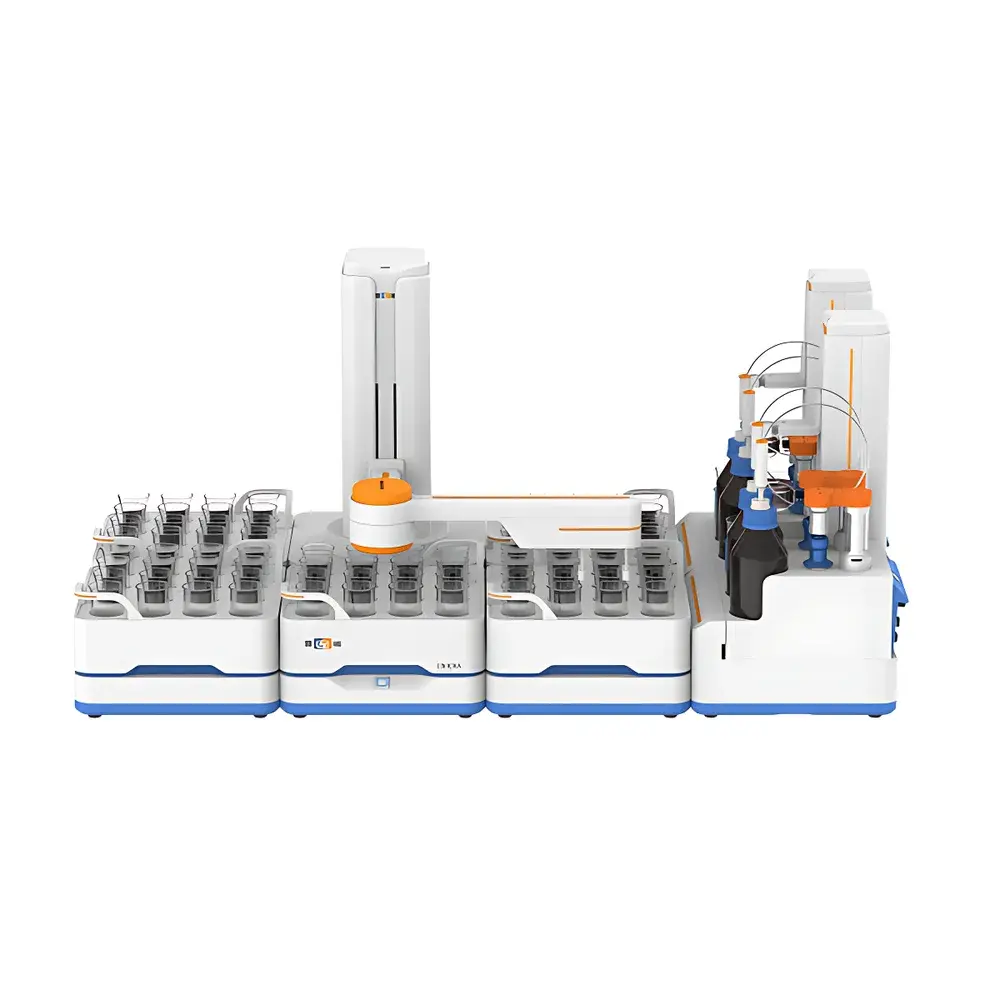
Leici SR-1/ZDJ-6 Series Fully Automated Potentiometric Titration System
| Brand | Leici |
|---|---|
| Origin | Shanghai, China |
| Manufacturer Type | Original Equipment Manufacturer (OEM) |
| Product Origin | Domestic (China) |
| Model | SR-1 Robotic Autosampler + ZDJ-6 Titration Unit |
| Application Scope | General-purpose potentiometric titration |
Overview
The Leici SR-1/ZDJ-6 Series Fully Automated Potentiometric Titration System is an integrated electrochemical analysis platform engineered for precision, reproducibility, and regulatory compliance in high-throughput laboratory environments. Based on the fundamental principle of potentiometric endpoint detection—monitoring the potential difference between a reference electrode and an indicator electrode during titrant addition—the system delivers traceable, ISO/IEC 17025-aligned quantitative results for acid-base, redox, precipitation, and complexometric titrations. Its modular architecture separates sample handling (SR-1 robotic autosampler), reagent delivery and reaction control (ZDJ-6 titration unit), and data acquisition into interoperable subsystems, enabling configuration scalability without hardware redundancy. Designed for routine QC/QA workflows in regulated industries, the system operates under controlled environmental conditions and supports method validation per ICH Q2(R2) guidelines.
Key Features
- Modular Scalability: Independent SR-1 autosampler, ZDJ-6 titration module, and auxiliary units (e.g., magnetic stirrer, electrode cleaning station, reagent dosing manifold) can be configured or expanded based on throughput and analytical complexity requirements.
- High-Throughput Capability: Supports up to 80 sample positions with concurrent three-channel titration—enabling parallel analysis of multiple analytes or replicate determinations within a single run sequence.
- End-to-End Automation: Fully automated workflow encompassing sample aspiration, standardization (standard solution calibration), titrant dispensing, real-time potential monitoring, endpoint calculation (via first/second derivative or fixed potential methods), post-run electrode rinsing, and waste disposal.
- Comprehensive Resource Management: Integrated software modules for user access control (role-based permissions), validated method storage (with version history), electrode lifecycle tracking (calibration logs, slope monitoring), reagent inventory management (expiry alerts, consumption tracking), and audit-ready electronic records.
- Programmable Logic Engine: Supports custom titration logic via script-based method editor—including conditional branching, multi-step titration sequences, dynamic volume adjustment based on preliminary readings, and adaptive endpoint criteria.
Sample Compatibility & Compliance
The system accommodates liquid, dissolved solid, and suspension samples across pH 0–14 and temperature ranges from 5 °C to 40 °C (with optional Peltier-controlled cell). Compatible electrodes include glass pH, Ag/AgCl, Pt, and ion-selective types (e.g., Cl−, F−, Cu2+). It meets essential design and performance criteria outlined in ASTM E202–22 (Standard Test Methods for Saponification Number of Fatty Materials), USP (Acid Value and Saponification Value), and ISO 3656:2021 (Animal and Vegetable Fats and Oils — Determination of Peroxide Value). All electronic records comply with ALCOA+ principles (Attributable, Legible, Contemporaneous, Original, Accurate, Complete, Consistent, Enduring, Available) and support FDA 21 CFR Part 11-compliant electronic signatures when deployed with validated software configurations.
Software & Data Management
The embedded titration software provides a GxP-aligned interface with full audit trail functionality—including timestamped operator actions, method parameter changes, calibration events, and result modifications. Data export options include CSV, PDF (with embedded chromatogram-style titration curves), and XML formats compatible with LIMS integration (via ASTM E1394 or HL7 interfaces). Raw potential vs. volume datasets are retained with metadata (electrode ID, ambient temperature, atmospheric pressure, reagent lot numbers). Backup and restore protocols follow ISO/IEC 27001-aligned data integrity policies, and system-generated reports include uncertainty estimation per EURACHEM/CITAC Guide.
Applications
- Food & Agriculture: Quantification of free fatty acids (acid value) and peroxide value in edible oils per AOAC Official Method 945.38 and ISO 660.
- Pharmaceuticals: Assay of active pharmaceutical ingredients (APIs) such as chlorhexidine digluconate, sodium chloride, and lithium carbonate using pharmacopoeial monographs (USP-NF, EP).
- Electrochemical Materials: Determination of residual chloride in lithium-ion battery cathode precursors (e.g., LiNi0.8Co0.15Al0.05O2) via argentometric titration per ASTM D512.
- Environmental Testing: Total alkalinity and chloride concentration in wastewater effluents per EPA Method 310.1 and ISO 9297.
- Chemical Manufacturing: Quality control of industrial acids (HCl, H2SO4), bases (NaOH), and salts (NaCl, KBr) across batch release testing.
FAQ
Does the system support non-aqueous titrations?
Yes—compatible with common non-aqueous solvents (e.g., glacial acetic acid, dimethylformamide) using appropriate electrodes and solvent-specific calibration protocols.
Can method files be transferred between instruments?
Method definitions are stored in standardized XML format and fully portable across SR-1/ZDJ-6 systems running identical firmware versions.
Is GLP/GMP audit support available?
Yes—the software includes configurable audit trail depth, electronic signature workflows, and IQ/OQ documentation templates aligned with Annex 11 and PIC/S TR 71 requirements.
What electrode maintenance features are included?
Automated electrode cleaning cycles, slope monitoring with configurable alert thresholds, and automatic recalibration prompts based on drift or failed verification checks.
How is reagent consumption tracked?
Real-time volumetric tracking of titrant and auxiliary reagents via calibrated burette encoders, with usage logs tied to each sample and method ID for cost allocation and inventory forecasting.





