
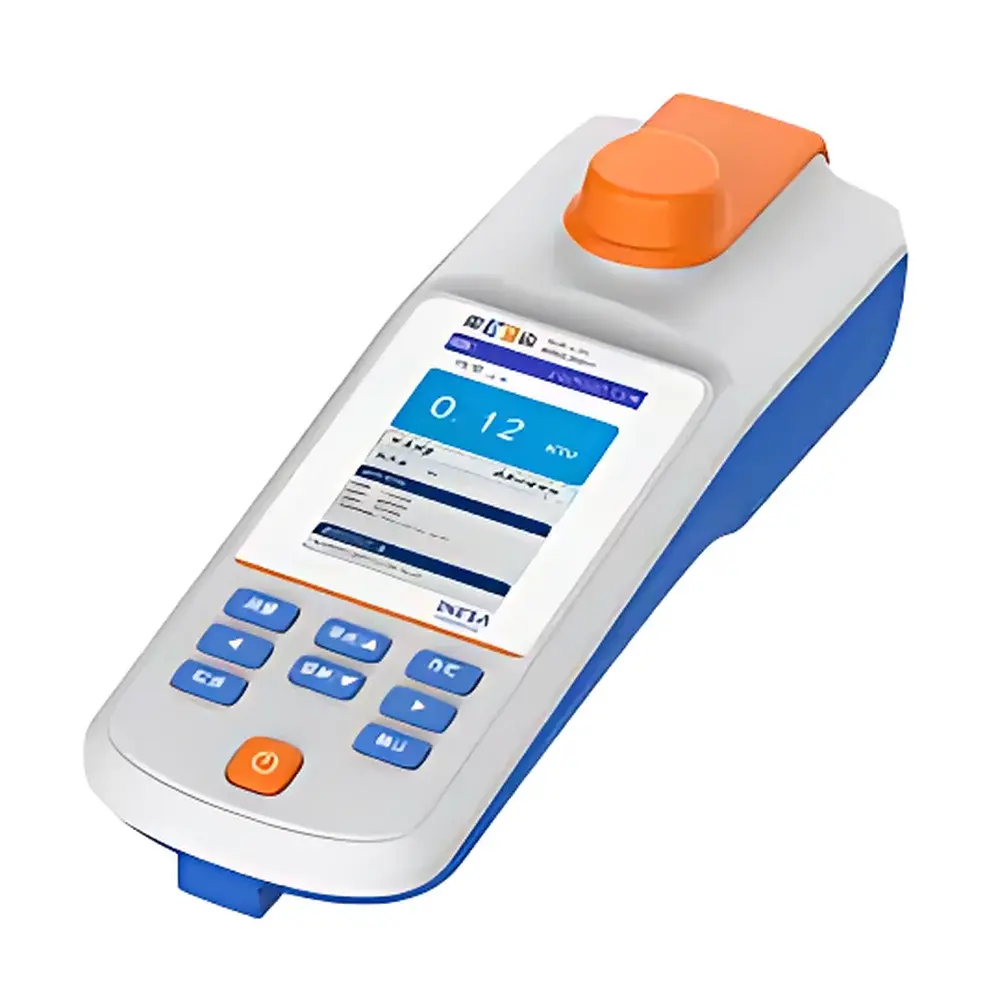
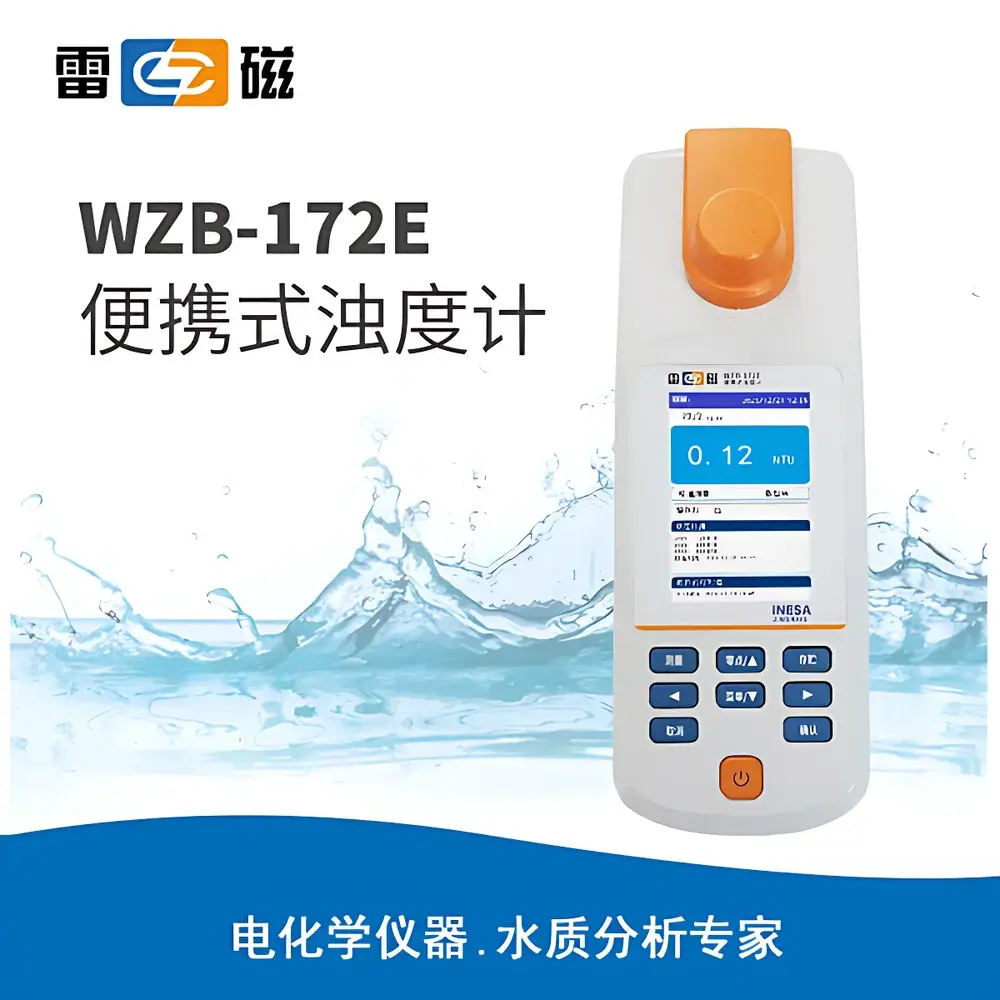
Leici WZB-172E Portable Turbidimeter
| Brand | Leici |
|---|---|
| Origin | Shanghai, China |
| Manufacturer Type | Direct Manufacturer |
| Regional Classification | Domestic (China) |
| Model | WZB-172E |
| Product Type | Portable |
| Measurement Range | (0.00–9.99) NTU, (10.0–99.9) NTU, (100–500) NTU |
| Resolution | 0.01 NTU / 0.1 NTU / 1 NTU |
| Accuracy | ±6% |
| Repeatability | ≤0.5% |
| Zero Drift | ±0.5% FS/30 min |
| Stability | ±0.5% FS/30 min |
| Calibration Points | Zero + up to 4 points (2, 20, 200, 500 NTU) |
| Data Storage Capacity | 1000 records |
| Display | 3.5-inch color LCD |
| Ingress Protection | IP65 |
| Operating Temperature | 5–40 °C |
| Relative Humidity | ≤85% RH |
| Power Supply | Rechargeable Li-ion battery |
| Dimensions & Weight | 90 × 250 × 90 mm, approx. 0.8 kg |
Overview
The Leici WZB-172E Portable Turbidimeter is an engineered field-deployable instrument designed for rapid, reliable turbidity quantification in water quality monitoring applications. It operates on the principle of nephelometric measurement—detecting scattered light at a 90° angle—and integrates dual-mode optical detection: standard 90° scatter (nephelometry) and combined scatter-transmission (ratio method), enabling robust performance across low-, mid-, and high-turbidity ranges. Compliant with U.S. EPA Method 180.1 and China’s HJ 1075–2019 standard for turbidity determination, the WZB-172E delivers traceable, standardized results suitable for regulatory reporting, drinking water safety verification, wastewater effluent assessment, and environmental field surveys. Its tungsten-halogen light source emits broadband visible radiation (400–600 nm), optimized for consistency with reference formazin standards and minimizing spectral interference from colored or absorbing samples.
Key Features
- 3.5-inch high-resolution color LCD with intuitive icon-based navigation and real-time graphical feedback
- Dual optical measurement modes: selectable 90° scatter (NTU/FNU) and scatter-transmission ratio (EBC-compatible), supporting multi-standard compliance
- Auto-ranging capability across three dynamic ranges: 0.00–9.99 NTU (0.01 NTU resolution), 10.0–99.9 NTU (0.1 NTU resolution), and 100–500 NTU (1 NTU resolution)
- IP65-rated enclosure for dust-tight operation and resistance to low-pressure water jets—validated for outdoor and harsh industrial environments
- Integrated long-life calibration kit (2, 20, 200, and 500 NTU formazin-equivalent standards) with traceable documentation
- Built-in zero-point correction, single-point and multi-point (up to 4-point) calibration routines, and factory-default restoration function
- Onboard power management: rechargeable lithium-ion battery with state-of-charge indicator, USB-C-compatible charging via PC or portable power bank, and auto-sleep mode to extend operational runtime
Sample Compatibility & Compliance
The WZB-172E accommodates standard 25-mm round glass vials (included) and supports sample volumes of 20–40 mL. Its optical path design minimizes wall-scatter artifacts and enables stable readings for suspended solids ranging from fine colloidal clays (50 µm). Instrument validation aligns with ISO 7027-1:2016 (optical properties of turbidimeters) and supports audit-ready GLP data integrity through timestamped records, operator ID tagging (via optional software configuration), and immutable storage. All calibration events—including date, standard value, deviation, and user annotation—are retained with full traceability. The device meets requirements for routine use under ISO/IEC 17025-accredited laboratories when operated within specified environmental limits (5–40 °C, ≤85% RH, non-condensing).
Software & Data Management
- 1000-measurement internal memory with searchable timestamps, units, and calibration status flags
- Micro-USB interface for bidirectional communication using Leici’s proprietary PC software (Windows-compatible), enabling batch export to CSV, PDF report generation, and firmware updates
- RS-232 serial port for direct connection to standard thermal printers—supports automatic print-on-measure and manual report recall
- GLP-compliant data structure: each record includes measurement time, temperature (if external probe connected), selected unit (NTU/FNU/EBC), mode (standard/average), and active calibration ID
- No cloud dependency: all data remains local unless explicitly exported—ensuring compliance with data sovereignty policies and secure transfer protocols
Applications
The WZB-172E serves as a primary field tool for municipal water utilities performing source water screening and distribution system integrity checks; environmental agencies conducting river, lake, and reservoir monitoring; food & beverage QA labs verifying process water clarity; and wastewater treatment plants assessing clarifier efficiency and filter backwash performance. Its portability and battery endurance support unattended deployments in remote locations, while its dual-mode optics mitigate errors caused by sample coloration or high absorbance—common limitations of single-beam transmissometers. Routine use cases include compliance verification against WHO guidelines (<5 NTU for drinking water), sediment transport studies, coagulation/flocculation optimization trials, and emergency response testing following flood or infrastructure failure events.
FAQ
What turbidity standards are supported for calibration?
Calibration is performed using formazin-equivalent standards traceable to NIST SRM 2102. The included kit provides certified values at 2, 20, 200, and 500 NTU. Users may also load custom calibration curves via PC software.
Is the instrument compliant with US EPA Method 180.1?
Yes—the optical geometry, light source spectral profile (400–600 nm), and signal processing algorithms meet all instrumental specifications defined in EPA Method 180.1 for nephelometric turbidity measurement.
Can the WZB-172E measure samples with high color or UV-absorbing compounds?
By default, the scatter-transmission ratio mode compensates for absorption-related attenuation, improving accuracy for yellow-colored or humic-rich waters where conventional 90° scatter alone may underestimate true particle concentration.
How is data security and audit readiness ensured?
All measurements include embedded metadata (time, temperature, operator ID if configured, calibration version), and no record can be edited or deleted without generating an auditable log entry. Exported files retain digital signatures compatible with FDA 21 CFR Part 11–aligned review workflows.
What maintenance is required for long-term accuracy?
Optical windows should be cleaned with lens-grade tissue and isopropyl alcohol after each use. Annual verification against certified reference standards is recommended; full recalibration is advised every 12 months or after 5000 measurements—whichever occurs first.





