
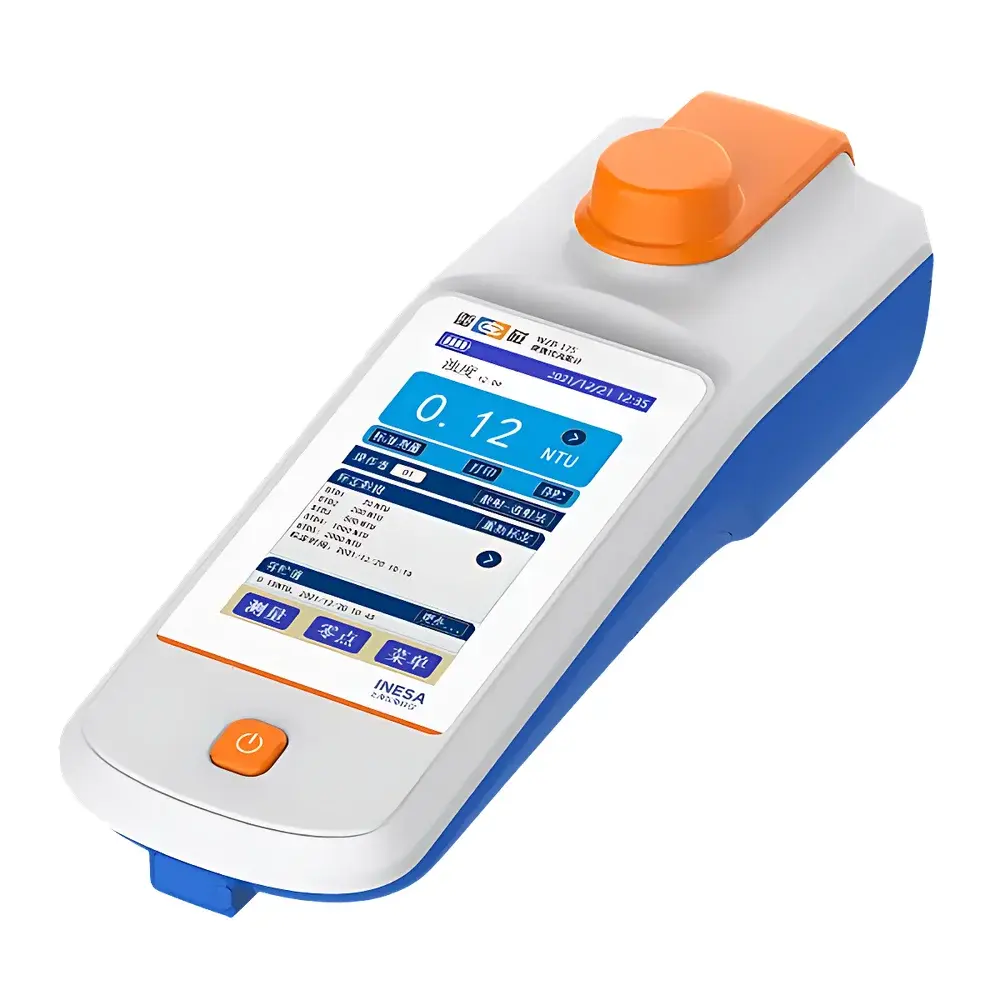
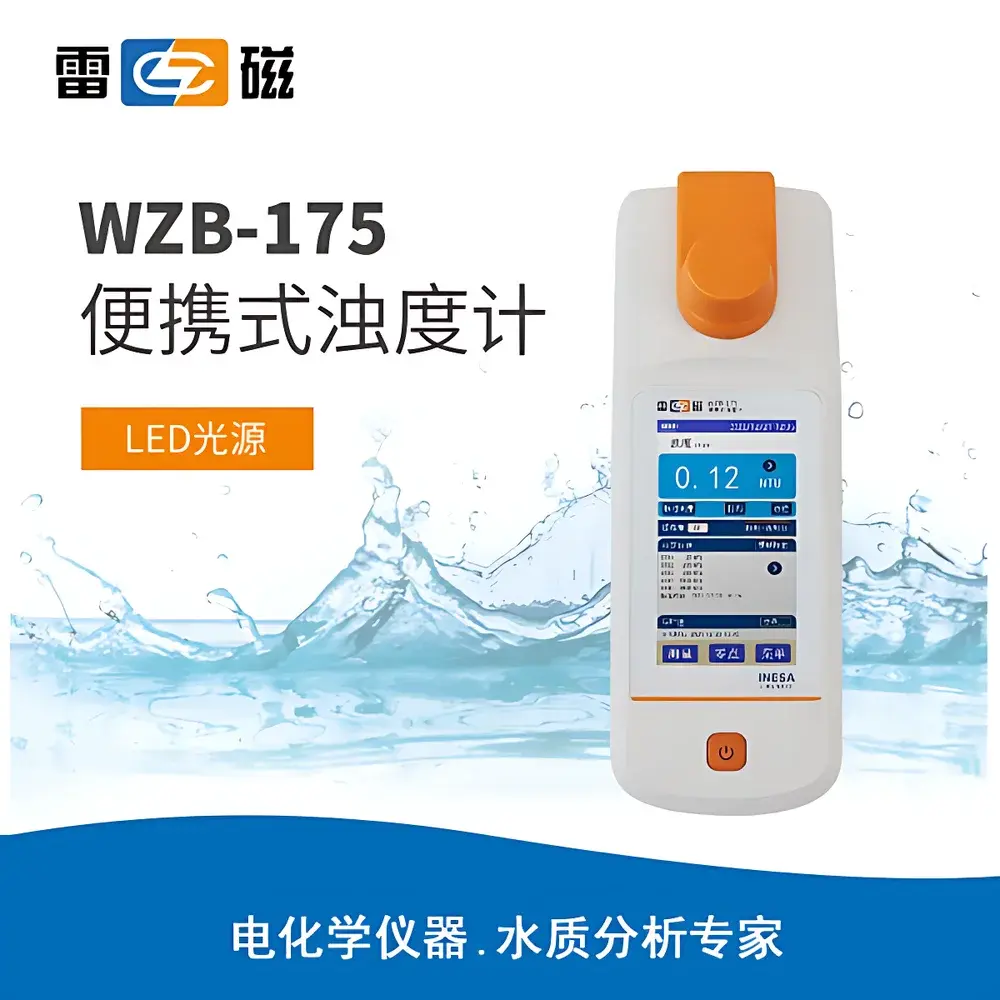
Leici WZB-175 Portable Turbidimeter
| Brand | Leici |
|---|---|
| Origin | Shanghai, China |
| Manufacturer Type | Direct Manufacturer |
| Regional Origin | Domestic (China) |
| Model | WZB-175 |
| Price Range | USD 700–1,400 |
| Product Type | Portable |
| Measurement Range | 0–2000 NTU (auto-ranging across four sub-ranges) |
| Resolution | 0.01 / 0.1 / 1 NTU (auto-selected by range) |
| Operating Temperature | 5–40 °C |
| Relative Humidity | ≤85% RH |
| Accuracy | ±6% of reading |
| Repeatability | ≤0.5% |
| Zero Drift | ±0.5% FS / 30 min |
| Stability | ±0.5% FS / 30 min |
| Calibration Points | Up to 6 points (2, 20, 200, 500, 1000, 2000 NTU) |
| Data Storage Capacity | 2000 measurements |
| Display | 4.3-inch color TFT LCD touchscreen |
| Protection Rating | IP65 |
| Interface | Micro-USB (PC communication), RS-232 (printer output) |
| Power Supply | Rechargeable Li-ion battery (with AC adapter: Input AC 100–240 V, Output DC 5 V / 2 A) |
| Dimensions & Weight | 90 × 250 × 90 mm, approx. 0.8 kg |
Overview
The Leici WZB-175 Portable Turbidimeter is an ISO 7027-compliant optical instrument engineered for field-deployable and laboratory-grade turbidity measurement in water quality monitoring applications. It employs a stable 860 nm infrared LED light source and implements dual-mode optical detection—nephelometric (90° scattered light) and combined scatter-transmission measurement—enabling accurate quantification of suspended particulate matter across diverse sample matrices. Designed in accordance with HJ 1075–2019 (Chinese Environmental Monitoring Standard for Turbidity) and aligned with international metrological conventions, the WZB-175 delivers traceable, reproducible results under variable ambient conditions. Its compact form factor, robust IP65-rated enclosure, and integrated lithium-ion power system make it suitable for routine use in wastewater treatment plants, drinking water distribution networks, environmental field surveys, and regulatory compliance testing where portability and measurement integrity are equally critical.
Key Features
- 4.3-inch high-resolution color TFT touchscreen interface with intuitive icon-based navigation and real-time graphical feedback
- Dual optical measurement modes: standardized 90° nephelometry and scatter-transmission hybrid method for enhanced accuracy in low- and high-turbidity samples
- Auto-ranging capability across four dynamic ranges: (0.00–9.99) NTU, (10.0–99.9) NTU, (100–999) NTU, and (1000–2000) NTU—with resolution automatically optimized per range (0.01/0.1/1 NTU)
- Comprehensive calibration support: zero-point adjustment and up to six-point calibration using certified formazin or polymer-based standards (2, 20, 200, 500, 1000, 2000 NTU)
- Multi-unit reporting: seamless switching between NTU (Nephelometric Turbidity Units), FNU (Formazin Nephelometric Units), and EBC (European Brewery Convention units) to meet regional regulatory requirements
- GLP-compliant data management: timestamped storage of 2000 measurements with operator ID tagging, audit-ready export via Micro-USB, and optional RS-232 printer integration
- Built-in battery health monitoring: real-time charge-level indicator, low-battery warning, and charging status feedback during PC or mobile power bank recharging
Sample Compatibility & Compliance
The WZB-175 accommodates standard 25 mm round glass cuvettes (included) and supports both clear and moderately colored aqueous samples typical of surface water, effluent, potable water, and process streams. Its 860 nm LED minimizes interference from natural chromophores (e.g., humic substances), improving fidelity in environmentally relevant matrices. The instrument conforms to ISO 7027:2016 for instrument performance and optical design, satisfies the technical requirements of HJ 1075–2019 for environmental monitoring applications in China, and meets general-purpose suitability criteria under ASTM D6508 and US EPA Method 180.1. While not FDA 21 CFR Part 11-certified out-of-the-box, its data logging architecture—including immutable timestamps, user-defined IDs, and full calibration history—supports validation pathways for GLP and GMP-aligned laboratories performing internal quality control or regulatory submissions.
Software & Data Management
Data acquisition and archival follow a structured, traceable workflow. Each stored measurement includes date/time stamp, measurement mode, selected unit, calibration status, and operator ID (if configured). Export is performed via Leici’s dedicated PC communication software (Windows-compatible), supporting CSV and Excel-formatted reports with embedded metadata. All calibration parameters—including zero offset, slope coefficients, and multi-point curve fit residuals—are retained in non-volatile memory and can be restored or reset to factory defaults without firmware intervention. The device maintains full audit trail integrity: no measurement record may be edited or deleted without explicit confirmation, and all deletions are logged with timestamp and user context. Firmware updates are delivered via signed binary packages through the same Micro-USB channel, ensuring version control and secure deployment.
Applications
- Field verification of turbidity compliance at drinking water intake and distribution points (e.g., WHO guideline value ≤ 1 NTU, US EPA MCL = 0.3 NTU for filtered systems)
- Routine monitoring of clarifier and filter effluent in municipal and industrial wastewater treatment facilities
- Environmental sampling campaigns assessing sediment resuspension, stormwater runoff impact, and lake/wetland trophic state indicators
- Pharmaceutical water system qualification (PW, WFI) where turbidity serves as a secondary particulate indicator per USP
- Educational laboratories requiring ISO-standardized instrumentation for analytical chemistry and environmental science curricula
FAQ
What optical principle does the WZB-175 use for turbidity measurement?
It operates on ISO 7027–defined nephelometry (90° scattered light detection) and offers a supplementary scatter-transmission mode to improve linearity in high-turbidity samples (>400 NTU).
Is the instrument suitable for measuring colored or highly absorbing samples?
Yes—the 860 nm infrared LED significantly reduces absorbance-related bias compared to visible-light sources, making it appropriate for moderately colored natural waters.
Can calibration curves be imported or exported via PC software?
No; calibration points are entered manually or via standard reference values. However, all calibration metadata—including date, standard values used, and calculated coefficients—is stored and exportable.
Does the device support password-protected user accounts?
No. User identification is text-based and configurable per session but lacks role-based access control or encrypted authentication.
What is the recommended recalibration frequency for routine use?
Leici recommends daily zero-point verification and multi-point calibration before first use each day when operating under GLP conditions; otherwise, calibration should occur whenever drift exceeds ±3% or after cleaning optics or changing cuvettes.




