
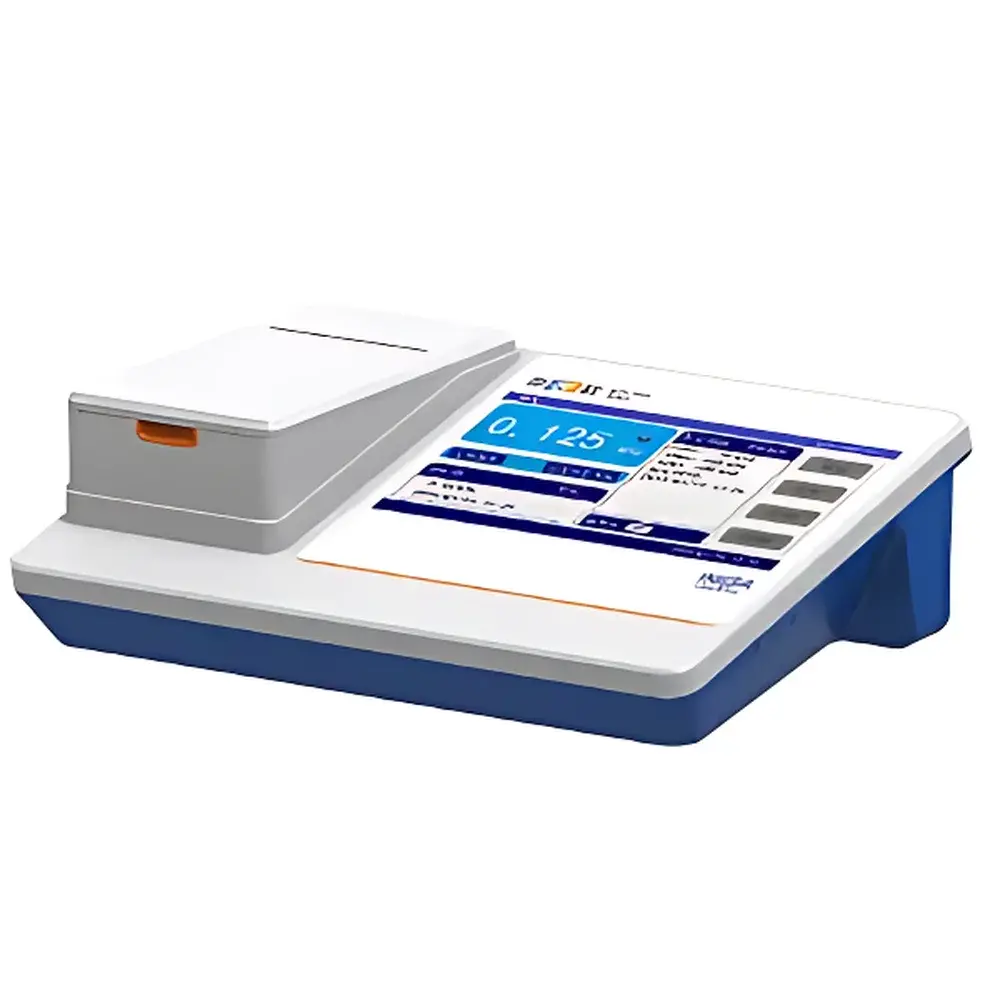
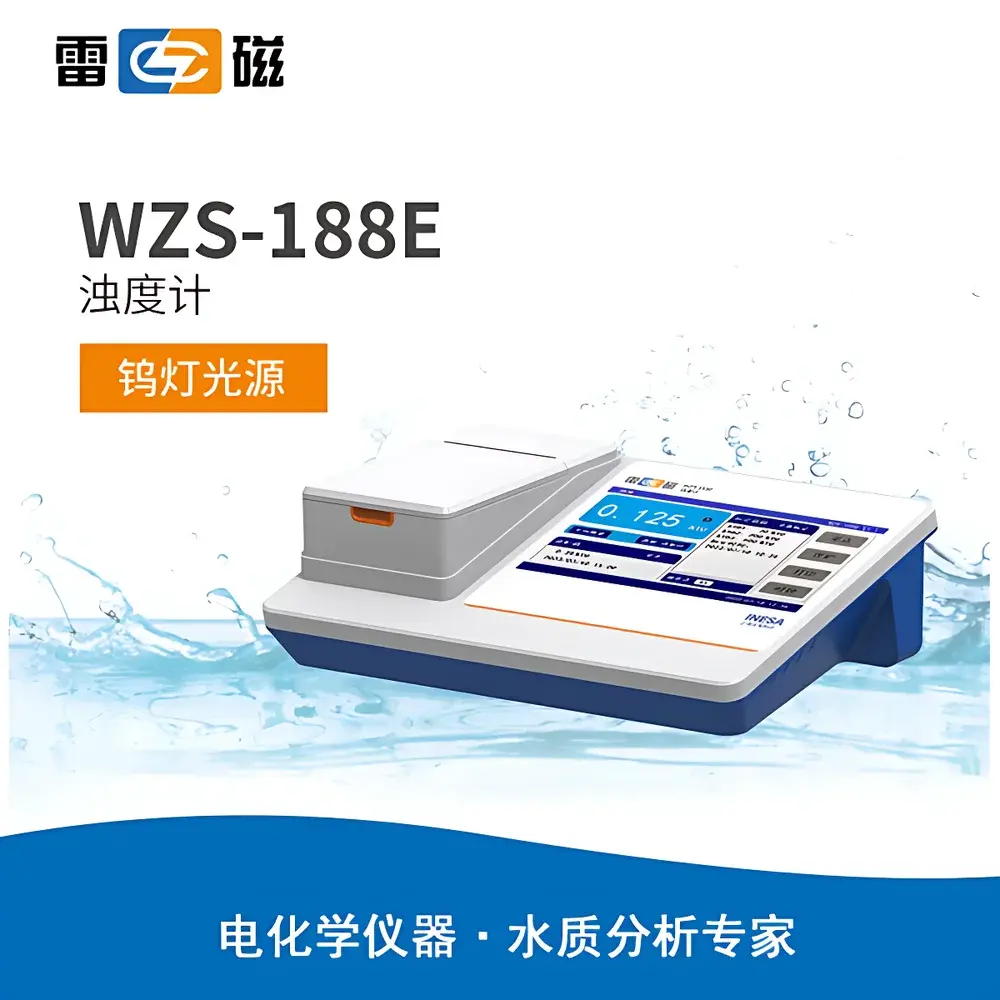
Leici WZS-188E Benchtop Turbidimeter
| Brand | Leici |
|---|---|
| Origin | Shanghai, China |
| Manufacturer Type | Direct Manufacturer |
| Regional Category | Domestic (China) |
| Model | WZS-188E |
| Form Factor | Benchtop / Laboratory |
| Measurement Range | (0.000–9.999) NTU, (10.00–99.99) NTU, (100.0–999.9) NTU, (1000–4000) NTU |
| Resolution | 0.001 / 0.01 / 0.1 / 1 NTU |
| Accuracy | ±6% |
| Light Source | Tungsten-Halogen Lamp |
| Compliance | US EPA Method 180.1, HJ 1075–2019 |
| Measurement Principle | Nephelometric (90° scatter) and Scatter-Transmission dual-mode |
| IP Rating | IP54 |
| Display | 7-inch HD color capacitive touchscreen |
| Calibration Options | Single-point or multi-point |
| Units | NTU, FNU, EBC |
| Modes | Standard measurement, averaging mode (for dynamic suspension stabilization), auto-ranging |
| Data Management | Onboard storage, recall, deletion, USB export, RS-232 printer output |
| Software Interface | PC communication via dedicated software (USB) |
| GLP Support | Full audit trail, timestamped records, user ID logging, calibration history retention |
Overview
The Leici WZS-188E Benchtop Turbidimeter is a precision optical instrument engineered for reliable, traceable turbidity quantification in environmental monitoring, drinking water treatment, wastewater analysis, and pharmaceutical quality control laboratories. It operates on the nephelometric principle—measuring light scattered at 90° from a collimated tungsten-halogen beam—as defined in US EPA Method 180.1 and China’s HJ 1075–2019 standard. In addition to conventional 90° scattering, the WZS-188E implements a dual-mode optical architecture that integrates scatter-transmission compensation, enabling robust performance across highly variable sample matrices—including colored, absorbing, or high-solids suspensions where traditional single-angle systems may exhibit deviation. Its four auto-ranging measurement spans (0.000–9.999 NTU up to 1000–4000 NTU) ensure optimal signal-to-noise ratio across low- and high-turbidity regimes without manual gain adjustment.
Key Features
- 7-inch high-resolution capacitive touchscreen interface with intuitive icon-driven navigation and real-time graphical display of measurement trends
- Tungsten-halogen light source delivering stable spectral output (400–600 nm) compliant with international turbidity standards for consistent photometric response
- Dual optical measurement modes: selectable nephelometric (90° scatter) for low-to-mid range clarity assessment, and scatter-transmission hybrid mode for improved linearity in turbid or spectrally interfering samples
- IP54-rated enclosure ensuring dust resistance and protection against water splashes—suitable for shared lab environments and field-deployable benchtop use
- Integrated auto-ranging circuitry with dynamic gain optimization across four decades of turbidity (0.000–4000 NTU), eliminating manual range selection errors
- Multi-unit support (NTU, FNU, EBC) with automatic unit conversion based on selected calibration standard and application context
- Zero-point correction and multi-point calibration capability using certified formazin or styrene divinylbenzene (SDVB) standards (20, 200, 500, 1000, 2000 NTU)
- Averaging mode algorithmically compensates for Brownian motion and particle settling effects, reducing short-term fluctuations in heterogeneous suspensions
Sample Compatibility & Compliance
The WZS-188E accepts standard 25-mm round glass cuvettes (included) and supports both clear and mildly colored aqueous samples within ISO 7027 and US EPA 180.1 acceptance criteria. Its optical design mitigates interference from sample absorbance through scatter-transmission normalization, extending valid measurement into the upper turbidity range where transmission-only instruments fail. The device meets HJ 1075–2019 requirements for environmental water testing in China and aligns with ASTM D6508 and ISO 7027–1:2016 for method equivalence. All calibration and measurement events are time-stamped and logged with operator ID, satisfying GLP documentation requirements for regulated laboratories. While not inherently 21 CFR Part 11 compliant, its data export architecture (USB + RS-232) enables integration into validated LIMS or ELN platforms supporting electronic signature and audit trail functions.
Software & Data Management
Onboard memory retains up to 2,000 measurement records with full metadata: date/time stamp, operator ID, calibration status, measurement mode, unit, and raw signal intensity. Data export is supported via USB mass-storage mode (CSV format) or real-time streaming through RS-232 to serial printers or legacy lab systems. Leici’s dedicated PC communication software provides bidirectional control—including remote calibration initiation, firmware update, and batch report generation—with optional CSV-to-Excel mapping templates. All stored calibration curves, zero offsets, and factory defaults are preserved during power loss, fulfilling basic data integrity requirements under ICH Q7 and ISO/IEC 17025 clause 7.7.
Applications
- Drinking water quality verification per national regulatory limits (e.g., ≤1 NTU per WHO guidelines)
- Effluent monitoring in municipal and industrial wastewater treatment plants
- Process control in membrane filtration, coagulation-flocculation, and sedimentation units
- Pharmaceutical water system validation (PW, WFI) per USP and EP 2.2.2
- Environmental surface water and groundwater turbidity profiling in compliance with EPA NPDES permits
- Educational laboratory instruction on optical scattering theory and water quality parameter interrelationships
FAQ
What turbidity standards are compatible with the WZS-188E?
The instrument supports formazin-based and SDVB-based primary standards; pre-filled calibration vials (20/200/500/1000/2000 NTU) are supplied as standard.
Does the WZS-188E support 21 CFR Part 11 compliance?
It does not include built-in electronic signatures or role-based access control, but exported data can be ingested into validated third-party systems meeting Part 11 requirements.
Can measurements be performed in FNU or EBC units without recalibration?
Yes—unit switching is purely computational and references the same underlying scatter signal; no physical recalibration is required.
How is drift compensated during extended measurement sessions?
The device performs periodic internal reference checks and supports scheduled zero-point verification; averaging mode further reduces stochastic noise over user-defined intervals (1–10 readings).
Is the tungsten-halogen lamp field-replaceable?
Yes—the lamp module is designed for user-level replacement with alignment-free installation and automatic intensity normalization upon power-up.




