
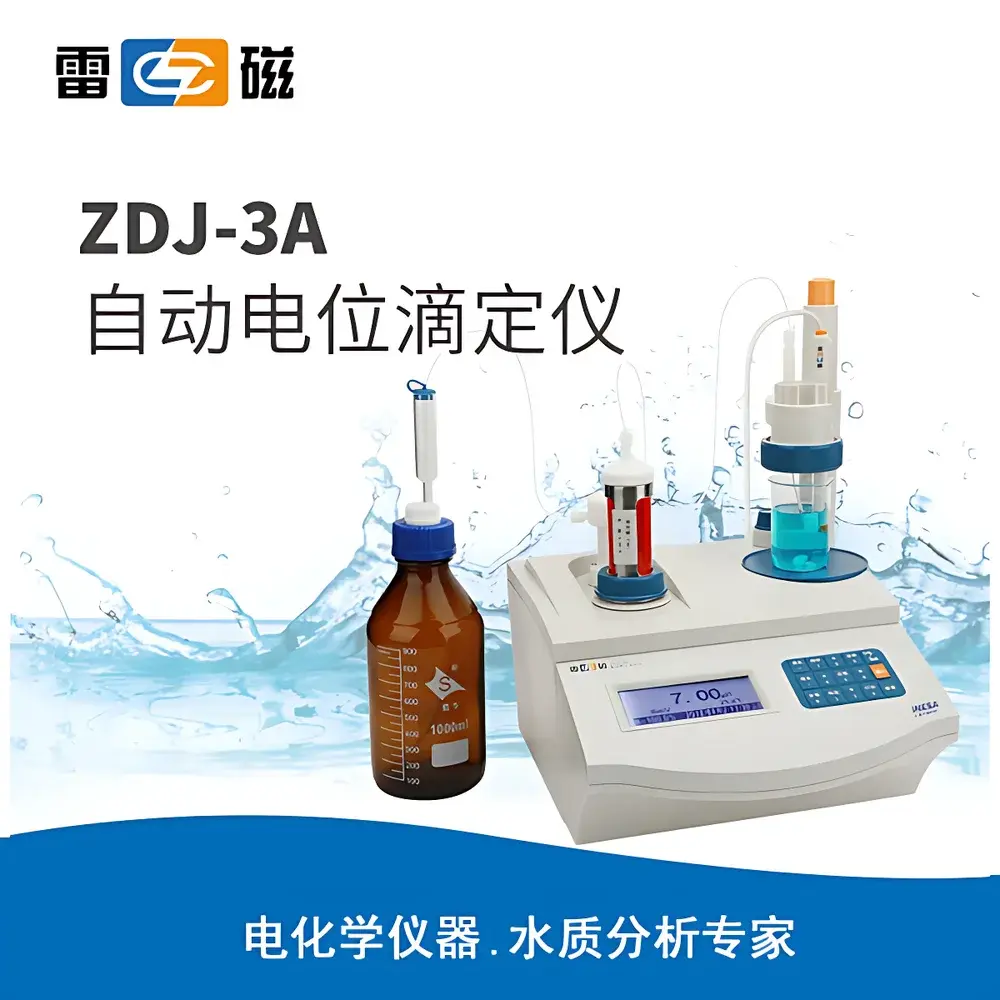
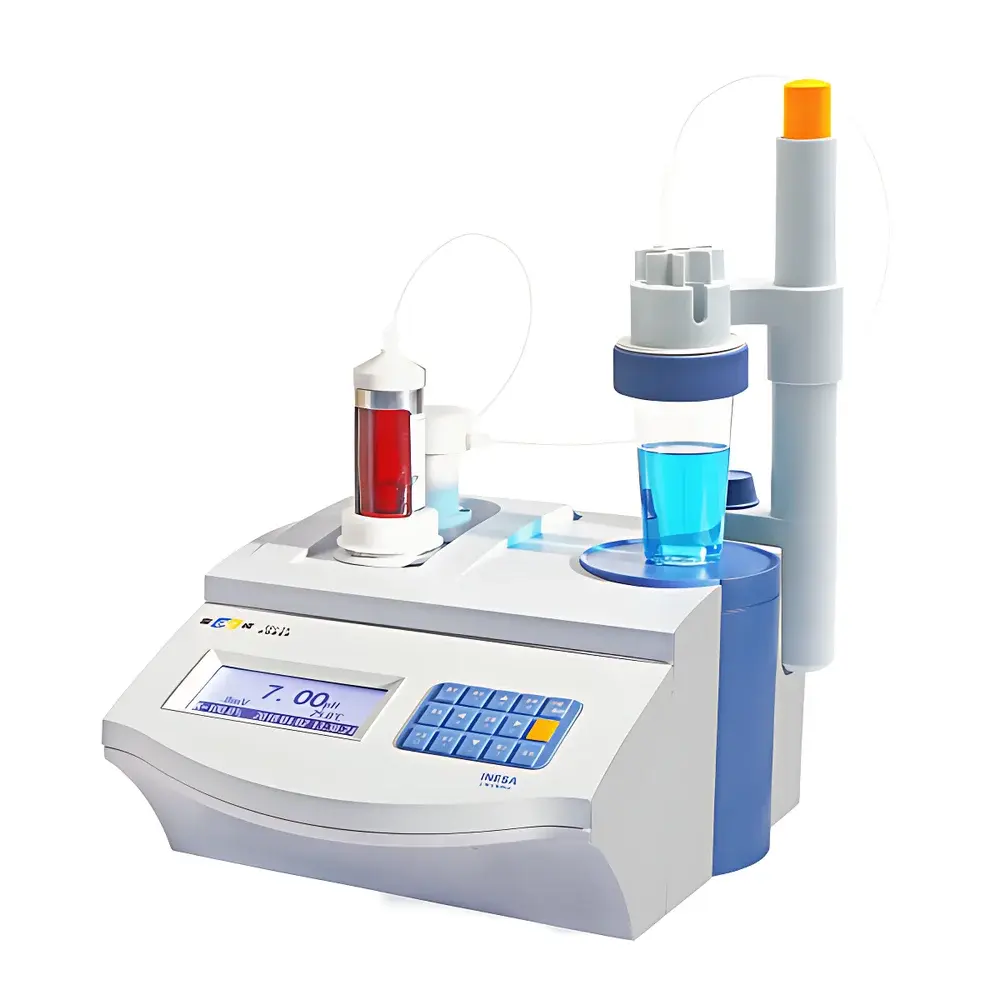
Leici ZDJ-3A Automatic Potentiometric Titrator
| Brand | Leici |
|---|---|
| Origin | Shanghai, China |
| Model | ZDJ-3A |
| Instrument Type | General-purpose Potentiometric Titrator |
| Measurement Range | (−1999 to +1999) mV, (0.00 to 14.00) pH |
| Meter Accuracy | ±0.3% of full scale |
| Meter Resolution | 1 mV, 0.01 pH |
| Titration Stability | ±1 mV / 3 h |
| Burette Resolution | 1/20000 (10 mL burette), 1/10000 (20 mL burette) |
| Burette Delivery Error | ±0.05 mL (10 mL), ±0.07 mL (20 mL) |
| Repeatability | 0.3% RSD |
| Power Supply | AC 220 V ±10%, 50 Hz |
| Dimensions (W×D×H) | 340 × 400 × 400 mm |
| Weight | 10 kg |
Overview
The Leici ZDJ-3A Automatic Potentiometric Titrator is a benchtop electrochemical analysis instrument engineered for precision and reproducibility in quantitative volumetric analysis. It operates on the principle of potentiometric endpoint detection—measuring the potential difference between a reference electrode and an indicator electrode as titrant is incrementally delivered. The system identifies inflection points in the E–V (potential vs. volume) curve to determine stoichiometric endpoints with high fidelity. Designed for routine laboratory environments—including quality control labs, academic teaching facilities, and industrial R&D centers—the ZDJ-3A delivers robust performance across acid-base, redox, precipitation, complexometric, and non-aqueous titrations. Its dual-mode operation (preset endpoint and manual titration) ensures flexibility without compromising method traceability or measurement integrity.
Key Features
- Dot-matrix LCD display with intuitive keypad interface, providing real-time visualization of titration curves, method parameters, current electrode potential, pH values, and cumulative titrant volume.
- Dual titration modes: preset endpoint titration (for standardized methods) and manual titration (for exploratory or method development work).
- Integrated pH measurement capability compliant with IUPAC pH scale conventions; supports calibration using standard buffer solutions (e.g., pH 4.01, 7.00, 10.01 at 25 °C).
- GLP-compliant data handling: stores up to 20 complete titration records, each including operator ID, date/time stamp, electrode serial number, calibration history, raw potential readings, and final result with uncertainty estimation.
- Built-in power-failure protection: automatically saves active method parameters and partial titration data during unexpected AC interruption.
- Bidirectional RS-232 serial interface supporting direct connection to external printers (ESC/P or PCL-compatible) for hardcopy generation of reports meeting internal audit requirements.
- Multi-language UI support (English and Simplified Chinese) facilitates deployment in multinational laboratories and educational institutions with bilingual staff.
Sample Compatibility & Compliance
The ZDJ-3A accommodates aqueous and non-aqueous samples compatible with standard glass pH electrodes, platinum redox electrodes, silver/silver chloride reference electrodes, and ion-selective electrodes (ISEs) with appropriate adapters. It meets essential functional requirements outlined in ISO 8655-3 (burette accuracy), ASTM E2087 (electrochemical titration practice), and USP (pH and potentiometric measurements). While not certified to IEC 61010-1 for safety or FDA 21 CFR Part 11 for electronic records, its data structure and audit trail design align with GLP and basic GMP documentation expectations. All stored results include immutable metadata required for internal validation protocols.
Software & Data Management
Data management is handled entirely through embedded firmware—no external PC software is required for operation or reporting. Each stored record contains timestamped electrode potential readings sampled at ≥2 Hz during titration, interpolated first-derivative (dE/dV) and second-derivative (d²E/dV²) values for endpoint confirmation, and calculated titrant concentration based on user-input standardization data. Exported printouts include header fields for lab name, analyst signature line, instrument ID, and environmental conditions (ambient temperature noted manually). Memory retention remains intact for ≥10 years under normal storage conditions, and data deletion requires authenticated password entry to prevent accidental erasure.
Applications
- Acid-base titrations: determination of total acidity in food extracts, alkalinity in wastewater, or amine content in pharmaceutical intermediates.
- Oxidation-reduction titrations: quantification of iron(II) in ore leachates, ascorbic acid in fortified beverages, or hydrogen peroxide in disinfectant formulations.
- Precipitation titrations: chloride assay in saline solutions or bromide in photographic emulsions using AgNO₃ titrant.
- Complexometric titrations: calcium and magnesium hardness testing in drinking water per APHA Standard Methods 3111B.
- Non-aqueous titrations: assay of weak bases (e.g., organic amines) in glacial acetic acid medium using perchloric acid titrant.
FAQ
What electrode types are supported?
Standard single-junction pH electrodes, double-junction reference electrodes, Pt wire redox electrodes, Ag/AgCl electrodes, and select ISEs (e.g., fluoride, nitrate) with BNC or DIN connectors.
Is method validation documentation provided?
Yes—factory calibration certificates for meter electronics and burette delivery accuracy are supplied; users must perform periodic verification per ISO/IEC 17025 Annex A.3 guidelines.
Can the instrument be integrated into a LIMS environment?
Not natively; however, printed reports may be scanned and archived, and manual transcription of CSV-formatted output is feasible via RS-232 terminal emulation.
What maintenance intervals are recommended?
Electrode cleaning after each sample series; burette piston lubrication every 6 months; annual verification of mV linearity using certified Zener cell standards.
Does it support dynamic titration mode with variable addition rates?
No—addition is fixed-step (programmable volume increments) with constant speed delivery; no adaptive rate control based on dE/dV magnitude.





