
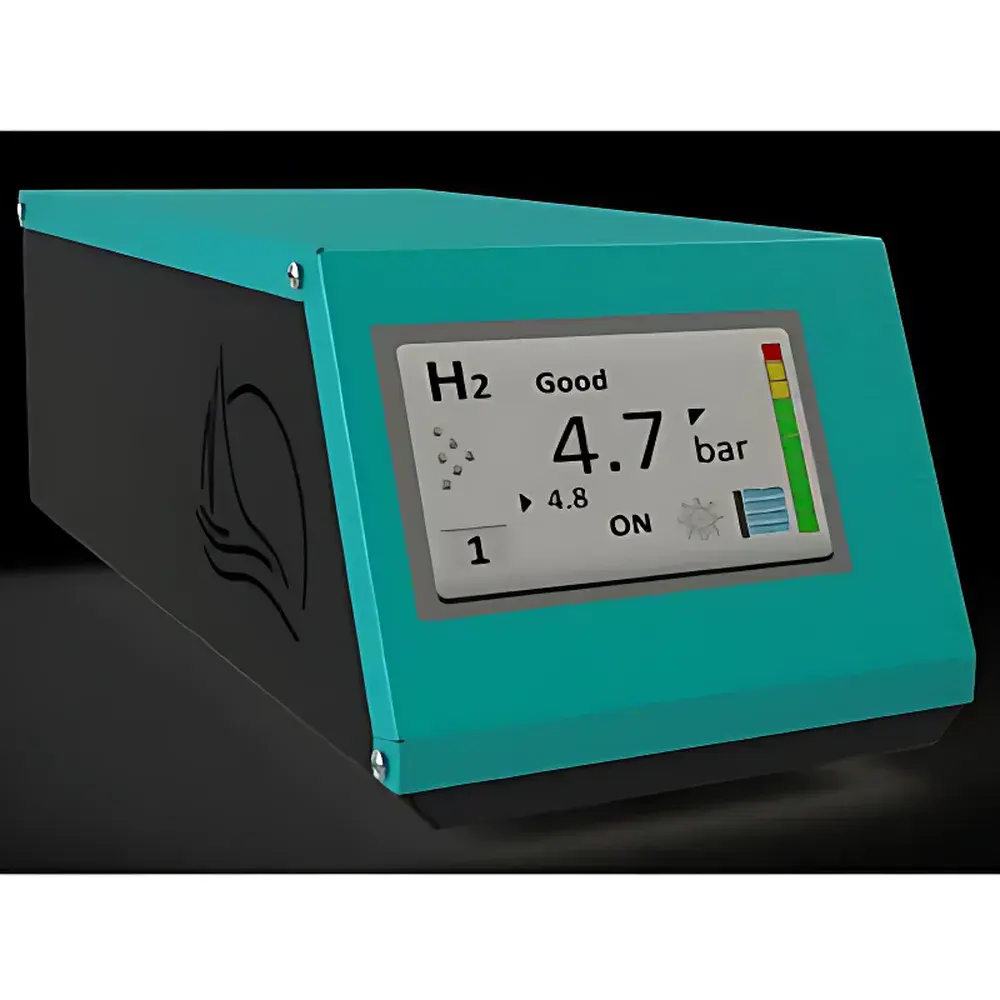
Leman Instruments LISAS H2 Hydrogen Generator
| Brand | Leman Instruments |
|---|---|
| Origin | France |
| Model | LISAS H2 |
| Hydrogen Generation Principle | Proton Exchange Membrane (PEM) Electrolysis |
| Output Flow Rate | 250 mL/min or 500 mL/min (Nml/min at 101.3 kPa / 20 °C) |
| Output Pressure | Adjustable from 0.5 to 10 bar (7–140 psig) |
| Hydrogen Purity | ≥99.999% (Total Hydrocarbon ≤0.1 ppm, Dew Point ≤−40 °C) |
| Power Consumption | 150 W (LISAS H2-250), 300 W (LISAS H2-500) |
| Water Source | 5 L external deionized water reservoir (TOC-free, resistivity ≥18.2 MΩ·cm) |
| Safety Features | Internal leak detection, pressure relief valve, over-temperature cutoff, current/voltage limiting, auto-shutdown |
| Communication | Ethernet 10/100, Wi-Fi 802.11 b/g/n |
| Display | 4.3″ TFT-LCD touchscreen |
| Noise Level | <50 dB(A) at 1 m |
| Dimensions (W×H×D) | 210 × 160 × 430 mm |
| Weight | 9 kg (H2-250), 14 kg (H2-500) |
| Certifications | CE |
Overview
The Leman Instruments LISAS H₂ Hydrogen Generator is a compact, laboratory-grade on-demand hydrogen source engineered for analytical instrumentation requiring ultra-high-purity hydrogen gas. Utilizing proven proton exchange membrane (PEM) electrolysis technology, it generates hydrogen directly from high-purity deionized water—eliminating the need for compressed gas cylinders, hazardous chemical reagents, or external gas supply infrastructure. The system operates under low-pressure electrochemical conditions, producing hydrogen at up to 10 bar output pressure with continuous purity ≥99.999% (hydrocarbon content ≤0.1 ppm, dew point ≤−40 °C). Designed for integration into modern analytical workflows—including GC-FID, GC-MS, LC-MS, and hydrogenation reactors—the LISAS H₂ delivers stable, traceable, and contamination-free hydrogen on demand, meeting stringent requirements for method reproducibility and regulatory compliance.
Key Features
- PEM-based electrolysis: Solid polymer electrolyte cell ensures rapid start-up, zero chemical handling, and no caustic electrolytes.
- Dual-flow configuration: Selectable models delivering 250 mL/min (LISAS H₂-250) or 500 mL/min (LISAS H₂-500) at standard temperature and pressure (101.3 kPa / 20 °C).
- Precision electronic pressure regulation: Fully software-controlled output pressure range from 0.5 to 10 bar (7–140 psig), optimized for carrier gas, fuel gas, or purge applications.
- Integrated 5 L external water reservoir: Compatible with TOC-free, high-resistivity (>18.2 MΩ·cm) deionized water; supports >6,000 L of hydrogen generation per fill.
- Real-time monitoring & diagnostics: 4.3″ color TFT-LCD touchscreen displays operating status, flow rate, pressure, water level, temperature, and active alarms.
- Networked remote operation: Dual communication interfaces—Ethernet 10/100 and IEEE 802.11 b/g/n Wi-Fi—enable centralized control, logging, and firmware updates across multi-instrument lab networks.
- Comprehensive safety architecture: Includes internal leak test cycle, redundant pressure relief valves, over-temperature shutdown, current/voltage limiting, and automatic fault isolation.
- Low acoustic footprint: <50 dB(A) at 1 m distance—suitable for open-bench deployment in shared laboratory environments.
- Stackable mechanical design: Compact footprint (210 × 160 × 430 mm) allows vertical stacking with other LISAS-series gas generators (N₂, O₂, Zero Air) to minimize floor space and simplify utility routing.
Sample Compatibility & Compliance
The LISAS H₂ is validated for use with major analytical platforms including Agilent, Thermo Fisher Scientific, and Bruker GC and GC-MS systems—particularly as FID fuel gas, carrier gas (for capillary columns), and purge gas in headspace analysis. Its consistent 99.999% purity meets ASTM D7622 (Standard Test Method for Determination of Total Hydrocarbons in High-Purity Hydrogen), ISO 8573-1 Class 1 for particulates and oil, and USP specifications for pharmaceutical-grade process gases. All operational parameters—including pressure setpoints, runtime logs, alarm events, and maintenance cycles—are timestamped and stored locally with optional export to LIMS or ELN systems. The embedded firmware supports audit-trail functionality aligned with FDA 21 CFR Part 11 requirements when deployed in GLP/GMP-regulated environments.
Software & Data Management
Leman’s proprietary LISAS Control Suite provides intuitive local and remote management via web browser or dedicated desktop client. Configuration, calibration, and diagnostic routines are accessible through role-based menus—no command-line interaction required. System logs record all critical events (e.g., water refill, pressure deviation, leak test result) with ISO 8601 timestamps and user attribution. Data export supports CSV and XML formats compatible with laboratory informatics systems. Firmware updates are delivered over secure HTTPS channels and verified via digital signature prior to installation. Optional SNMP integration enables proactive monitoring within enterprise IT infrastructure, supporting predictive maintenance alerts and uptime reporting.
Applications
- Fuel gas for Flame Ionization Detectors (FID) in gas chromatography—ensuring baseline stability and enhanced sensitivity.
- Carrier gas for capillary GC columns where helium shortage or cost volatility necessitates hydrogen substitution (subject to column compatibility verification).
- Purge and trap systems requiring inert, hydrocarbon-free hydrogen for volatile organic compound (VOC) analysis.
- Hydrogenation reaction support in synthetic chemistry labs—providing on-site, metered gas delivery without cylinder logistics.
- Calibration gas blending systems requiring certified hydrogen as a primary component.
- Reference gas supply for FTIR, Raman, or laser-based sensors requiring stable, low-moisture hydrogen backgrounds.
FAQ
What water quality is required for optimal operation?
Deionized water with resistivity ≥18.2 MΩ·cm and total organic carbon (TOC) <5 ppb is mandatory. Use of non-compliant water voids warranty and may cause PEM membrane degradation.
Can the LISAS H₂ operate unattended overnight?
Yes—fully autonomous operation is supported with integrated leak testing, water-level monitoring, and thermal safeguards. Continuous 24/7 duty cycle is rated per IEC 61000-3-2.
Is the hydrogen output pressure adjustable during operation?
Yes—pressure is dynamically controlled via embedded PID algorithm and can be modified in real time using the touchscreen interface or remote software without interrupting gas delivery.
Does the system comply with electrical safety standards for laboratory use?
All LISAS H₂ units are CE-marked per EN 61010-1:2019 (Safety Requirements for Electrical Equipment for Measurement, Control, and Laboratory Use) and meet EMC requirements per EN 61326-1.
How often does the PEM stack require replacement?
Under typical laboratory usage (≤8 h/day), the PEM electrolyzer is rated for ≥20,000 operating hours. Leman provides lifetime stack health monitoring via voltage decay trending and automated performance diagnostics.



