
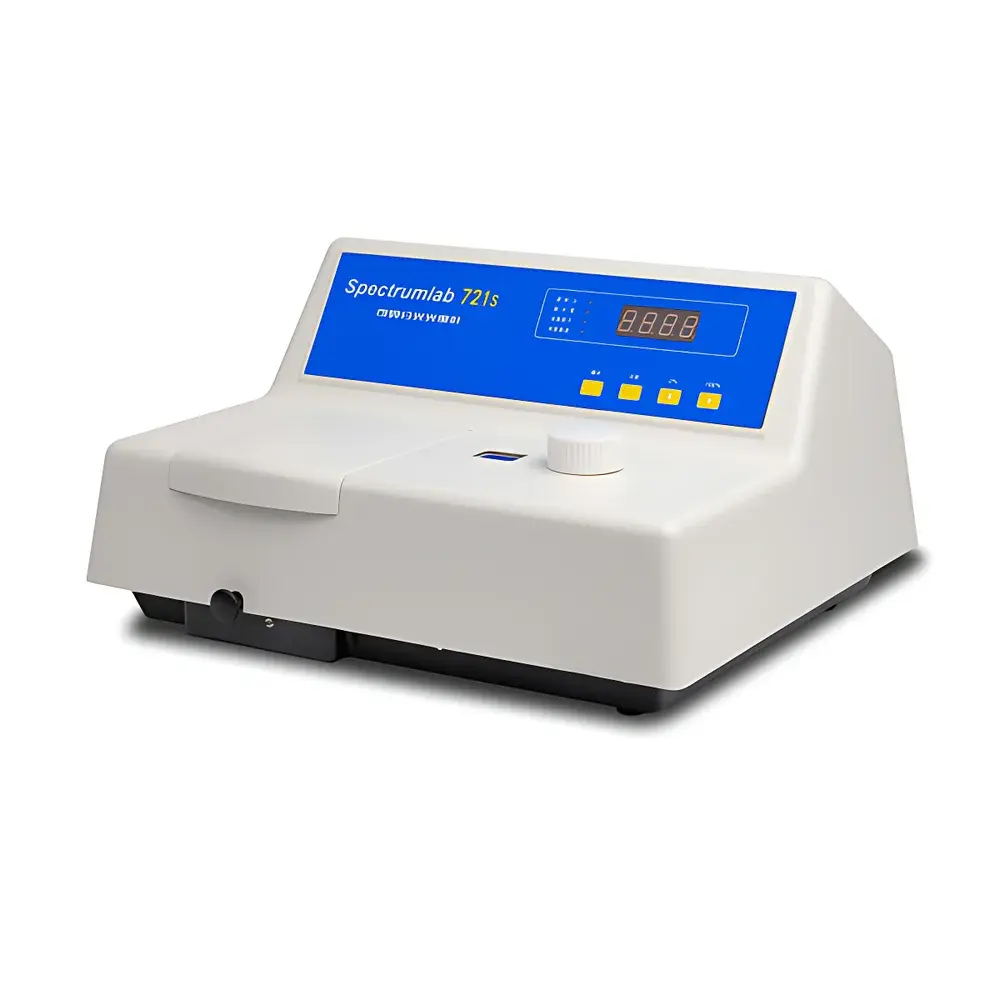
Lengguang Tech. 721S Visible Spectrophotometer
| Brand | Lengguang Tech. |
|---|---|
| Origin | Shanghai, China |
| Manufacturer Type | Original Equipment Manufacturer (OEM) |
| Product Origin | Domestic (China) |
| Model | 721S |
| Optical System | Single-beam Czerny-Turner monochromator with sealed grating |
| Detector | Silicon photocell |
| Wavelength Range | 360–1000 nm |
| Wavelength Selection | Manual dial adjustment |
| Spectral Bandwidth | 6 nm |
| Wavelength Accuracy | ±3.0 nm |
| Wavelength Repeatability | ≤1.5 nm |
| Stray Light | ≤1.0% T |
| Photometric Accuracy | ±0.8% T |
| Photometric Repeatability | ≤0.3% T |
| Photometric Range | 0.0–199.9% T / –0.3–2.999 A |
| Power Supply | 100–240 V AC, 50/60 Hz |
| Dimensions (W×D×H) | 370 × 320 × 240 mm |
| Net Weight | 4.0 kg |
Overview
The Lengguang Tech. 721S Visible Spectrophotometer is a manually operated, single-beam optical instrument engineered for routine quantitative and qualitative analysis in the visible spectrum. Based on classical Czerny-Turner (C-T) monochromator architecture, it employs a high-stability sealed diffraction grating to isolate discrete wavelengths from broadband halogen lamp illumination (10 W / 8 V). Its fixed 6 nm spectral bandwidth ensures consistent resolution across the 360–1000 nm operational range—optimized for applications where moderate spectral selectivity suffices, such as concentration determination of colored analytes, kinetic monitoring of colorimetric assays, and basic spectral scanning in teaching laboratories and QC environments. The instrument operates without microprocessor control; wavelength selection is performed via precision mechanical dial, supported by an integrated cutoff filter system that automatically engages appropriate interference filters during manual tuning—enhancing photometric stability and reducing stray light contribution at spectral extremes.
Key Features
- Robust C-T monochromator with sealed, high-efficiency diffraction grating—minimizes environmental degradation and maintains long-term wavelength fidelity.
- Automated cutoff filter switching synchronized with wavelength dial position—reduces second-order diffraction artifacts and improves signal-to-noise ratio above 600 nm.
- Aluminum die-cast chassis and structural components—provides dimensional stability, thermal inertia, and mechanical durability under repeated handling and transport.
- Universal AC power input (100–240 V, 50/60 Hz)—enables seamless deployment across international laboratory infrastructures without external voltage conversion.
- High-stability silicon photocell detector—offers low drift, linear response over 0.0–199.9% transmittance and –0.3–2.999 absorbance ranges, with photometric repeatability ≤0.3% T.
- Stray light performance ≤1.0% T at 360 nm—meets minimum requirements for routine visible-range analyses per ISO 6223 and ASTM E275 standards.
Sample Compatibility & Compliance
The 721S accommodates standard 10 mm pathlength cuvettes (glass or plastic), supporting both transmission and blank-reference measurements. It complies with fundamental design and performance criteria outlined in ISO 6223:2021 (Spectrophotometers — Vocabulary and general requirements) and aligns with the photometric accuracy and wavelength tolerance benchmarks specified in ASTM E275-22 (Standard Practices for Description and Measurement of Performance of Ultraviolet, Visible, and Near Infrared Spectrophotometers). While not equipped with electronic audit trails or user access controls, its mechanical architecture supports GLP-aligned documentation workflows when paired with standardized SOPs and manual logbook entries. No regulatory certification (e.g., FDA 21 CFR Part 11) is claimed, as the device lacks digital data capture or software-controlled operation.
Software & Data Management
The 721S operates entirely without embedded firmware or proprietary software. All measurement functions—including zeroing, blanking, and absorbance/transmittance readout—are executed via front-panel analog controls and a calibrated analog meter display. Data recording is manual: users transcribe values into lab notebooks or external spreadsheets. This architecture eliminates cybersecurity risks associated with networked instruments and ensures full traceability through handwritten annotations, timestamps, and signature verification—consistent with paper-based GLP compliance frameworks. No drivers, USB interfaces, or PC connectivity options are provided or supported.
Applications
- Routine quantification of transition metal complexes (e.g., Fe²⁺/Fe³⁺ with 1,10-phenanthroline, Cu²⁺ with bicinchoninic acid) in environmental and industrial water testing.
- Enzyme activity assays based on NADH/NADPH absorbance at 340 nm (within extended lower limit tolerance).
- Educational demonstrations of Beer–Lambert law, spectral scanning principles, and calibration curve construction in undergraduate chemistry laboratories.
- QC release testing of dyes, pigments, and pharmaceutical excipients where visual color grading is insufficient but full UV-Vis capability is unnecessary.
- Monitoring of oxidation-reduction reactions exhibiting distinct visible-band shifts (e.g., dichromate → chromium(III) at 600 nm).
FAQ
Is the 721S suitable for UV-range measurements below 360 nm?
No. The optical train, detector sensitivity, and lamp output are optimized for the visible region only. Measurements below 360 nm are not supported due to insufficient intensity and detector quantum efficiency.
Does the instrument support automatic wavelength scanning?
No. Wavelength selection is strictly manual via calibrated dial; no motorized drive or scan function is integrated.
Can the 721S be connected to a computer for data export?
No. It features no digital interface, analog output port, or data logging capability. All readings must be recorded manually.
What cuvette materials are compatible?
Standard 10 mm square glass or optical-grade polystyrene cuvettes are recommended. Quartz cuvettes are unnecessary and offer no performance benefit within the 360–1000 nm range.
Is service and calibration support available outside mainland China?
Lengguang Tech. provides technical documentation and calibration procedures compliant with ISO/IEC 17025 guidelines. Local authorized distributors may offer third-party calibration services; contact regional partners for availability.






