
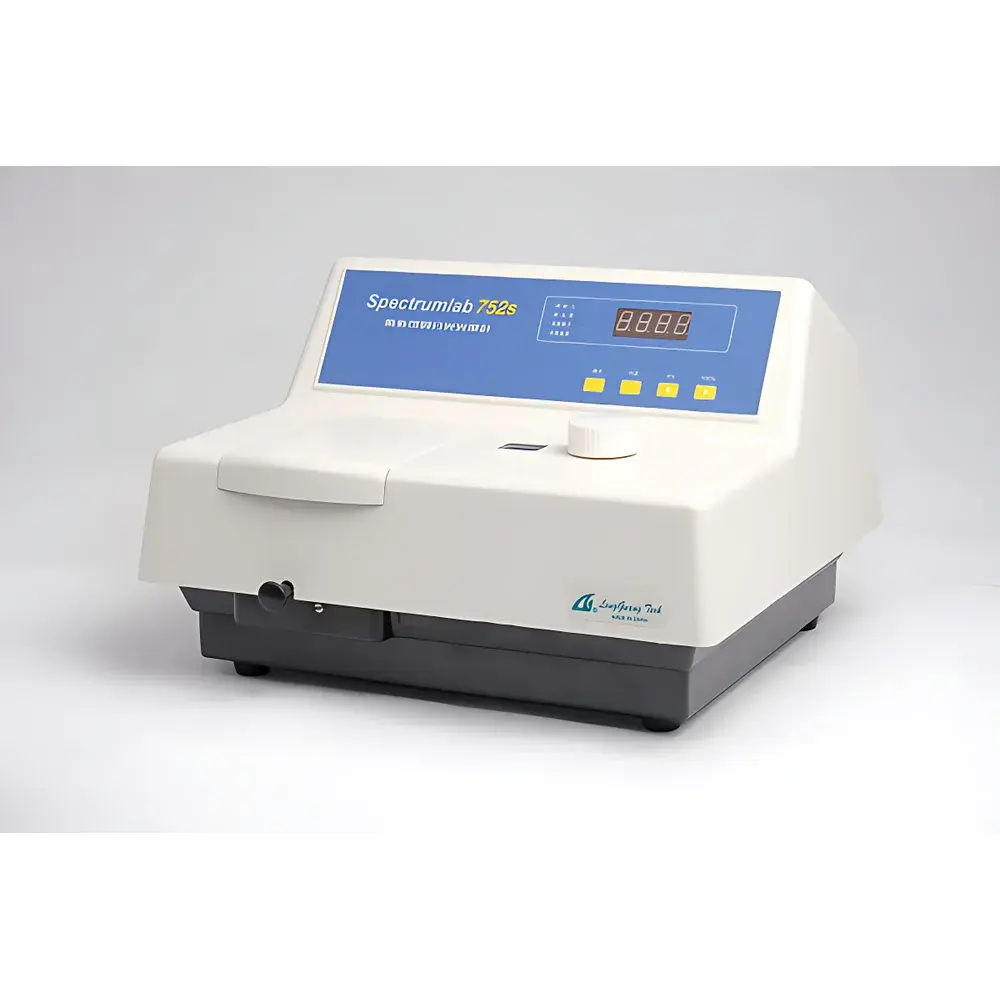
Lengguang Tech. 752S Ultraviolet-Visible Spectrophotometer
| Brand | Lengguang Tech. |
|---|---|
| Origin | Shanghai, China |
| Manufacturer Type | Original Equipment Manufacturer (OEM) |
| Instrument Architecture | Single-Beam |
| Detector Type | Photocell |
| Wavelength Range | 190–1100 nm |
| Wavelength Adjustment | Manual |
| Spectral Bandwidth | 2 nm |
| Wavelength Accuracy | ±2 nm |
| Wavelength Repeatability | ≤0.5 nm |
| Stray Light | ≤0.1% T |
| Photometric Accuracy | ±0.3% T |
| Photometric Repeatability | ≤0.1% T |
| Noise Level | ≤0.2% T (0% line), ≤0.5% T (100% line) |
| Absorbance Range | –0.3 to 2.999 A |
| Transmittance Range | 0.0 to 199.9% T |
| Dimensions | 370 × 320 × 240 mm |
| Net Weight | 7.5 kg |
| Light Source | Imported Japanese deuterium lamp (≥2000 h lifetime) + tungsten halogen lamp |
| Optical System | Czerny–Turner monochromator with precision holographic grating and aspheric mirrors |
| Interface | RS232 serial port (optional data acquisition software) |
Overview
The Lengguang Tech. 752S Ultraviolet-Visible Spectrophotometer is a single-beam, manually operated UV-Vis spectrophotometer engineered for routine qualitative and quantitative analysis in resource-constrained or education-focused laboratory environments. It operates on the principle of Beer–Lambert law-based absorbance measurement, utilizing a Czerny–Turner (C-T) monochromator architecture with a high-efficiency holographic diffraction grating and precision aspheric optical elements to deliver consistent spectral resolution across its full 190–1100 nm wavelength range. The instrument integrates a dual-light-source configuration: a stabilized Japanese-origin deuterium lamp for the ultraviolet region (190–350 nm) and a tungsten-halogen lamp for the visible and near-infrared regions (350–1100 nm). This combination ensures stable radiant output and extended operational lifetime (≥2000 hours for the D₂ lamp), minimizing downtime associated with frequent source replacement. Its 2 nm spectral bandwidth provides sufficient resolution for standard applications such as concentration determination, purity assessment, and kinetic monitoring—without the complexity or cost of variable-slit or double-beam architectures.
Key Features
- Robust mechanical construction: Die-cast aluminum chassis enhances structural rigidity, thermal stability, and long-term alignment retention under routine benchtop use.
- Optimized optical train: Precision C-T monochromator with holographic grating and aspheric collimating/focusing mirrors delivers high throughput and low aberration across the UV-Vis-NIR spectrum.
- Imported critical components: Deuterium lamp and photodetector sourced from Hamamatsu Photonics (Japan), ensuring low noise, high signal-to-noise ratio, and inter-unit performance consistency.
- Pre-calibrated light sources and built-in spectral energy correction facilitate straightforward lamp replacement and field-level recalibration without requiring external standards or service engineers.
- Low stray light design (≤0.1% T at 220 nm and 340 nm) supports reliable measurement of highly absorbing samples and improves accuracy in low-transmittance regions critical for nucleic acid and protein quantification.
- RS232 interface enables integration with third-party data acquisition systems or optional Lengguang-provided software for spectral scanning, kinetics, multi-wavelength analysis, and report generation compliant with basic GLP documentation requirements.
Sample Compatibility & Compliance
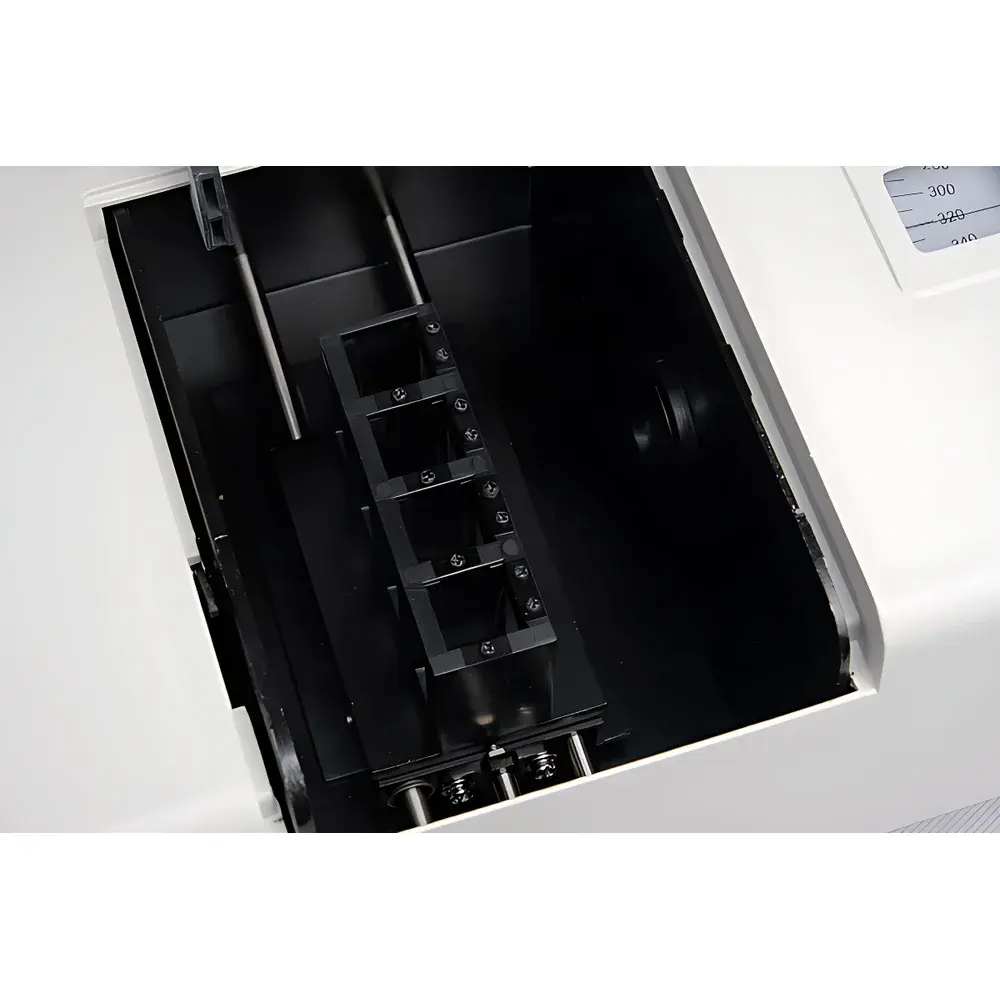
The 752S accommodates standard 10 mm pathlength quartz or glass cuvettes (including matched pairs for reference/blank compensation), and supports both transmission and absorbance modes. It is routinely deployed in clinical chemistry labs for serum bilirubin and creatinine assays, environmental labs for COD and nitrate analysis per EPA Method 353.2 analogs, and QC laboratories performing raw material verification against internal specifications. While not certified to ISO/IEC 17025 or FDA 21 CFR Part 11 out-of-the-box, its photometric repeatability (≤0.1% T) and wavelength accuracy (±2 nm) align with ASTM E275 and ISO 6223 performance benchmarks for Class B general-purpose spectrophotometers. Users implementing instrument qualification protocols may document system suitability using NIST-traceable neutral density filters and holmium oxide reference standards.
Software & Data Management
The optional RS232-compatible software package provides real-time data streaming, time-scan and wavelength-scan functions, peak detection, and arithmetic operations (e.g., A₁ – A₂, %T conversion). Export formats include CSV and TXT for downstream processing in Excel, MATLAB, or LIMS platforms. Audit trail functionality is limited to manual operator logging; however, the software supports user-defined method templates and sample ID tagging—enabling traceability within non-regulated or internally audited workflows. No cloud connectivity or electronic signature features are included, consistent with its design intent for standalone, low-infrastructure deployment.
Applications
- Clinical diagnostics: Hemoglobin derivative analysis, enzyme activity assays (e.g., ALT, AST), and therapeutic drug monitoring via fixed-wavelength endpoint measurements.
- Biochemistry: DNA/RNA quantification at 260 nm, protein concentration estimation (Bradford/Lowry) at 595/750 nm, and Bradford dye-binding kinetics.
- Environmental testing: Detection of heavy metals (via complexometric colorimetry), phosphate, ammonia, and organic pollutants using APHA-standardized colorimetric methods.
- Pharmaceutical QA: Excipient identification, dissolution profile verification, and assay validation per USP <857> guidelines for non-GMP release testing.
- Academic teaching: Fundamental spectroscopy experiments including absorption spectra of transition metal complexes, conjugated dyes, and semiconductor nanoparticles.
FAQ
Is the 752S compliant with FDA 21 CFR Part 11?
No—the instrument and its optional software do not support electronic signatures, audit trails, or role-based access control required for Part 11 compliance. It is intended for use in non-GxP or internally governed environments.
Can I use quartz cuvettes below 200 nm?
Yes—standard fused silica cuvettes are compatible down to 190 nm. Avoid standard glass or plastic cuvettes in the UV region due to strong absorption.
What maintenance is required beyond lamp replacement?
Routine cleaning of the sample compartment and optical windows with lint-free tissue and spectroscopic-grade methanol is recommended quarterly. No internal optical alignment is user-serviceable.
Does the 752S support automatic wavelength scanning?
No—it is a manually tuned instrument. Wavelength selection is performed via mechanical dial; spectral scans require stepwise manual adjustment and point-by-point data recording.
Is NIST-traceable calibration available?
Lengguang Tech. offers factory calibration using NIST-traceable holmium oxide and didymium filters. End-users may perform verification using independently procured standards, but full recalibration requires return-to-factory service.
Related Products





