
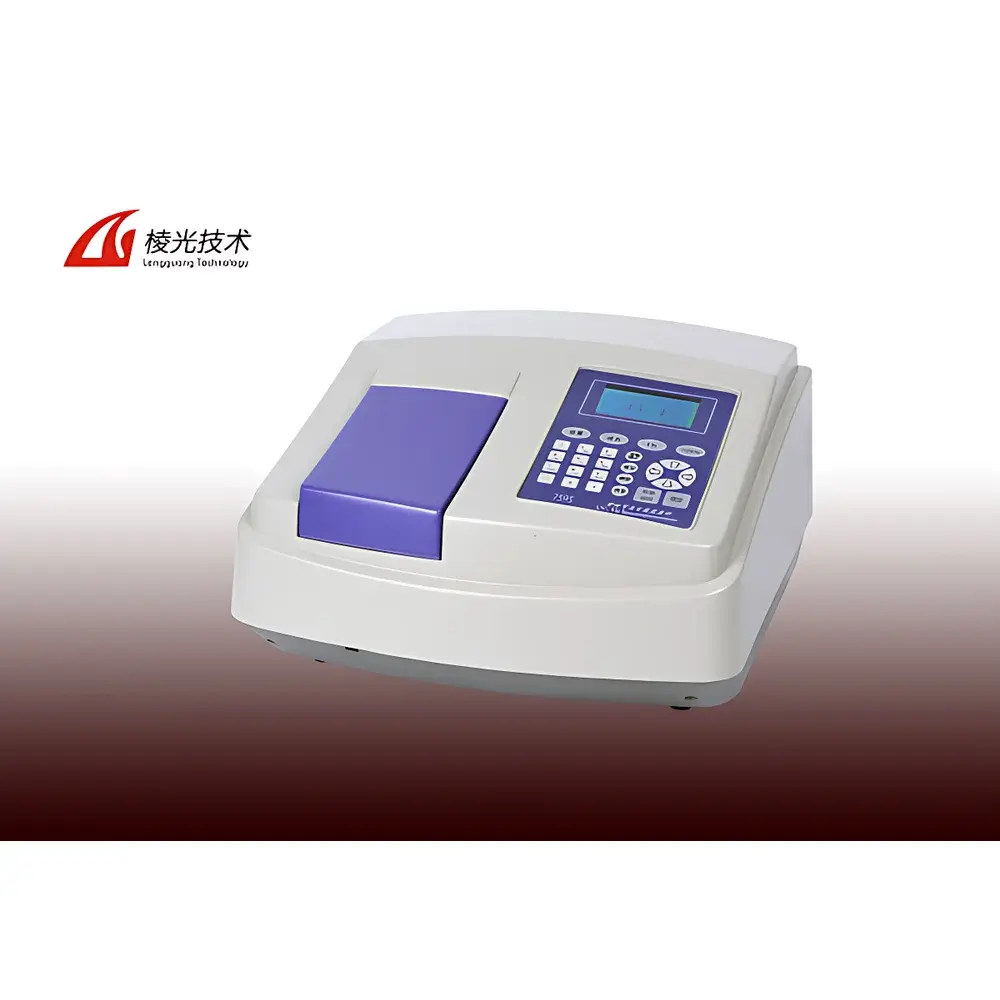
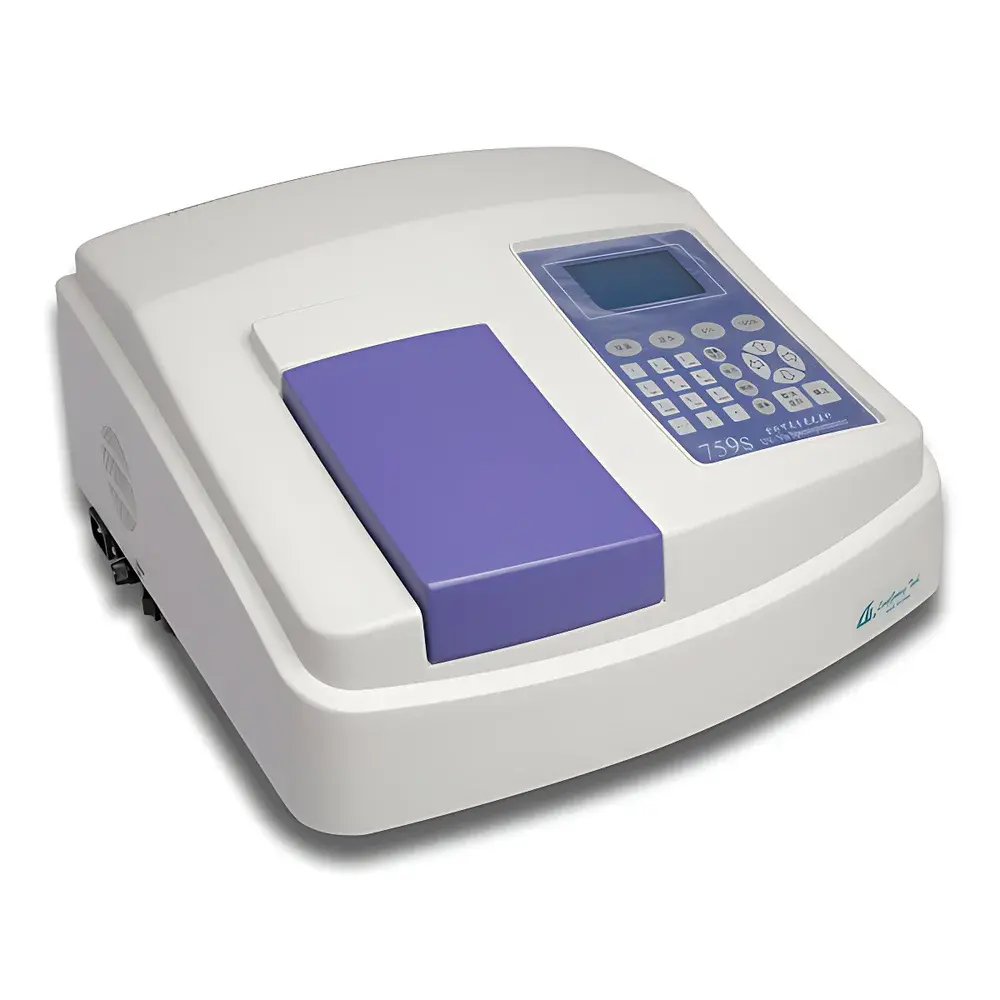
Lengguang Tech. 756S Ultraviolet-Visible Spectrophotometer
| Brand | Lengguang Tech. |
|---|---|
| Origin | Shanghai, China |
| Manufacturer Type | Original Equipment Manufacturer (OEM) |
| Instrument Type | Domestic |
| Model | 756S |
| Optical Design | Single-Beam |
| Detector Type | Photocell |
| Wavelength Range | 190–1100 nm |
| Wavelength Accuracy | ±0.5 nm |
| Wavelength Repeatability | ≤0.2 nm |
| Spectral Bandwidth | 2 nm |
| Stray Light | ≤0.1%T (at 220 nm, using NaI solution) |
| Transmittance Accuracy | ±0.5%T |
| Transmittance Repeatability | ≤0.2%T |
| Baseline Flatness | ±0.002 A |
| Drift | ≤0.0008 A/h |
| Noise | ≤0.5%T (at 100%T), ≤0.2%T (at 0%T) |
| Photometric Range | 0.0–200%T, –0.3–4.0 A |
| Scan Speed | Up to 7000 nm/min |
| Wavelength Drive | Stepper Motor with Microstepping Control |
| Data Storage | USB-A Port for U-Disk Export (Excel-compatible CSV/TXT) |
| Display | 128×64 Dot-Matrix LCD |
| Interfaces | USB-A (U-disk), USB-B (PC connection), RS-232 (printer) |
| Dimensions | 370 × 357 × 220 mm |
Overview
The Lengguang Tech. 756S Ultraviolet-Visible Spectrophotometer is a single-beam scanning instrument engineered for precision quantitative and qualitative analysis across research, quality control, and routine laboratory applications. It operates on the fundamental principle of Beer–Lambert law-based absorbance measurement, utilizing a dual-light-source configuration—deuterium lamp (190–350 nm) and tungsten-halogen lamp (350–1100 nm)—to ensure continuous spectral coverage from deep UV through near-infrared. The optical path is stabilized via monolithic aluminum die-cast housing, minimizing thermal drift and mechanical misalignment. Its 2 nm fixed spectral bandwidth enables resolution sufficient for most pharmaceutical, biochemical, environmental, and materials characterization tasks while maintaining signal-to-noise performance optimized for routine operation. Designed for compliance with standard spectroscopic validation protocols, the 756S supports baseline correction, wavelength calibration verification, and photometric accuracy checks traceable to NIST-traceable reference standards.
Key Features
- High-wavelength fidelity: Internal spectral reference lines enable automated wavelength calibration and long-term stability monitoring without external hardware.
- Low stray light performance: ≤0.1%T at 220 nm (measured with sodium iodide solution), critical for accurate high-absorbance measurements (e.g., concentrated protein solutions or highly colored dyes).
- Robust photometric accuracy: ±0.5%T transmittance accuracy and ≤0.2%T repeatability, validated per ISO 9001-aligned internal QC procedures.
- High-speed spectral acquisition: Adjustable scan rates up to 7000 nm/min; wavelength positioning speed up to 10,000 nm/min—enabling rapid kinetic profiling and time-resolved studies.
- Standalone operation capability: Integrated 128×64 graphical LCD and ARM32-based embedded system support full quantitative analysis—including multi-point calibration curves, coefficient-based concentration calculation, and data export—without PC dependency.
- USB-A host port for direct U-disk storage: All quantitative results, calibration files, and scanned spectra are saved in plain-text or CSV format compatible with Excel, MATLAB, and LIMS environments.
Sample Compatibility & Compliance
The 756S accommodates standard 10 mm rectangular cuvettes (quartz, glass, or plastic) and supports optional accessories including variable-pathlength cells and micro-volume adapters. Its optical design meets essential requirements for method validation under USP , EP 2.2.25, and ISO/IEC 17025-accredited laboratories. While not inherently 21 CFR Part 11 compliant in standalone mode, its PC-connected software supports audit trail logging, user access controls, and electronic signature functionality when deployed in regulated GxP environments. Routine performance qualification (PQ) can be executed using certified reference materials such as potassium dichromate (UV range) and neutral density filters (visible range), aligning with ASTM E275 and ISO 6223 guidelines.
Software & Data Management
The optional PC-based application provides comprehensive spectral analysis tools: kinetic time-scan, multi-wavelength quantitation, DNA/RNA purity assessment (A260/A280, A260/A230), peak identification, derivative spectroscopy, and custom formula computation. Raw data export supports .csv, .txt, and .jdx (JCAMP-DX) formats. Software-generated reports include instrument parameters, calibration history, operator ID, timestamp, and measurement metadata—facilitating GLP documentation and internal audit readiness. All baseline corrections, wavelength calibrations, and photometric validations are digitally recorded and exportable for regulatory review.
Applications
- Pharmaceutical QA/QC: Assay of active pharmaceutical ingredients (APIs), excipient compatibility testing, and dissolution profile analysis.
- Clinical biochemistry: Quantification of total protein, albumin, bilirubin, and enzyme activity assays (e.g., LDH, ALT) using standardized colorimetric protocols.
- Environmental monitoring: Nitrate, phosphate, and heavy metal ion detection in water samples following EPA-approved spectrophotometric methods.
- Food safety: Detection of adulterants (e.g., melamine), antioxidant capacity (DPPH assay), and pigment concentration (e.g., chlorophyll, carotenoids).
- Materials science: Characterization of optical thin films, nanoparticle plasmon resonance, and polymer degradation kinetics.
FAQ
Is the 756S suitable for GLP-compliant laboratories?
Yes—when used with the PC software and configured with user authentication, audit trails, and electronic signatures, it supports core GLP data integrity requirements.
Can I perform DNA/RNA quantification directly on the instrument?
The standalone unit does not compute A260/A280 ratios; however, the PC software includes dedicated nucleic acid analysis modules with preloaded extinction coefficients and purity thresholds.
What is the lamp lifetime, and how is replacement handled?
Deuterium lamp life is rated at 500 hours; tungsten lamp life exceeds 2000 hours. Lamp replacement requires no optical realignment due to precision-machined socket design and factory calibration retention.
Does the instrument support external printers or network connectivity?
It features an RS-232 serial port for direct printer integration. Network connectivity is not built-in but achievable via USB-to-Ethernet adapters paired with compatible drivers.
How is wavelength accuracy verified during routine use?
The instrument includes automated self-check routines using internal spectral references; users may also validate against holmium oxide or didymium glass filters per ISO 6223 recommendations.





