
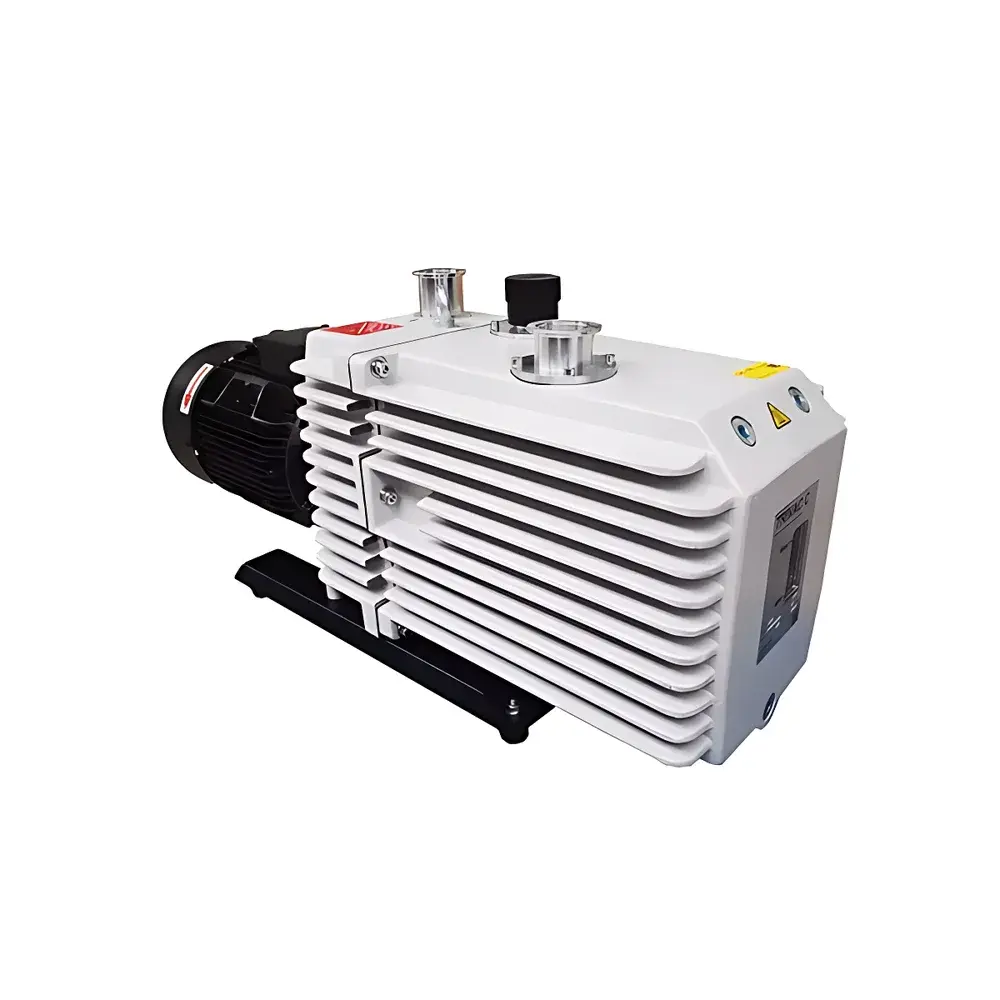
Leybold TRIVAC C Series D8C Two-Stage Oil-Sealed Rotary Vane Vacuum Pump
| Brand | Leybold |
|---|---|
| Origin | Tianjin, China |
| Manufacturer Type | Authorized Distributor |
| Country of Origin | China |
| Model | D8C |
| Pump Type | Oil-Sealed Rotary Vane Pump |
| Ultimate Vacuum (with gas ballast closed) | 0.3 mbar |
| Pumping Speed (50 Hz) | 8.11 m³/h |
| Pumping Speed (60 Hz) | 9.65 m³/h |
| Inlet/Outlet Port | DN25 KF |
| Noise Level (LpA) | 54–56 dB(A) |
| Motor Power | 550 W (Single-phase 220 V, 50 Hz or Three-phase 380 V, 50/60 Hz) |
| Oil Type | Leybold LVO 130 |
| Oil Capacity | 1.5 L (max), 1.0 L (min) |
| Net Weight (dry) | 32 kg |
| Dimensions (W × D × H) | 260 × 173 × 272 mm |
| Operating Ambient Temperature | 10–40 °C |
| Maximum Allowable Water Vapor Pressure | 30 mbar |
| Gas Ballast Enabled Ultimate Pressure | ~6 × 10⁻² mbar |
| Gas Ballast Disabled Ultimate Pressure | ~3 × 10⁻² mbar |
Overview
The Leybold TRIVAC C Series D8C is a compact, two-stage oil-sealed rotary vane vacuum pump engineered for reliable primary vacuum generation in laboratory and light industrial environments. Based on the proven TRIVAC C platform, the D8C employs a dual-rotor design with precision-machined vanes rotating eccentrically within an elliptical stator chamber. This configuration enables continuous volumetric displacement across two compression stages, delivering stable base pressures down to 0.3 mbar (absolute) without gas ballast and as low as 6 × 10⁻² mbar when gas ballast is engaged—critical for handling condensable vapors such as water or solvents. Its robust cast-aluminum housing, integrated oil mist separator, and thermally stable rotor geometry ensure consistent performance under variable load conditions. Designed for integration into vacuum ovens, freeze dryers, vacuum filtration systems, and refrigeration service rigs, the D8C complies with IEC 61000-6-3 (EMC) and meets CE marking requirements for safety and electromagnetic compatibility.
Key Features
- Two-stage oil-sealed rotary vane architecture for high compression ratio and stable ultimate vacuum
- Integrated gas ballast valve enabling safe evacuation of water vapor and other condensables up to 30 mbar partial pressure
- Leybold-specified LVO 130 synthetic vacuum pump oil for extended service life, low vapor pressure, and oxidation resistance
- Low-noise operation (54–56 dB(A)) achieved via optimized rotor dynamics and acoustic damping in housing
- DN25 KF standardized inlet and outlet ports for rapid, leak-tight connection to common vacuum tubing and fittings
- Thermal protection circuitry and overload relay integrated into motor control path per IEC 60034-1
- Compact footprint (260 × 173 × 272 mm) suitable for benchtop or under-bench installation in space-constrained labs
Sample Compatibility & Compliance
The D8C is compatible with non-corrosive, non-reactive gases and vapors typical in general laboratory vacuum applications—including air, nitrogen, argon, water vapor (within specified partial pressure limits), and common organic solvent vapors encountered during rotary evaporation or vacuum distillation. It is not rated for use with halogenated compounds, strong oxidizers (e.g., O₃, Cl₂), or acidic gases (e.g., HCl, HF) without supplemental scrubbing or cold trap protection. The pump conforms to ISO 21360-1 for vacuum measurement methodology and supports GLP-compliant documentation through external pressure logging via analog output (0–10 V) or optional digital interface (RS485 Modbus RTU). While not inherently 21 CFR Part 11 compliant, audit trails and user-access controls can be implemented at the system level when integrated with validated SCADA or LIMS platforms.
Software & Data Management
The D8C operates as a standalone mechanical vacuum source and does not include embedded firmware, touchscreen interface, or onboard data storage. However, it features a 0–10 V analog output proportional to motor current—a proxy for load condition—and supports integration with third-party vacuum controllers (e.g., Pfeiffer TPG300 series, Edwards INT100) for automated pressure regulation and fault logging. When paired with a calibrated Pirani or capacitance manometer and a programmable logic controller (PLC), full cycle monitoring—including pump-down time, ultimate pressure stabilization, and thermal drift—is achievable. Raw operational data (motor voltage, current, runtime hours) may be captured via external energy meters or industrial IoT gateways for predictive maintenance scheduling aligned with ISO 13374-1 standards.
Applications
- Primary vacuum stage in laboratory freeze dryers (lyophilizers) operating down to 0.1–1 mbar range
- Vacuum degassing of resins, adhesives, and casting compounds prior to curing
- Refrigeration system evacuation and charging in HVAC/R maintenance workflows
- Support vacuum for rotary evaporators processing heat-sensitive solvents
- Backing pump for diffusion or turbomolecular pumps in medium-vacuum hybrid systems
- Vacuum-assisted filtration and solvent recovery in chemical synthesis workflows
- Leak testing of sealed enclosures using pressure-rise or decay methods
FAQ
What is the recommended oil change interval for the D8C under continuous operation?
Under standard laboratory duty cycles (≤8 h/day, ambient temperature ≤35 °C), Leybold recommends oil replacement every 3,000 operating hours or annually—whichever occurs first. Extended intervals require oil analysis (acid number, viscosity, particulate count) per ASTM D6595.
Can the D8C be operated vertically or inverted?
No. The D8C must be installed in its designated horizontal orientation with the exhaust port facing upward to ensure proper oil return to the sump and prevent oil carryover into the vacuum line.
Is the pump suitable for vacuum drying of hygroscopic materials?
Yes—provided the gas ballast is engaged during initial pump-down to purge moisture, and the process temperature remains below 40 °C to avoid thermal degradation of the LVO 130 oil.
Does the D8C meet UL or CSA certification for North American installations?
The D8C carries CE marking and complies with EU Machinery Directive 2006/42/EC. For UL/cUL listing in the U.S. or Canada, end-users must verify conformance through a Nationally Recognized Testing Laboratory (NRTL) as part of final system integration.
How is motor protection implemented in case of overheating or phase loss?
The integrated thermal overload relay disconnects power upon sustained rotor temperature exceeding 155 °C (Class F insulation), and the motor winding is protected against single-phasing via built-in phase-failure detection in three-phase configurations.



