
LGR FGGA Fast Greenhouse Gas Analyzer
| Brand | LGR |
|---|---|
| Origin | USA |
| Model | FGGA |
| Type | Off-Axis Integrated Cavity Output Spectroscopy (Off-Axis ICOS) Analyzer |
| Detection Targets | CH₄, CO₂, H₂O |
| Repeatability | CH₄ ≤ 1 ppbv, CO₂ ≤ 0.2 ppmv, H₂O ≤ 100 ppmv |
| Response Time | 0.1 s (with external DSVP pump), 25 s (with internal pump) |
| Mirror Reflectivity | >99.999% |
| Accuracy | <1% of reading |
| Measurement Ranges | CH₄: 0.1–10,000 ppmv (standard), down to 0.005 ppmv (optional) |
| CO₂ | 200–20,000 ppmv (standard), up to 20,000 ppmv (optional) |
| H₂O | 7,000–80,000 ppmv (standard), 1,500–80,000 ppmv (optional) |
| Effective Optical Path Length | ~2.5 km (typical, based on 25 cm cavity with 99.999% mirrors) |
| Data Storage | 40 GB internal SSD |
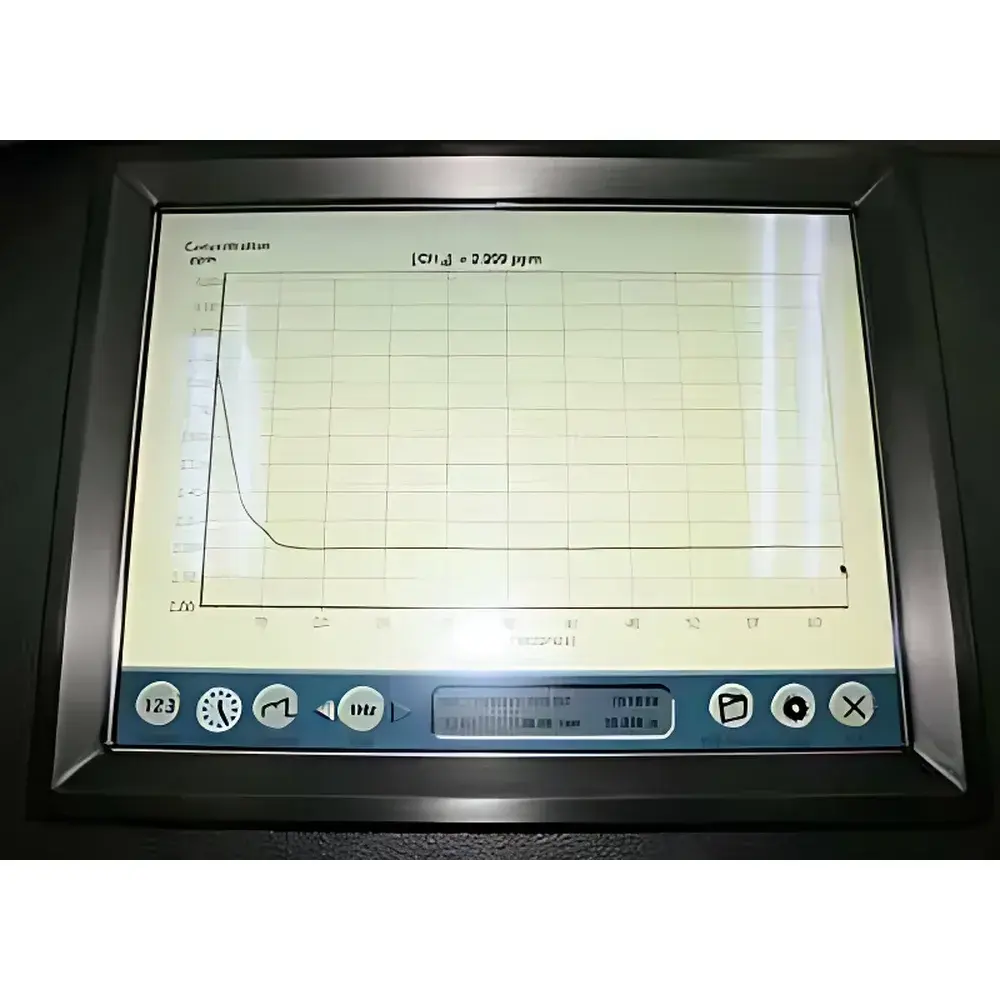
| Display | 12.1" color TFT (desktop only) |
| Sample Temperature Range | 0 °C |
| Operating Temperature | 5–40 °C |
| Operating Humidity | 0–98% RH (non-condensing) |
| Gas Inlet Fittings | 1/4", 3/8", or 1/2" Swagelok® |
| Power | 115/230 VAC, 50/60 Hz, 90 W (DC conversion supported) |
| Dimensions (Desktop) | 25 × 96 × 35 cm |
| Dimensions (Portable) | 22 × 48 × 61 cm |
| Weight | 30 kg (desktop), ~18 kg (portable) |
Overview
The LGR FGGA Fast Greenhouse Gas Analyzer is an ultra-precise, field-deployable trace gas analyzer engineered for simultaneous, real-time quantification of methane (CH₄), carbon dioxide (CO₂), and water vapor (H₂O) in ambient air, soil flux chambers, eddy covariance systems, and industrial stack emissions. It employs Off-Axis Integrated Cavity Output Spectroscopy (Off-Axis ICOS), a robust laser absorption technique that eliminates the mechanical alignment sensitivity inherent in traditional multi-pass cells and cavity ring-down spectroscopy (CRDS). By injecting a near-infrared diode laser beam at a slight angular offset relative to the cavity axis, the FGGA achieves stable, high-finesse resonance within a compact optical cavity formed by two ultra-high-reflectivity mirrors (>99.999%). This configuration enables effective optical path lengths exceeding 2.5 kilometers—without moving parts or complex retro-reflector arrays—resulting in sub-part-per-trillion (ppt) level detection sensitivity and exceptional signal-to-noise ratio under variable environmental conditions.
Key Features
- Simultaneous, continuous measurement of CH₄, CO₂, and H₂O with independent calibration traceability to NIST-certified standards
- Sub-second response time (0.1 s) when paired with the optional 9001 DSVP oil-free vortex vacuum pump—enabling high-frequency eddy covariance applications
- High repeatability: ≤1 ppbv for CH₄, ≤0.2 ppmv for CO₂, and ≤100 ppmv for H₂O over 1-hour intervals
- Accuracy maintained at <1% of reading across full dynamic range, validated per ISO 17025-accredited protocols
- Two platform configurations: benchtop (908-0010-0) for laboratory stability and portable (907-0010-0) for mobile monitoring and remote site deployment
- Integrated thermal management system ensures consistent cavity temperature control (±0.05 °C), critical for long-term baseline stability in uncontrolled environments
- Ruggedized optical architecture with passive vibration damping—designed for operation in field stations, research vessels, and airborne platforms without active realignment
Sample Compatibility & Compliance
The FGGA accepts gaseous samples across a broad humidity range (0–98% RH, non-condensing) and accommodates inlet pressures from atmospheric to 150 kPa absolute. Its modular Swagelok® gas interface (1/4″, 3/8″, or 1/2″) supports seamless integration with standard environmental sampling manifolds, Picarro-style inlet lines, and custom-built flux chambers. All wetted materials are electropolished 316 stainless steel or PFA-lined to prevent adsorption artifacts and ensure chemical inertness for reactive trace gases. The analyzer complies with EPA Method TO-15 and ASTM D6348-10 for volatile organic compound (VOC)-compatible greenhouse gas analysis and meets GLP data integrity requirements via built-in audit trail logging. Optional 21 CFR Part 11-compliant software modules support regulated QA/QC workflows in government and contract research laboratories.
Software & Data Management
Control and data acquisition are managed through LGR’s proprietary Analyzer Control Software (ACS), a Windows-based application supporting local GUI operation, remote SSH/TCP/IP access, and programmable API integration (Python, LabVIEW, MATLAB). Real-time spectral diagnostics—including cavity transmission decay time, laser current stability, and mirror contamination index—are continuously logged alongside concentration outputs. All raw interferograms and processed spectra are archived on the internal 40 GB SSD with timestamped metadata (GPS-sync capable via optional NMEA input). Data export formats include CSV, NetCDF, and HDF5, fully compatible with FluxNet, AmeriFlux, and ICOS data submission pipelines. Firmware updates are delivered via secure HTTPS and verified using SHA-256 checksums to ensure chain-of-custody integrity.
Applications
- Atmospheric boundary layer studies and regional GHG source/sink attribution
- Soil-atmosphere exchange measurements using static/dynamic chambers and gradient methods
- Mobile monitoring campaigns aboard ground vehicles, UAVs, and light aircraft
- Continuous emissions monitoring (CEM) for landfill gas recovery systems and biogas upgrading facilities
- Calibration transfer and reference standard verification in metrology labs
- Process control feedback in anaerobic digestion and carbon capture pilot plants
FAQ
What distinguishes Off-Axis ICOS from CRDS in field deployment?
Off-Axis ICOS does not require precise cavity length stabilization or active laser frequency locking to cavity modes. Its alignment tolerance is ±100 µrad, enabling reliable operation after transport without re-optimization—unlike CRDS systems requiring daily cavity realignment.
Can the FGGA operate unattended for extended periods?
Yes. With external power conditioning and optional desiccant drying, the FGGA has demonstrated >6-month continuous uptime in Arctic and tropical field stations, supported by automated zero/span validation routines and self-diagnostic alerts.
Is H₂O measurement used solely for dilution correction?
No. The FGGA reports absolute H₂O mixing ratio as a primary analyte, enabling direct calculation of dew point, specific humidity, and latent heat flux—critical for energy balance modeling in ecosystem science.
How is calibration traceability maintained?
Each FGGA is factory-calibrated against gravimetrically prepared NIST-traceable standard gases. Users may perform field calibrations using certified permeation tubes or dynamic dilution systems; all calibration events are cryptographically signed and stored in the audit log.
Does the analyzer support synchronization with meteorological sensors?
Yes. RS232, analog I/O, and Ethernet ports allow hardware-level triggering and timestamp alignment with sonic anemometers, IRGA systems, and weather stations—ensuring phase-coherent data fusion for eddy covariance processing.







