
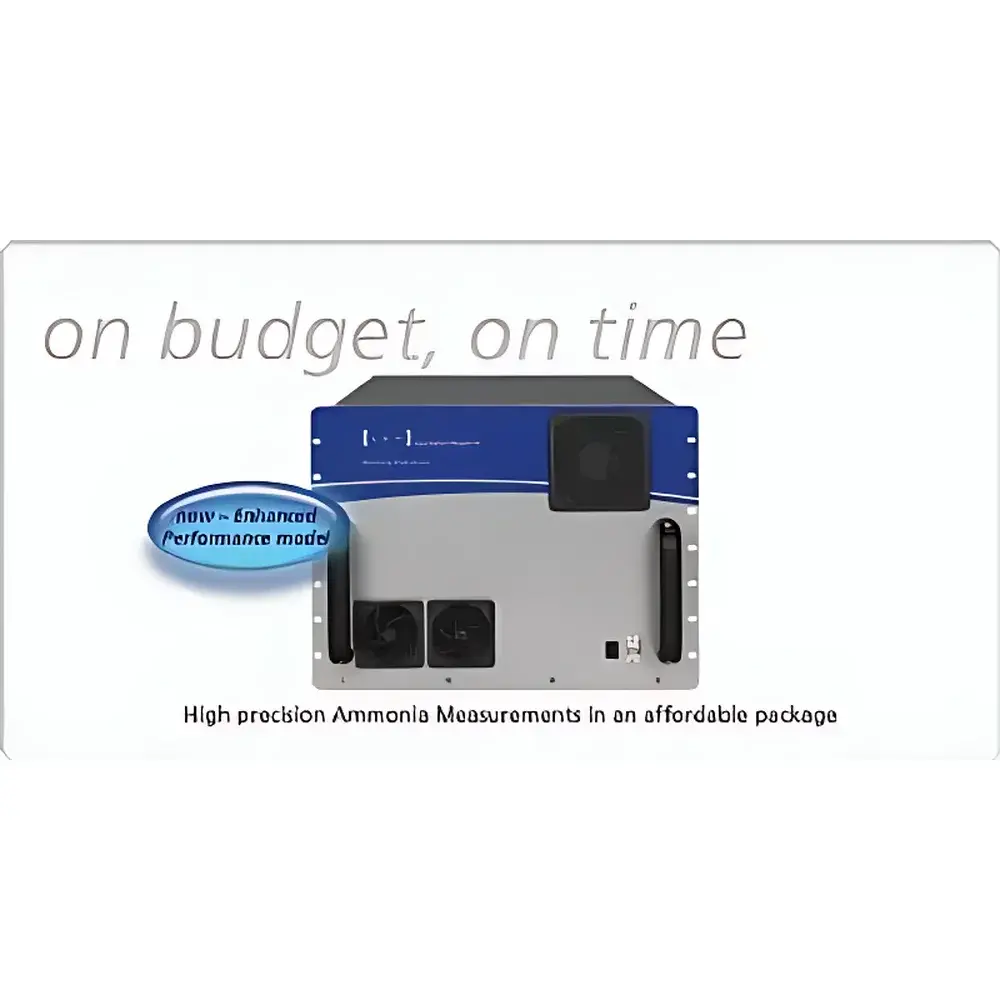
LGR Model 908-0016 / 907-0016 / 911-0016 / 915-0016 Ammonia Analyzer (AA) with OA-ICOS Technology
| Origin | USA |
|---|---|
| Manufacturer Type | Authorized Distributor |
| Origin Category | Imported |
| Models | 908-0016 (Benchtop), 907-0016 (Rackmount Standard), 911-0016 (Rackmount EP), 915-0016 (Ultra-Portable) |
| Power | 115/230 VAC, 50/60 Hz, 120 W (Standard) / 150 W (EP) |
| Dimensions & Weight | Benchtop: 25.4 × 96.5 × 35.6 cm, 29.5 kg |
| Rackmount Standard | 22.2 × 48.3 × 61 cm, 29.5 kg |
| Rackmount EP | 35.6 × 48.3 × 61 cm, 40.5 kg |
| Ultra-Portable | 17.8 × 47 × 35.6 cm, 19 kg |
| Measurement Range (NH₃) | 1–10,000 ppb (full-spec) |
| H₂O Range | 0–60,000 ppm (non-condensing) |
| Precision (1σ) | 0.6 ppb (10 s), 0.2 ppb (100 s), 0.12 ppb (300 s) |
| Max Drift (EP, 24 h, STP) | 0.2 ppb |
| Temp. Control Stability (EP) | ±0.003 °C |
| Pressure Control Stability (EP) | ±0.001 torr |
| Sampling Rate | 0.01–1 Hz (user-selectable) |
| Operating Temp. | 5–45 °C (Standard), 0–45 °C (EP) |
| Sample Temp. | 0–50 °C |
| Humidity | 0–100% RH (non-condensing) |
| Outputs | RS-232, Analog, Ethernet, USB |
| Detection Principle | Off-Axis Integrated Cavity Output Spectroscopy (OA-ICOS) |
Overview
The LGR Ammonia Analyzer (AA) is a high-performance, field-deployable trace gas analyzer engineered for continuous, real-time quantification of ammonia (NH₃) and water vapor (H₂O) in ambient air, emissions streams, and controlled laboratory environments. Utilizing Los Gatos Research’s proprietary Off-Axis Integrated Cavity Output Spectroscopy (OA-ICOS) technology, the AA eliminates the operational constraints inherent to conventional Cavity Ring-Down Spectroscopy (CRDS) systems—specifically, the need for active laser wavelength locking, dynamic cavity alignment, and aggressive thermal stabilization during measurement. OA-ICOS achieves exceptional optical pathlengths (>10 km effective) within a compact, mechanically robust cavity, enabling sub-ppb detection limits with second-level temporal resolution and long-term stability unattainable with traditional absorption techniques.
Key Features
- Simultaneous, fully calibrated NH₃ and H₂O concentration output at user-selectable rates from 0.01 to 1 Hz—ideal for eddy covariance flux studies, stack monitoring, and rapid process control feedback loops.
- EP-series models incorporate LGR’s patented precision temperature and pressure regulation architecture, delivering thermal stability of ±0.003 °C and pressure stability of ±0.001 torr—critical for minimizing baseline drift and maximizing inter-laboratory reproducibility.
- Measurement range spans 1–10,000 ppb NH₃ under full specification; extended-range configuration supports 0–200 ppm for industrial safety or scrubber efficiency applications.
- H₂O measurement extends to 60,000 ppm without condensation interference, enabling accurate humidity correction across wide environmental gradients—including tropical field sites and humidified calibration gas streams.
- Real-time, high-resolution absorption spectra are continuously rendered on the embedded Linux-based computer interface—providing immediate spectral validation, outlier identification, and diagnostic transparency without external software.
- Low power consumption (120–150 W) and modular form factors—including ultra-portable (19 kg) and rackmount configurations—support unattended operation in remote observatories, mobile laboratories, and ISO-classified cleanrooms.
Sample Compatibility & Compliance
The AA accepts sample gas at temperatures between 0–50 °C and relative humidity up to 100% RH (non-condensing), accommodating diverse sampling interfaces—from Nafion dryers and heated stainless-steel lines to custom inlet manifolds. Its optical design is insensitive to particulate loading and vibration, ensuring reliable performance in roadside, agricultural, and industrial settings. The instrument complies with data integrity requirements for regulatory-grade monitoring: raw spectral data, timestamped concentration outputs, and system diagnostics are logged internally with audit-trail capability. When integrated with LGR’s Data Acquisition Software (Model 904-0002), the AA supports time-synchronized acquisition with co-located sensors (e.g., anemometers, GPS, CO₂ analyzers), fulfilling metadata standards required by EPA Method TO-11A, ISO 14644-3, and EU Directive 2008/50/EC for ambient NH₃ reporting. Firmware and data handling protocols are compatible with 21 CFR Part 11-compliant workflows when deployed in GLP/GMP environments.
Software & Data Management
Each analyzer ships with an onboard Linux OS (Ubuntu LTS-based) hosting a web-accessible interface accessible via Ethernet or Wi-Fi. Users configure measurement parameters, view live spectra, and download time-series data directly through any modern browser—no proprietary drivers or client installation required. All data—including raw interferograms, fitted line intensities, and residual error metrics—are stored on internal SSD storage with configurable retention policies. Remote access enables secure SSH login for firmware updates, diagnostic scripting, and real-time troubleshooting. Optional Data Acquisition Software (Model 904-0002) provides synchronized multi-instrument logging (up to 16 channels), automated CSV/NetCDF export, and configurable alarm thresholds compliant with SCADA integration standards. All timestamps are traceable to UTC via NTP synchronization, and file metadata includes instrument serial number, calibration history, and environmental context tags.
Applications
- Ambient air quality networks requiring compliance-grade NH₃ monitoring per national reference methods (e.g., UK AQMA, German BLU, U.S. CASTNET).
- Eddy covariance flux towers measuring biosphere–atmosphere NH₃ exchange over croplands, forests, and wetlands.
- Industrial emission source testing—including fertilizer plants, livestock facilities, and wastewater treatment lagoons—per EPA Performance Specification 18 (PS-18) and EN 15267.
- Process analytical technology (PAT) deployment in pharmaceutical and chemical manufacturing where NH₃ serves as a reaction intermediate or cleaning agent residue.
- Calibration transfer laboratories validating secondary standards against primary CRMs traceable to NIST SRM 2690c and ISO 17025-accredited reference gases.
- Mobile platforms (vans, drones, UAVs) leveraging the ultra-portable (915-0016) variant for spatial mapping of urban NH₃ hotspots and fugitive emissions surveys.
FAQ
What distinguishes OA-ICOS from CRDS in practical operation?
OA-ICOS decouples laser frequency tuning from cavity resonance matching, eliminating the need for active cavity length feedback loops. This reduces sensitivity to mechanical drift and thermal transients, resulting in lower maintenance overhead and higher uptime in uncontrolled environments.
Can the AA operate unattended for extended periods?
Yes. With its solid-state laser architecture, passive thermal design (EP models), and embedded data logging, the AA supports >30-day autonomous operation when paired with uninterruptible power supplies and telemetry modules.
Is factory calibration traceable to international standards?
All instruments are calibrated using NIST-traceable NH₃ permeation tubes and certified moisture generators, with calibration certificates documenting uncertainty budgets per ISO/IEC 17025 requirements.
How does the analyzer handle cross-sensitivity to other nitrogen-containing compounds?
The OA-ICOS spectral fitting algorithm isolates the target NH₃ rovibrational line near 653.5 nm, with built-in compensation for H₂O continuum absorption and validated specificity against NO₂, NO, and N₂O at typical atmospheric mixing ratios.
What support is available for method validation documentation?
LGR provides comprehensive IQ/OQ/PQ protocol templates, uncertainty calculation worksheets, and technical notes aligned with ASTM D6348, ISO 11359, and USP , supporting regulatory submission packages for environmental and pharmaceutical applications.
Related Products







