
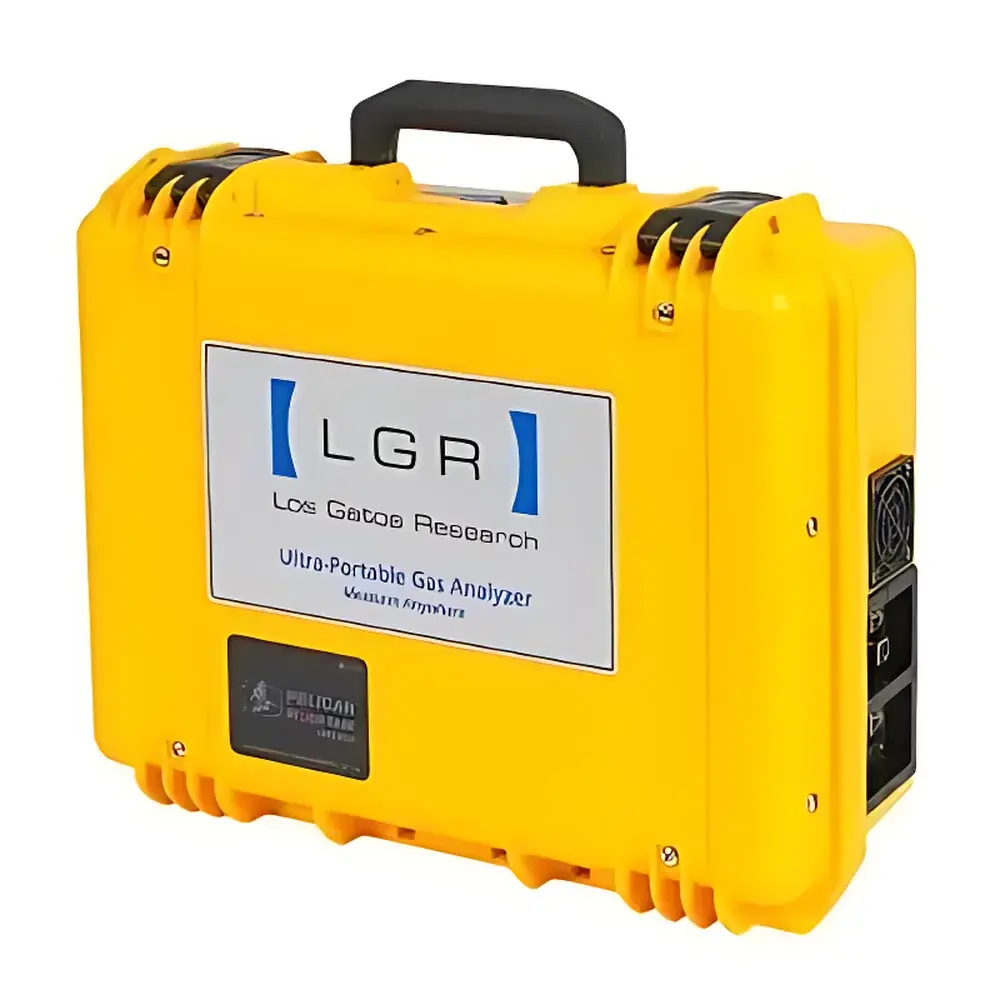
LGR Model 915-0011 Portable Cavity Ring-Down Spectroscopy (CRDS) Greenhouse Gas Analyzer for CH₄, CO₂, and H₂O
| Origin | USA |
|---|---|
| Manufacturer Type | Authorized Distributor |
| Origin Category | Imported |
| Model | 915-0011 |
| Response Time | 1 s |
| Repeatability | CH₄ < 0.25 ppb (100 s), CO₂ < 40 ppb (100 s), H₂O < 15 ppm (100 s) |
| Measurement Principle | Cavity Ring-Down Spectroscopy (CRDS) |
| Form Factor | Portable |
| Power Consumption | 60 W (DC), 66 W (AC) |
| Dimensions | 17.8 cm H × 47 cm W × 35.6 cm D |
| Weight | 15 kg |
| Operating Temperature | 5–45 °C |
| Sample Temperature Range | −10–50 °C |
| Relative Humidity | 0–100% RH (non-condensing) |
| Detection Limits (1σ, 100 s) | CH₄: 0.25 ppb, CO₂: 40 ppb, H₂O: 15 ppm |
| Full-Scale Linear Range | CH₄: 0.01–100 ppm (extendable to 10% vol), CO₂: 1–20,000 ppm, H₂O: 500–70,000 ppm (0–100% RH) |
| Data Output | RS-232, Analog, Ethernet, USB |
| Accuracy | <1% uncertainty (uncalibrated, 10–35 °C) |
| Sampling Rate | 0.01–1 Hz |
Overview
The LGR Model 915-0011 Portable Cavity Ring-Down Spectroscopy (CRDS) Greenhouse Gas Analyzer is a field-deployable, high-precision instrument engineered for simultaneous, real-time quantification of methane (CH₄), carbon dioxide (CO₂), and water vapor (H₂O) mole fractions in ambient air or controlled gas streams. Unlike conventional NDIR or electrochemical sensors, this analyzer employs ultra-stable, wavelength-scanned CRDS technology—where laser light is trapped within a high-finesse optical cavity formed by ultra-reflective mirrors (>99.999% reflectivity). The exponential decay time (“ring-down time”) of the light intensity is measured with picosecond resolution; minute changes in cavity loss directly correlate to trace gas concentration via Beer–Lambert law-based calibration. This physics-first approach delivers inherent stability, immunity to source intensity fluctuations, and exceptional sensitivity without moving parts or consumables. Designed for unattended operation across diverse environmental regimes—from alpine permafrost sites to tropical wetlands—the 915-0011 meets TSA carry-on specifications and operates reliably under dynamic pressure and temperature gradients typical of drone-mounted, vehicle-based, or handheld deployments.
Key Features
- Triple-species detection (CH₄, CO₂, H₂O) with fully independent, overlapping spectral channels—no cross-sensitivity to common interferents (e.g., CO, NH₃, VOCs, or O₂).
- Real-time spectral visualization via integrated oscilloscope interface—enabling on-the-fly validation of absorption line shape, baseline stability, and cavity alignment status.
- Dry-mole-fraction reporting for CH₄ and CO₂ computed in real time using measured H₂O concentration and ideal gas law correction—eliminating post-processing artifacts.
- Extended-range option supports CH₄ quantification up to 10% v/v (100,000 ppm), validated across full scale with linear response (R² > 0.9999) and no signal saturation.
- Ultra-low power draw (60 W DC) enables continuous operation from Li-ion battery packs (e.g., 24 V, 20 Ah) for >8 hours—critical for remote flux tower or eddy-covariance campaigns.
- Ruggedized IP65-rated enclosure with shock-absorbing elastomer mounts, conformal-coated PCBs, and sealed optical path—certified for transport in commercial aircraft cargo holds and drone gondolas.
Sample Compatibility & Compliance
The 915-0011 accepts sample gas at flow rates of 0.5–2.0 L/min via standard 1/4″ Swagelok fittings. Integrated pressure and temperature sensors (±0.1 kPa, ±0.1 °C) enable automatic compensation for non-standard conditions. The analyzer complies with ISO 14064-3:2019 requirements for GHG monitoring system validation and supports audit-ready data logging aligned with EPA Method TO-15 and ASTM D6348-10 for trace gas speciation. Its digital output architecture satisfies FDA 21 CFR Part 11 criteria when paired with LGR’s optional data acquisition software (Model 904-0002), providing electronic signatures, user access controls, and immutable audit trails. All factory calibrations are traceable to NIST Standard Reference Materials (SRMs) for CH₄ and CO₂, with documented uncertainty budgets available upon request.
Software & Data Management
LGR’s proprietary DataStream™ software (v5.2+) provides synchronized acquisition, visualization, and export of analyzer outputs alongside auxiliary sensors—including GPS position, 3D wind vectors, barometric pressure, and soil temperature probes—via configurable TTL/RS-232/USB interfaces. Raw ring-down decay waveforms, calibrated mole fractions, cavity mirror health metrics, and diagnostic flags are logged at user-selectable intervals (10 ms to 1 min) in ASCII or HDF5 format. The software includes built-in tools for zero/span drift correction, water-vapor dilution correction, and automated flux computation using the HMR (Hutchinson-Mosier-Robinson) or EC (Eddy Covariance) algorithms. Remote firmware updates and configuration management are supported over Ethernet or cellular modems, enabling long-term unattended operation in distributed sensor networks.
Applications
- Soil-atmosphere gas exchange studies: High-temporal-resolution CH₄ and CO₂ flux measurements from static chambers or automated chamber systems, with sub-ppb precision critical for distinguishing microbial production from oxidation pathways.
- Point-source emission verification: Quantitative plume mapping around landfills, oil & gas infrastructure, and wastewater treatment plants—validated against EPA OTM-33A protocols for mobile leak detection.
- Airborne greenhouse gas surveys: Integration into small UAVs or light aircraft for regional-scale atmospheric inversion modeling, leveraging its low mass, low power, and vibration resilience.
- Carbon cycle research: Long-term monitoring at AmeriFlux, ICOS, or FluxNet sites where dry-mole-fraction accuracy and interannual stability are prerequisites for trend analysis.
- Calibration transfer and reference standard verification: Use as a field-deployable primary standard for validating tunable diode laser (TDL) or photoacoustic spectrometers in situ.
FAQ
Does the 915-0011 require routine calibration with certified gas standards?
No. CRDS physics ensures intrinsic stability; however, biannual zero checks (using purified N₂) and annual span verification (using NIST-traceable CH₄/CO₂ blends) are recommended for GLP-compliant applications.
Can the analyzer operate continuously in high-humidity environments?
Yes. The optical cavity is actively temperature-controlled and isolated from sample stream moisture; condensation is prevented by heated inlet lines and internal dew-point management.
What vacuum pump options are available for rapid sample turnover?
Three configurations: Dry scroll pump (0.1 s gas exchange time), N940 diaphragm pump (0.7 s), and N920 dual-stage pump (1.2 s)—all compatible with the integrated 16-channel multiplexer (Model MIU-377-16) for multi-location monitoring.
Is raw spectral data accessible for custom algorithm development?
Yes. The instrument exports full ring-down decay waveforms, mirror reflectivity estimates, and laser wavelength metadata via Ethernet API, supporting MATLAB, Python, and LabVIEW integration.
How is measurement uncertainty quantified across temperature and pressure variations?
Uncertainty propagation is performed in real time using embedded thermodynamic models; total expanded uncertainty (k=2) remains ≤1% across 10–35 °C and 70–106 kPa, as verified per GUM (JCGM 100:2008).







