
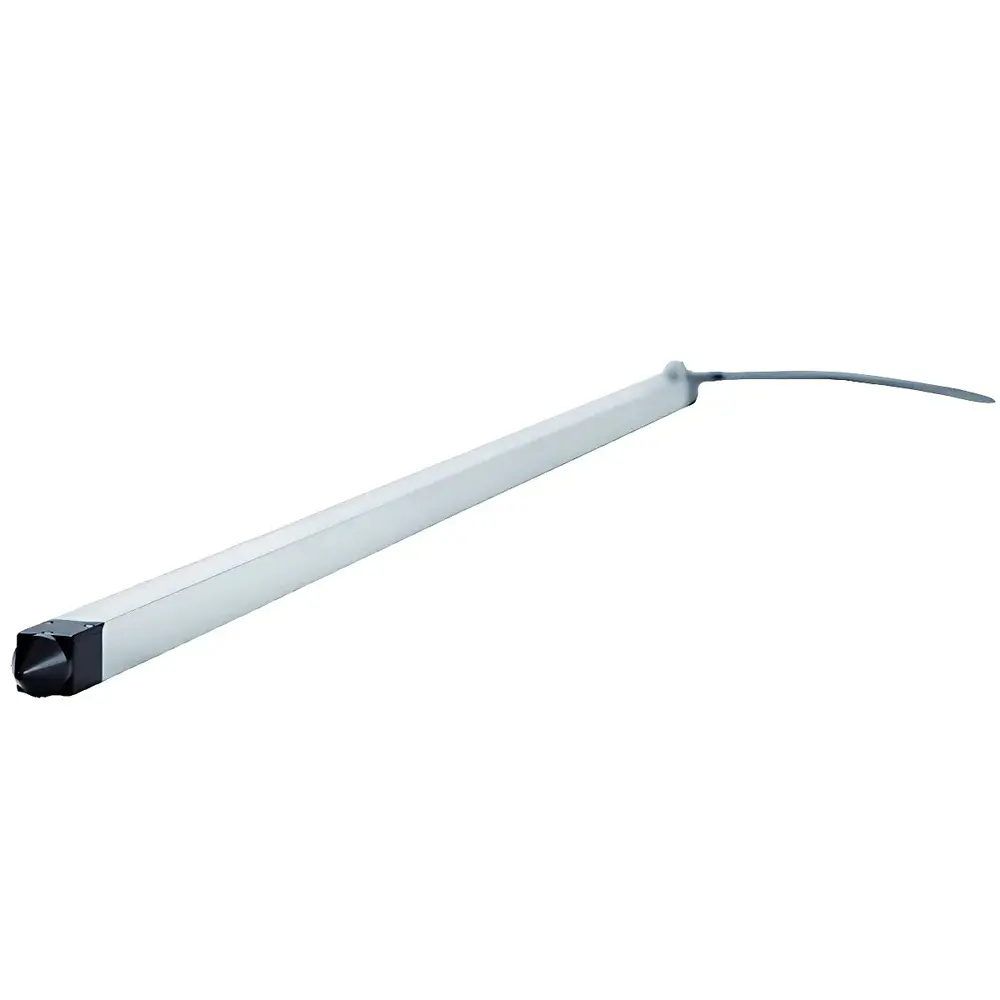
LI-COR LI-191R Linear Quantum Sensor for Integrated PAR Measurement
| Brand | LI-COR |
|---|---|
| Origin | USA |
| Model | LI-191R |
| Measurement Range | 0–5000 μmol·s⁻¹·m⁻² (PPFD) |
| Spectral Range | 400–700 nm |
| Calibration Uncertainty | ±10% (NIST-traceable) |
| Sensitivity | 7 μA per 1000 μmol·s⁻¹·m⁻² (typ.) |
| Linearity Error | ≤1% up to 10,000 μmol·s⁻¹·m⁻² |
| Response Time | 10 μs |
| Temperature Dependence | ≤±0.15%/°C |
| Cosine Correction | Acrylic diffuser |
| Azimuthal Error | <±2% at 45° elevation over 360° |
| Spatial Uniformity | ±7% across 1 m length (tested under 2.54 cm incandescent source) |
| Active Area | 1 m × 12.7 mm |
| Operating Environment | −40 to +65 °C, 0–95% RH (non-condensing) |
| Detector | Blue-enhanced silicon photovoltaic cell |
| Housing | Anodized aluminum with acrylic diffuser and stainless steel fasteners |
| Dimensions | 121.3 × 2.54 × 2.54 cm (L×W×D) |
| Weight | 1.4 kg |
| Cable Length | Standard 2 m (5 m optional) |
Overview
The LI-COR LI-191R Linear Quantum Sensor is an engineered solution for spatially integrated photosynthetically active radiation (PAR) measurement—specifically designed to quantify photon flux density (PPFD) across heterogeneous light fields. Unlike point sensors, the LI-191R employs a continuous 1-meter quartz light guide beneath a seamless acrylic diffuser, enabling simultaneous optical integration over its full active length. This architecture implements the principle of linear quantum detection: incident photons within the 400–700 nm spectral band are collected, homogenized via internal total internal reflection in the quartz rod, and converted to current by a blue-enhanced silicon photovoltaic detector. The resulting analog output is directly proportional to the spatially averaged PPFD (μmol·s⁻¹·m⁻²), making it ideal for canopy-level profiling, understory light characterization, and ecosystem-scale radiation budgeting where discrete point sampling introduces unacceptable spatial aliasing.
Key Features
- True linear integration over 1 m length—eliminates interpolation bias in vertically stratified or horizontally patchy canopies
- NIST-traceable absolute calibration with ±10% uncertainty; sensitivity of 7 μA per 1000 μmol·s⁻¹·m⁻² (typical)
- Optimized quantum response: spectral responsivity closely matches the CIE-defined PAR action spectrum (400–700 nm)
- High-speed response (10 μs) and exceptional linearity (≤1% deviation up to 10,000 μmol·s⁻¹·m⁻²)
- Robust environmental rating: operational from −40 to +65 °C and 0–95% RH (non-condensing); sealed anodized aluminum housing with stainless steel hardware
- Low temperature dependence (≤±0.15%/°C) and precise cosine correction (<±2% azimuthal error at 45° elevation)
- Validated for long-term unattended deployment—selected by the National Ecological Observatory Network (NEON®) for standardized PAR monitoring
Sample Compatibility & Compliance
The LI-191R is compatible with any data acquisition system accepting low-current analog inputs (e.g., LI-1500, Campbell Scientific CR series, or third-party loggers with appropriate signal conditioning). Its spectral filtering effectively suppresses near-infrared radiation (>700 nm), critical for accurate PAR quantification beneath vegetation where NIR/visible ratios exceed 3:1. The sensor complies with ISO 17166:2022 (CIE S 026/E:2018) definitions of photosynthetic photon flux and meets functional requirements for GLP-aligned ecological field studies. While not inherently 21 CFR Part 11 compliant, its analog output supports audit-ready data capture when paired with validated logging systems featuring electronic signatures, time-stamping, and change history tracking.
Software & Data Management
Raw current output from the LI-191R is converted to PPFD using factory-provided calibration coefficients (µA → μmol·s⁻¹·m⁻²). Integration with LI-COR’s LI-1500 Light Meter or third-party platforms (e.g., LoggerNet, LabVIEW, Python-based PyCampbell) enables real-time visualization, automated averaging, and metadata tagging (e.g., height, orientation, timestamp). For networked deployments, the sensor interfaces seamlessly with NEON’s standardized data ingestion pipeline, supporting FAIR (Findable, Accessible, Interoperable, Reusable) data principles. All calibration records—including NIST traceability documentation—are archived and retrievable per ISO/IEC 17025 requirements.
Applications
- Vertical PAR profiling in forest canopies, agroforestry systems, and greenhouse multi-layer cropping
- Understory light mapping for ecological succession studies and shade-tolerant species modeling
- Validation of radiative transfer models (e.g., SCOPE, 3D Radiosity) requiring spatially resolved boundary conditions
- Long-term ecosystem monitoring in NEON, AmeriFlux, and ICOS networks
- Controlled-environment agriculture (CEA) system commissioning and uniformity verification
- Calibration reference for UAV-mounted multispectral PAR estimators
FAQ
Is the LI-191R suitable for underwater PAR measurements?
No—the sensor is rated for terrestrial outdoor use only; its acrylic diffuser and housing are not pressure-rated or optimized for aquatic refractive index compensation.
Can the LI-191R be used with non-LI-COR data loggers?
Yes—provided the logger accepts low-current analog input (0–250 µA range) and supports user-defined scaling via calibration coefficients.
What is the recommended recalibration interval?
LI-COR recommends recalibration every 2 years for research-grade applications or after exposure to extreme thermal cycling or mechanical shock.
Does the sensor require leveling during installation?
No—its cosine-corrected diffuser ensures accurate angular response independent of tilt; however, consistent orientation (e.g., horizontal placement) is required for comparative time-series analysis.
How does the LI-191R differ from the LI-190R quantum sensor?
The LI-190R is a point sensor (1 cm² active area); the LI-191R provides spatial integration over 1 m, reducing sampling variance in non-uniform fields by >80% in typical canopy scenarios.




