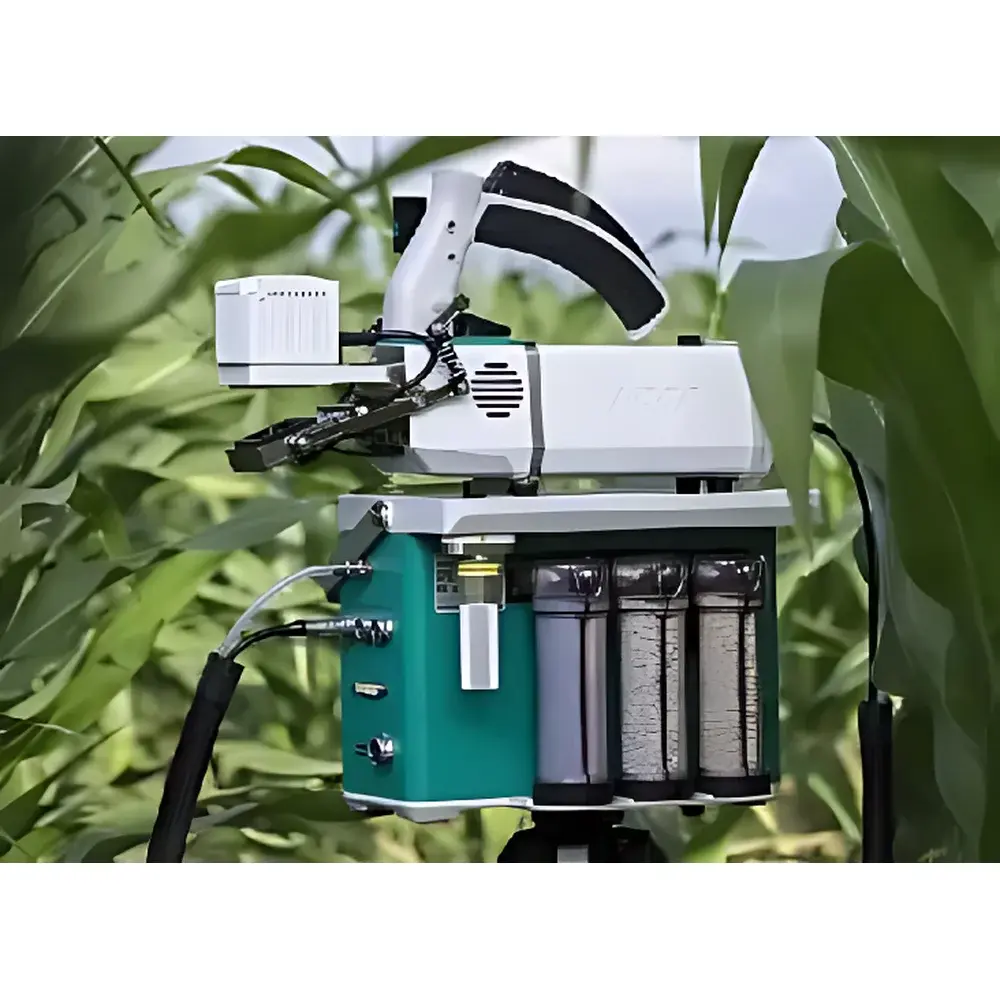
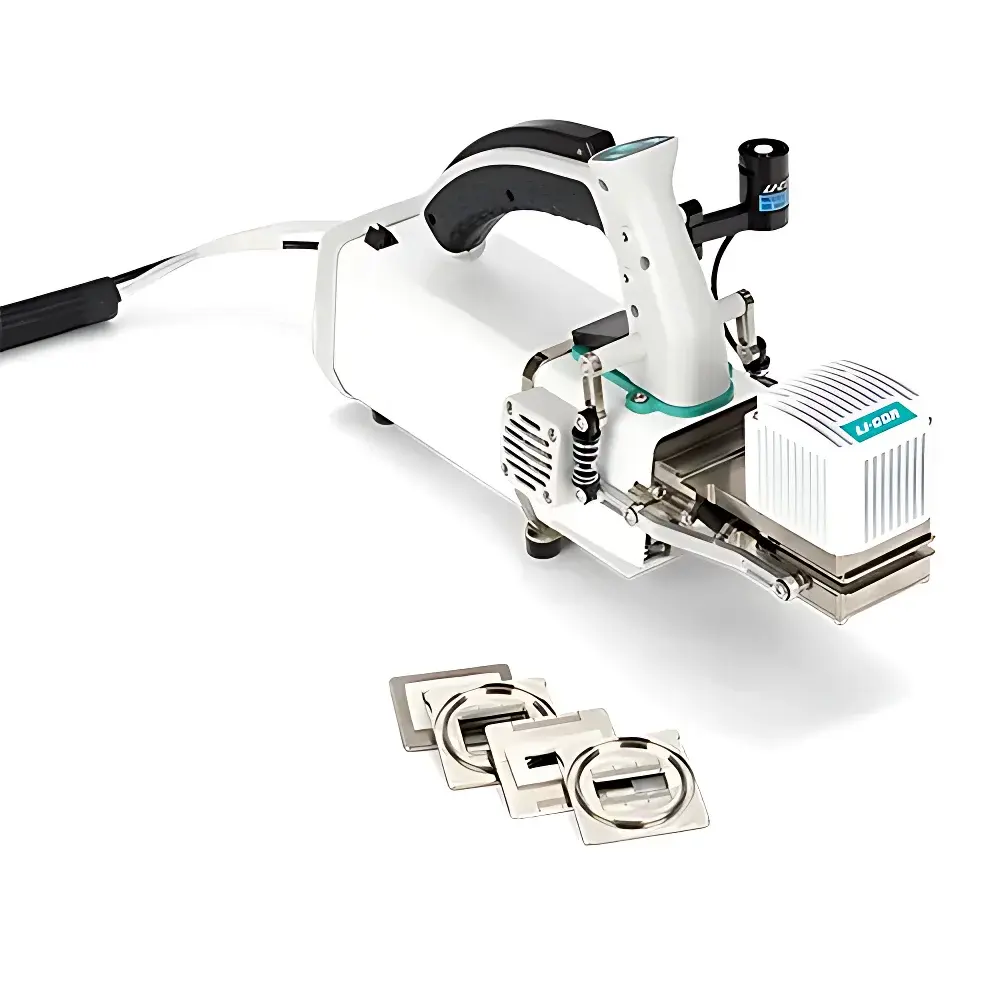
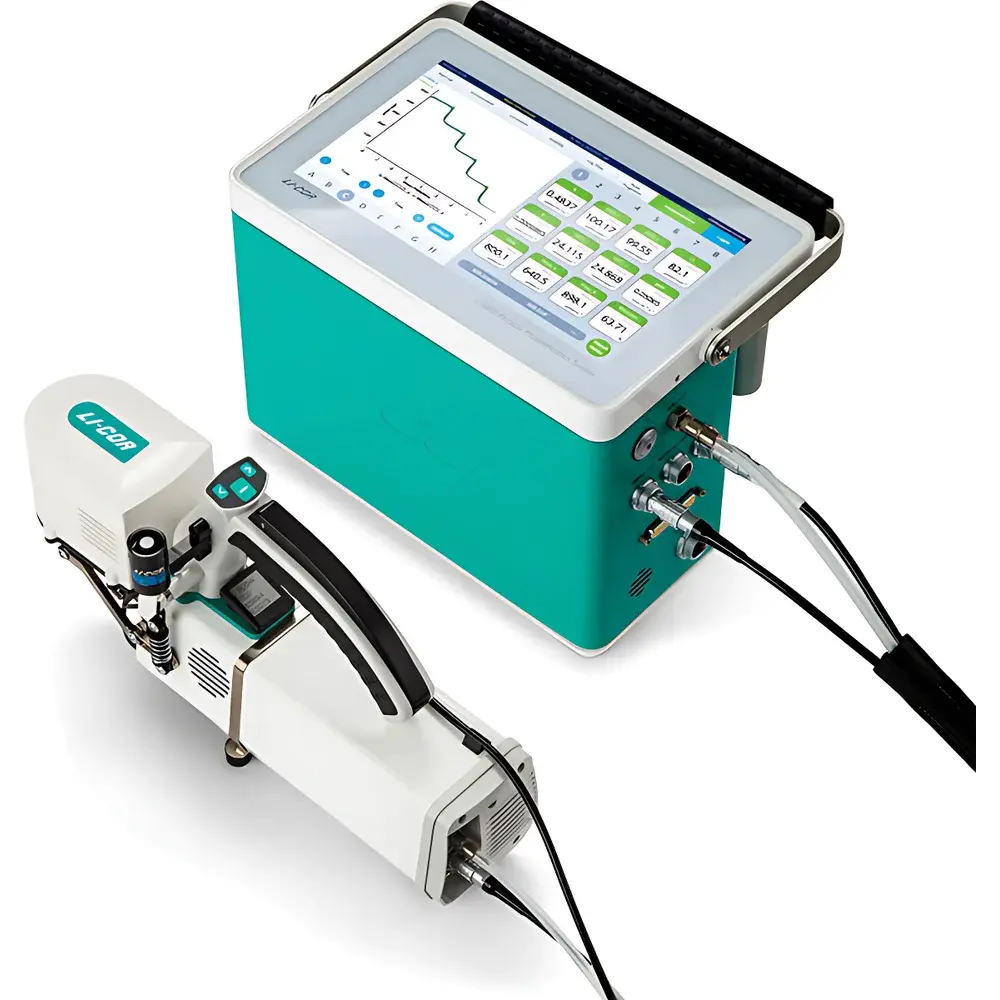
LI-COR LI-6800 Portable Photosynthesis and Chlorophyll Fluorescence Measurement System
| Brand | LI-COR |
|---|---|
| Origin | USA |
| Model | LI-6800 |
| CO₂ Range | 0–>2000 µmol/mol (control resolution ≤1 µmol/mol) |
| H₂O Control | 0–90% RH |
| Flow Rate | 0–2000 cm³/min |
| Fluorescence Acquisition Rate | 250 kHz |
| Saturation Flash Intensity | up to 16,000 µmol·m⁻²·s⁻¹ |
| Light Sources | 6800-01A (0–3000 µmol·m⁻²·s⁻¹), 6800-02 (0–>2000 µmol·m⁻²·s⁻¹), 6800-03 (0–3000 µmol·m⁻²·s⁻¹) |
| Chamber Pressurization | 0–200 Pa |
| Temperature Control Range | ±10°C around ambient, resolution <0.1°C |
| RACiR™ Protocol Duration | ~5 min for full A-Ci curve |
| OJIP Kinetics | Supported via Multiphase Flash™ technology |
| Simultaneous Gas Exchange & Fluorescence | Yes |
| Leaf Area Estimation | Automated in situ calculation |
| Compliance | Designed for GLP-compliant workflows |
Overview
The LI-COR LI-6800 Portable Photosynthesis and Chlorophyll Fluorescence Measurement System is an integrated, field-deployable instrument engineered for high-fidelity, real-time quantification of plant physiological responses under controlled environmental conditions. It combines dual-pathway measurement capability—non-dispersive infrared gas analysis (NDIR) for CO₂ and H₂O vapor exchange, and pulse-amplitude modulated (PAM) chlorophyll fluorescence detection—within a single, co-located optical and gas sampling architecture. This physical integration eliminates time-lag artifacts between gas exchange and fluorescence signals, enabling true synchrony at sub-second temporal resolution. The system operates on the principle of open-path gas exchange coupled with kinetic fluorescence induction analysis, supporting both steady-state and transient physiological assessments—including rapid A-Ci response curves (RACiR™), OJIP transients, and light-response profiling. Its modular chamber design accommodates diverse sample types—from intact leaves and mosses to soil surfaces and small invertebrates—making it suitable for ecological field studies, crop phenotyping, stress physiology, and climate change research.
Key Features
- Co-located IRGA and fluorescence detector: Minimizes signal latency and improves cross-parameter correlation fidelity.
- Rapid A-Ci Response (RACiR™): Generates full CO₂ response curves in approximately five minutes using dynamic CO₂ ramping protocols.
- High-speed fluorescence acquisition: 250 kHz sampling enables robust capture of fast OJIP kinetics and multiphasic fluorescence decay profiles.
- Multiphase Flash™ technology: Delivers precisely timed, high-intensity saturating pulses (up to 16,000 µmol·m⁻²·s⁻¹) for accurate determination of Fm′ and quantum yield parameters under actinic illumination.
- Active chamber pressurization: Maintains internal overpressure up to 200 Pa to suppress ambient air infiltration and ensure stable gas composition within the leaf cuvette.
- Boundary layer conductance control: Integrated high-RPM mixing fan (16,000 rpm) homogenizes boundary layer resistance, reducing stomatal conductance estimation error.
- Precision environmental control: Independent regulation of CO₂ (0–>2000 µmol/mol, ±1 µmol/mol), H₂O (0–90% RH), temperature (±10°C from ambient, <0.1°C resolution), and photosynthetic photon flux density (PPFD) across multiple interchangeable light sources.
- Intelligent leaf area estimation: Onboard image-based algorithm calculates effective leaf area directly from chamber-mounted camera feed, eliminating manual input errors.
Sample Compatibility & Compliance
The LI-6800 supports a wide range of biological and abiotic samples through its expandable chamber ecosystem. Standard configurations include the 3×3 cm fluorescent leaf chamber (6800-01A), red-blue LED chamber (6800-02), full-spectrum RGBW chamber (6800-03), large-leaf chamber (6800-09), moss chamber (6800-19), soil CO₂/H₂O flux chamber (6800-12A), aquatic chamber (6800-18), and insect respiration chamber (6800-24). Customizable adapters (e.g., 6800-17) allow integration with user-built cuvettes. All hardware and firmware are designed to meet international standards for scientific instrumentation reliability and traceability. Data acquisition and storage comply with GLP/GMP-aligned practices when paired with LI-COR’s official software platform, which includes electronic signature support, user access controls, and full audit trail functionality aligned with FDA 21 CFR Part 11 expectations.
Software & Data Management
Control and analysis are performed via LI-COR’s proprietary LI-6800 Desktop Software, a Windows-based application offering intuitive protocol configuration, real-time visualization, and post-acquisition parameter derivation. The software implements standardized calculations for key physiological indices—including net photosynthesis (An), stomatal conductance (gs), intercellular CO₂ concentration (Ci), electron transport rate (ETR), non-photochemical quenching (NPQ), and quantum yield of PSII (ΦPSII). Batch processing tools enable automated extraction of RACiR-derived Vcmax and Jmax, as well as OJIP-derived performance indices (PIABS, PITOT). Raw data files (.l68) store all sensor timestamps, calibration metadata, and environmental setpoints, ensuring full experimental reproducibility. Export options include CSV, Excel, and MATLAB-compatible formats for third-party statistical modeling or integration into larger ecosystem modeling frameworks.
Applications
- Photosynthetic acclimation to elevated CO₂, drought, heat, and nutrient limitation.
- Comparative ecophysiology across species, genotypes, or developmental stages.
- Validation of remote sensing vegetation indices against ground-truthed physiological metrics.
- Soil carbon flux partitioning and rhizosphere respiration dynamics.
- Non-invasive assessment of herbicide mode-of-action and photoinhibitory stress.
- Field-based phenotyping in breeding programs targeting water-use efficiency or photosynthetic capacity.
- Underwater photosynthesis studies using the aquatic chamber module.
- Diurnal tracking of dynamic photoinhibition and recovery kinetics.
FAQ
Can the LI-6800 measure both gas exchange and fluorescence simultaneously?
Yes. The IRGA analyzer is physically mounted adjacent to the fluorescence detection optics within the same leaf chamber head, enabling synchronous, time-aligned acquisition without interpolation or temporal alignment correction.
What is the minimum measurable CO₂ concentration and its control precision?
The system supports CO₂ setpoints from 0 to >2000 µmol/mol, with closed-loop control stability achieving ±1 µmol/mol accuracy under standard operating conditions.
Is the LI-6800 suitable for long-term unattended operation in remote field sites?
While primarily designed for portable, operator-assisted measurements, optional external power modules, weatherproof enclosures, and programmable background protocols (BP) enable semi-automated deployments lasting several hours; however, continuous multi-day autonomous operation requires supplementary telemetry and battery infrastructure.
Does the system support custom light treatment sequences, such as fluctuating light regimes?
Yes. The Auto Control function allows users to define time-varying light intensity, CO₂, temperature, and humidity profiles—enabling simulation of natural diel cycles or experimental stress transitions like sudden irradiance shifts.
Are calibration procedures traceable to NIST standards?
Gas analyzers are factory-calibrated using NIST-traceable reference gases; users perform routine zero/span verification with certified gas mixtures, and calibration history is logged automatically within the software audit trail.
Related Products