
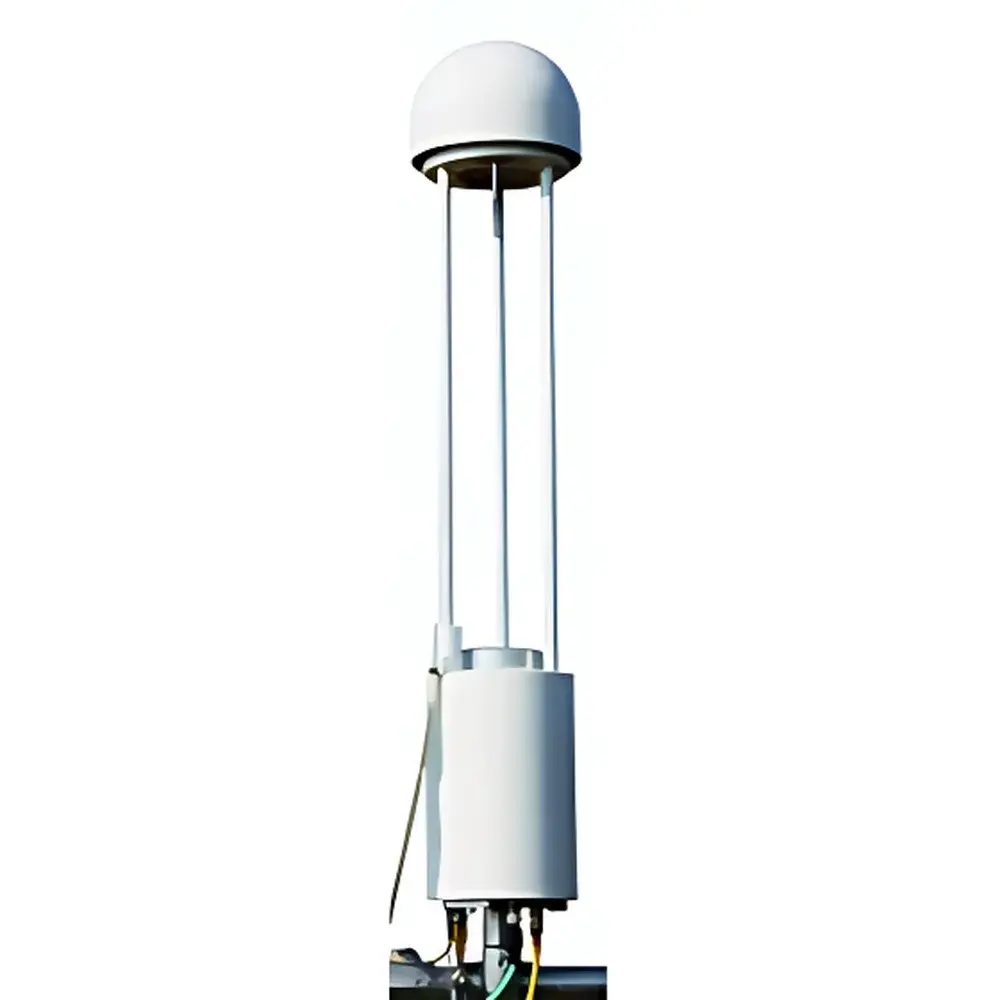
LI-COR LI-7700 Open-Path Methane (CH₄) Analyzer
| Brand | LI-COR |
|---|---|
| Origin | USA |
| Model | LI-7700 |
| Instrument Type | Online Analyzer |
| Target Gas | Methane (CH₄) |
| Measurement Precision | ±5 ppb |
| Measurement Range | 0–25 µmol/mol at −25 °C |
Overview
The LI-COR LI-7700 Open-Path Methane (CH₄) Analyzer is a field-deployable, high-frequency gas analyzer engineered for eddy covariance (EC) flux measurements of atmospheric methane. As the world’s first commercially available open-path CH₄ analyzer, it operates on tunable diode laser absorption spectroscopy (TDLAS) at near-infrared wavelengths, enabling direct, non-contact, in-situ detection of CH₄ concentration at 10 Hz or higher sampling rates. Unlike closed-path systems, the LI-7700 eliminates sample tubing, pumps, and associated artifacts—including pressure drop, water vapor adsorption, flow-induced time lags, and surface contamination—thereby preserving the high-frequency covariance structure essential for accurate EC flux computation. Its optical path remains unobstructed and self-cleaning via integrated air-knife technology, ensuring long-term stability in remote, dusty, or high-humidity environments. Designed for low-power operation (<12 W typical), the LI-7700 supports solar-powered deployment across ecological gradients—from peatlands and rice paddies to permafrost tundra and forest canopies—where reliable power infrastructure is unavailable.
Key Features
- True open-path architecture with no inlet lines, pumps, or membranes—eliminates phase lag and adsorption bias in CH₄ signal dynamics
- High-precision TDLAS measurement with ±5 ppb noise-equivalent concentration (NEC) at 10 Hz, traceable to NIST standards
- Temperature-stabilized optical bench and actively controlled filter wheel ensure spectral calibration integrity over extended field deployments
- Integrated optical path cleaning system (air-knife) minimizes particulate accumulation and reduces maintenance frequency by >80% versus legacy open-path designs
- Low mass (3.2 kg) and compact footprint (24 × 14 × 12 cm) facilitate mounting on standard EC tripods or towers without structural reinforcement
- Native synchronization with 3D sonic anemometers (e.g., Gill WindMaster Pro) via TTL trigger and PTPv2 time alignment for sub-millisecond timestamp coherence
- Robust aluminum housing rated IP65, operational from −25 °C to +45 °C ambient temperature range
Sample Compatibility & Compliance
The LI-7700 is optimized for ambient air sampling in natural and semi-natural ecosystems, including wetlands, agricultural fields, boreal forests, and arctic tundra. It complies with internationally recognized protocols for greenhouse gas flux monitoring, including the FLUXNET Best Practices Handbook (2022), ICOS Ecosystem Thematic Centre specifications, and the AmeriFlux Metadata Standard v3.1. Its measurement methodology aligns with ISO 14064-1 (Greenhouse Gas Accounting) and supports data traceability required under IPCC Tier 2 and Tier 3 reporting frameworks. When deployed as part of a full EC system—including LI-7500RS (CO₂/H₂O), a Gill 3D sonic anemometer, and optional Biomet meteorological sensors—the configuration satisfies the QA/QC criteria outlined in the US EPA Method TO-15 supplement for continuous ambient CH₄ monitoring and enables GLP-compliant data acquisition when paired with SmartFlux®’s audit-trail-enabled firmware.
Software & Data Management
Raw CH₄ concentration data are output in binary GHG format, fully compatible with LI-COR’s EddyPro® software suite. EddyPro® supports both local post-processing (EddyPro Desktop) and real-time on-site computation (EddyPro Field Edition embedded in SmartFlux® modules). All processing steps—including spike detection, coordinate rotation, spectral correction, density effects (WPL), and uncertainty quantification—are documented in machine-readable metadata logs compliant with FAIR (Findable, Accessible, Interoperable, Reusable) principles. When integrated with SmartFlux®, raw data undergo real-time flux computation using configurable algorithms (e.g., planar-fit rotation, u* thresholding, stationarity tests), with results stored locally on industrial-grade USB storage and optionally transmitted via LTE or Iridium satellite link. FluxSuite®, LI-COR’s cloud-based platform, provides remote diagnostics, multi-station dashboard visualization, automated alerting (e.g., signal dropout, temperature excursion), and role-based access control—fully aligned with 21 CFR Part 11 requirements for electronic records and signatures where applicable.
Applications
The LI-7700 serves as the core CH₄ sensor in eddy covariance networks studying biogeochemical cycling across diverse land-use types. Key application domains include: quantifying CH₄ emissions from rice agriculture under alternate wetting and drying (AWD) regimes; characterizing seasonal hysteresis between soil temperature and CH₄ flux in northern peatlands; validating satellite-based CH₄ column retrievals (e.g., TROPOMI, GOSAT) through ground-truthing; assessing mitigation efficacy of rewetting interventions in degraded fens; and supporting inverse modeling of regional CH₄ budgets in conjunction with atmospheric transport models (e.g., WRF-Chem, STILT). Its high temporal resolution also enables process-level studies—such as ebullition event detection, diel patterns in methanotrophic uptake, and turbulence–chemistry coupling—unattainable with low-frequency flask or cavity ring-down sampling.
FAQ
Does the LI-7700 require zero/span calibration in the field?
No—its TDLAS design relies on fundamental molecular absorption lines and does not require periodic zero/span gas injections. Long-term drift is mitigated via internal reference cell monitoring and factory-applied spectral calibration verified annually.
Can the LI-7700 be used alongside closed-path analyzers like the LI-7200RS?
Yes—dual-system configurations are supported for intercomparison studies or redundancy-critical deployments; however, co-location requires careful spatial separation (>2 m) and synchronized timing to avoid cross-interference.
Is the LI-7700 compatible with third-party sonic anemometers?
Yes—any anemometer providing analog voltage outputs (Ux, Uy, Uz) and TTL sync pulses at ≥10 Hz is compatible; LI-COR provides detailed pinout and timing specifications for integration.
What data formats does the LI-7700 output?
ASCII header + binary GHG format (compatible with EddyPro®); optional ASCII streaming mode via RS-232 or Ethernet for custom ingestion pipelines.
How is instrument health monitored during unattended operation?
Real-time diagnostic parameters—including laser current, detector voltage, window transmission, and internal temperature gradients—are logged continuously and accessible via FluxSuite® or local serial query.
Related Products







