
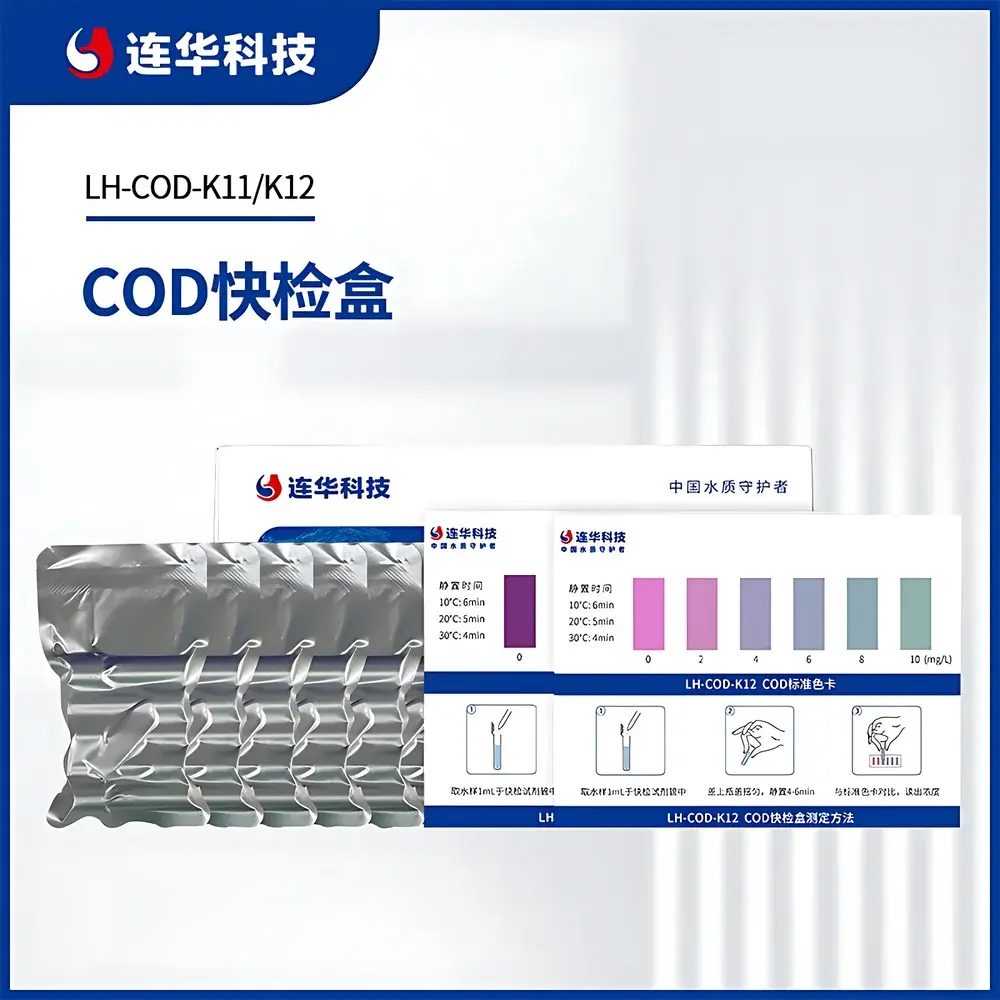
Lianhua Technology LH-COD-K11/LH-COD-K12 High- and Low-Range COD Quick Test Kit
| Brand | Lianhua Technology |
|---|---|
| Origin | Beijing, China |
| Manufacturer Type | Manufacturer |
| Product Origin | Domestic (China) |
| Model | LH-COD-K11 / LH-COD-K12 |
| Pricing | Upon Request |
Overview
The Lianhua Technology LH-COD-K11/LH-COD-K12 High- and Low-Range COD Quick Test Kit is a field-deployable, colorimetric analytical system engineered for rapid determination of Chemical Oxygen Demand (COD) in water and wastewater samples. Based on the standardized dichromate oxidation method (aligned with ISO 6060 and HJ 828–2017), the kit employs pre-measured reagents sealed in calibrated glass vials to oxidize organic matter under acidic, high-temperature conditions. The resulting color intensity—proportional to the concentration of reduced Cr³⁺—is quantified via visual comparison against a high-stability, NIST-traceable color scale. Designed for emergency response, mobile laboratories, and routine on-site screening, this dual-range system enables reliable COD assessment without benchtop spectrophotometers or dedicated analytical personnel.
Key Features
- Dual-Range Design: LH-COD-K11 covers 0–150 mg/L COD (low range), optimized for surface water, drinking water sources, and treated effluent; LH-COD-K12 spans 0–1500 mg/L COD (high range), suitable for raw sewage, industrial discharge, and landfill leachate.
- Visual Colorimetric Readout: Integrated reference color chart printed on durable, UV-stabilized polymer card—calibrated to ±5% accuracy at mid-range concentrations per batch QC verification.
- Precision-Reagent Packaging: Each test vial contains pre-weighed K₂Cr₂O₇, Ag₂SO₄ catalyst, and H₂SO₄ in exact stoichiometric ratios; sealed under inert gas to ensure reagent stability for ≥24 months at ambient storage (15–30°C).
- Field-Optimized Workflow: Requires only a heat source (e.g., portable COD digester or sand bath), timer, and distilled water rinse—no pipettes, balances, or calibration curves needed.
- Operator-Independent Protocol: Standardized 2-hour digestion at 150°C followed by immediate visual assessment minimizes inter-user variability; validated across operators with <2 years of environmental field experience.
Sample Compatibility & Compliance
The LH-COD-K11/K12 kit is validated for use with clarified aqueous matrices including municipal wastewater, river water, cooling tower blowdown, and pretreated industrial effluents. Turbid or highly chlorinated samples require prior dilution or chloride masking (using HgSO₄ additive, available separately). Results comply with the fundamental principles of ISO 6060:1989 (Water quality — Determination of chemical oxygen demand) and are consistent with U.S. EPA Method 410.4 for screening-level COD estimation. While not intended for regulatory reporting without laboratory confirmation, data generated meet GLP documentation requirements when paired with Lianhua’s optional digital logsheet (LH-LOG-COD v2.1) supporting audit-ready metadata capture (date, operator ID, sample ID, lot number, ambient temperature).
Software & Data Management
No embedded electronics or firmware are included—ensuring zero power dependency and maximal ruggedness. However, Lianhua provides optional companion tools: (1) a free web-based COD interpretation portal (cod.lianhua-tech.com) enabling photo-based color matching via smartphone upload and AI-assisted hue analysis (ISO 11664-4 compliant); (2) Excel-compatible template (LH-COD-Data-Template.xlsx) for traceable recordkeeping aligned with ISO/IEC 17025 clause 7.5.2. All reagent lots undergo full QC release testing—including blank absorbance, recovery spikes (100±10 mg/L glucose-glutamic acid standard), and inter-lot consistency—and certificates of analysis are supplied digitally upon request.
Applications
- Rapid pre-discharge verification at municipal wastewater pumping stations
- On-the-spot compliance checks during environmental inspections (e.g., China MEP “Blue Sky” enforcement campaigns)
- Troubleshooting bioreactor performance in decentralized treatment units
- Baseline COD mapping in watershed emergency response (e.g., post-spill or flood scenarios)
- Educational use in university environmental engineering labs for method validation exercises
FAQ
What is the shelf life of unopened vials?
Unopened vials retain full reactivity for 24 months from manufacturing date when stored between 15–30°C, away from direct sunlight and humidity.
Can this kit replace laboratory COD analysis for regulatory submission?
No. It serves as a rapid screening tool; confirmatory analysis using certified lab methods (e.g., ISO 6060 or ASTM D1252) is required for compliance reporting.
How does chloride interference affect results?
Samples with Cl⁻ > 1000 mg/L require addition of mercury sulfate (HgSO₄) to suppress interference—available as optional accessory LH-COD-CL-MASK.
Is the color chart NIST-traceable?
Yes. Reference colors are produced using Pantone Solid Coated standards calibrated against NIST SRM 2806a (liquid color standards) and verified annually by an ILAC-accredited metrology lab.
Are there disposal guidelines for used vials?
Spent vials contain hexavalent chromium residues and must be treated as hazardous waste per local regulations (e.g., China GB 5085.3–2007 or U.S. EPA 40 CFR Part 261).







