
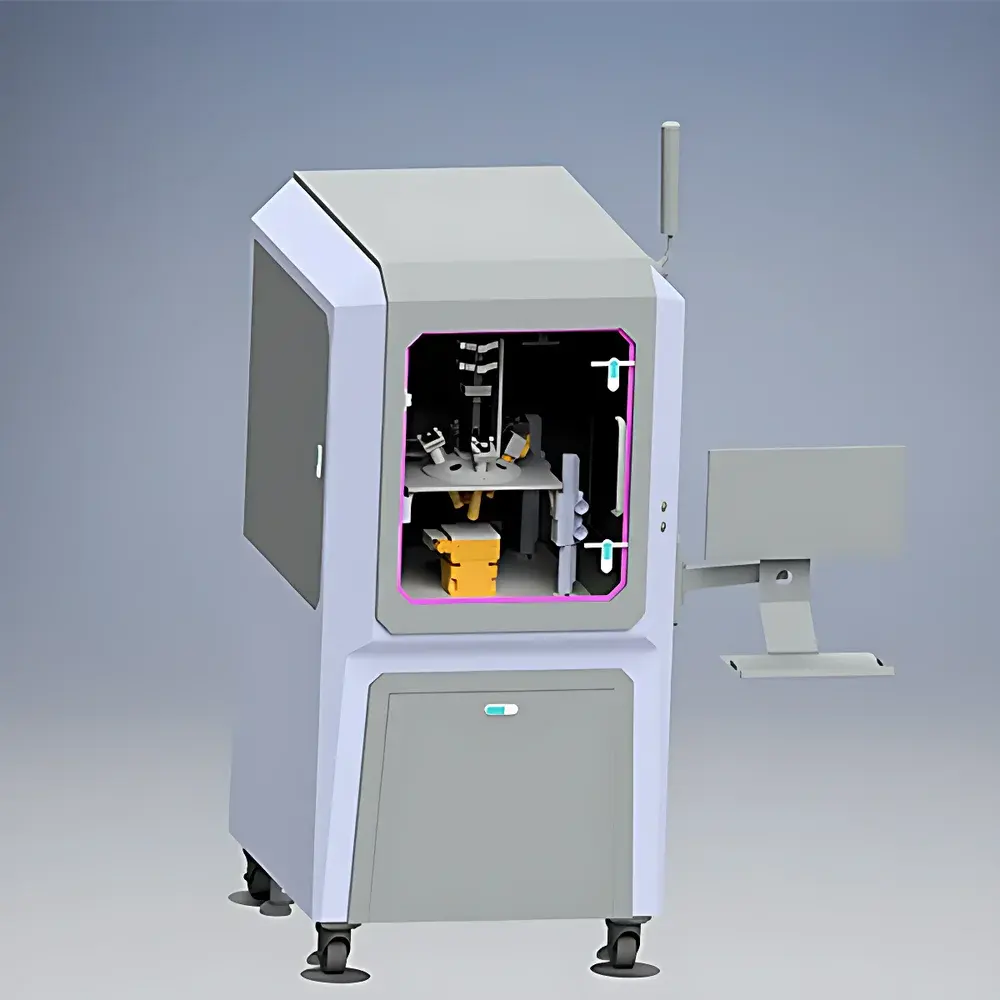
LIBS-R900 Research-Grade Laser-Induced Breakdown Spectroscopy System
| Brand | ZOLIX |
|---|---|
| Origin | Beijing, China |
| Manufacturer Type | Original Equipment Manufacturer (OEM) |
| Product Category | Domestic |
| Model | LIBS-R900 |
| Price | USD 84,000 (approx.) |
| Instrument Form Factor | Benchtop |
Overview
The ZOLIX LIBS-R900 Research-Grade Laser-Induced Breakdown Spectroscopy (LIBS) System is a benchtop analytical platform engineered for elemental identification and spatially resolved quantitative analysis across solid, liquid, and gaseous samples. It operates on the fundamental principle of laser-induced plasma generation: a high-energy pulsed laser is tightly focused onto the sample surface, producing transient micro-plasma with temperatures exceeding 10,000 K. This plasma emits element-specific atomic and ionic emission lines during its decay phase. The emitted light is collected via optimized optical pathways and dispersed by a high-resolution spectrometer; spectral data are acquired using a national-indigenous iCMOS detector with nanosecond-scale temporal gating. Unlike conventional techniques requiring extensive sample preparation, LIBS enables direct, minimally destructive, in-situ analysis—making it particularly valuable for heterogeneous, non-conductive, or irregularly shaped materials where traditional methods (e.g., ICP-OES or XRF) face limitations.
Key Features
- Full-spectrum detection range from 200 nm to 900 nm, with optional extended configurations covering UV–NIR domains
- Optical resolution ≤ 0.1 nm (FWHM), configurable to sub-0.05 nm for high-fidelity line separation in complex matrices
- Ultrafast gated detection with minimum gate width of 3 ns and timing precision of ±10 ps for optimal plasma signal-to-background optimization
- Modular laser source integration supporting selectable pulse energies (50 mJ, 100 mJ, 200 mJ, 400 mJ) at fundamental wavelengths (e.g., 1064 nm) or frequency-doubled outputs
- Motorized XYZ translation stage with customizable travel ranges and micron-level repeatability for high-accuracy mapping
- Integrated coaxial and off-axis optical architectures—enabling flexible experimental configurations for standoff, micro-LIBS, or vacuum-compatible operation
- Real-time auto-focus system combining machine vision algorithms and laser triangulation for dynamic surface tracking during raster scanning
- Comprehensive safety enclosure compliant with Class 1 laser product standards (IEC 60825-1), certified for transport and immediate operational deployment
Sample Compatibility & Compliance
The LIBS-R900 accommodates diverse sample forms without digestion or coating: bulk metals, geological cores, biological tissues (e.g., skin sections, tumor biopsies), aerosol filters, aqueous suspensions, and gas-phase targets under controlled purge environments. Optional vacuum chamber integration supports low-background measurements for trace element detection in ultra-high-purity materials. All optical and electronic subsystems conform to CE marking requirements. Software architecture supports audit trails, user access control, and electronic signature functionality—aligning with GLP and GMP documentation practices. Data export formats (CSV, HDF5, JCAMP-DX) ensure interoperability with third-party spectral libraries and regulatory reporting tools compliant with ASTM E2926-22 (Standard Guide for LIBS Analysis) and ISO/IEC 17025:2017 clause 7.7 (Reporting of Results).
Software & Data Management
The proprietary ZOLIX LIBS Studio software provides an integrated environment for acquisition, processing, visualization, and reporting. Core modules include real-time spectral display with peak identification (NIST Atomic Spectra Database v2023), automatic baseline correction, intensity normalization, and multivariate calibration (PLS, PCA). Mapping functionality generates 2D/3D pseudo-color elemental distribution maps with pixel-level quantification based on internal standardization or calibration-free CF-LIBS algorithms. All acquisitions are timestamped, metadata-tagged (laser energy, delay time, gate width, stage coordinates), and automatically archived with version-controlled file naming. The API supports Python and MATLAB scripting for custom algorithm integration. Database connectivity includes ODBC-compliant interfaces for SQL Server, PostgreSQL, and cloud-based LIMS platforms—facilitating enterprise-scale data governance and cross-instrument correlation.
Applications
- Geoscience & Archaeometry: In-field elemental profiling of ores, slag, ceramics, and sediment layers for provenance studies and stratigraphic dating
- Environmental Monitoring: Quantitative detection of heavy metals (Pb, Cd, As, Hg) in soil digests, airborne particulates, and freshwater bioindicators
- Metallurgy & Materials Science: Rapid alloy verification, inclusion analysis, coating thickness validation, and corrosion product characterization
- Biomedical Research: Label-free elemental mapping of Ca/P ratios in bone sections, Zn/Cu gradients in brain tissue, and Fe accumulation in pathological specimens
- Energy Sector: Real-time coal ash composition monitoring, catalyst deactivation assessment, and nuclear fuel cladding integrity screening
- Forensics & Cultural Heritage: Non-invasive pigment analysis in paintings, ink differentiation in documents, and gunshot residue fingerprinting
FAQ
What is the typical detection limit for major elements (e.g., Fe, Al, Si) in solid metallic samples?
Detection limits vary with matrix, laser fluence, and integration strategy—but routinely achieve 10–100 ppm for most transition metals under optimized gated acquisition conditions.
Can the system be operated in ambient air, or is inert gas purging mandatory?
Ambient operation is fully supported; however, Ar or He purge significantly enhances signal stability and lowers LODs for light elements (e.g., C, N, O, Li) by suppressing molecular band interference.
Is spectral calibration traceable to NIST standards?
Yes—wavelength calibration uses Hg/Ne/Ar lamp references with automated polynomial fitting; intensity calibration employs calibrated photodiode-based radiometric transfer standards.
Does the software support compliance with FDA 21 CFR Part 11 for regulated laboratories?
Full Part 11 readiness is available via optional software license, including role-based permissions, electronic signatures, and immutable audit logs.
What upgrade paths exist for hybrid modalities?
Pre-engineered optical ports allow seamless integration of Raman spectroscopy (785 nm/532 nm excitation), time-resolved fluorescence, and confocal microscopy modules—all synchronized via shared timing electronics and coordinate registration.
Related Products




