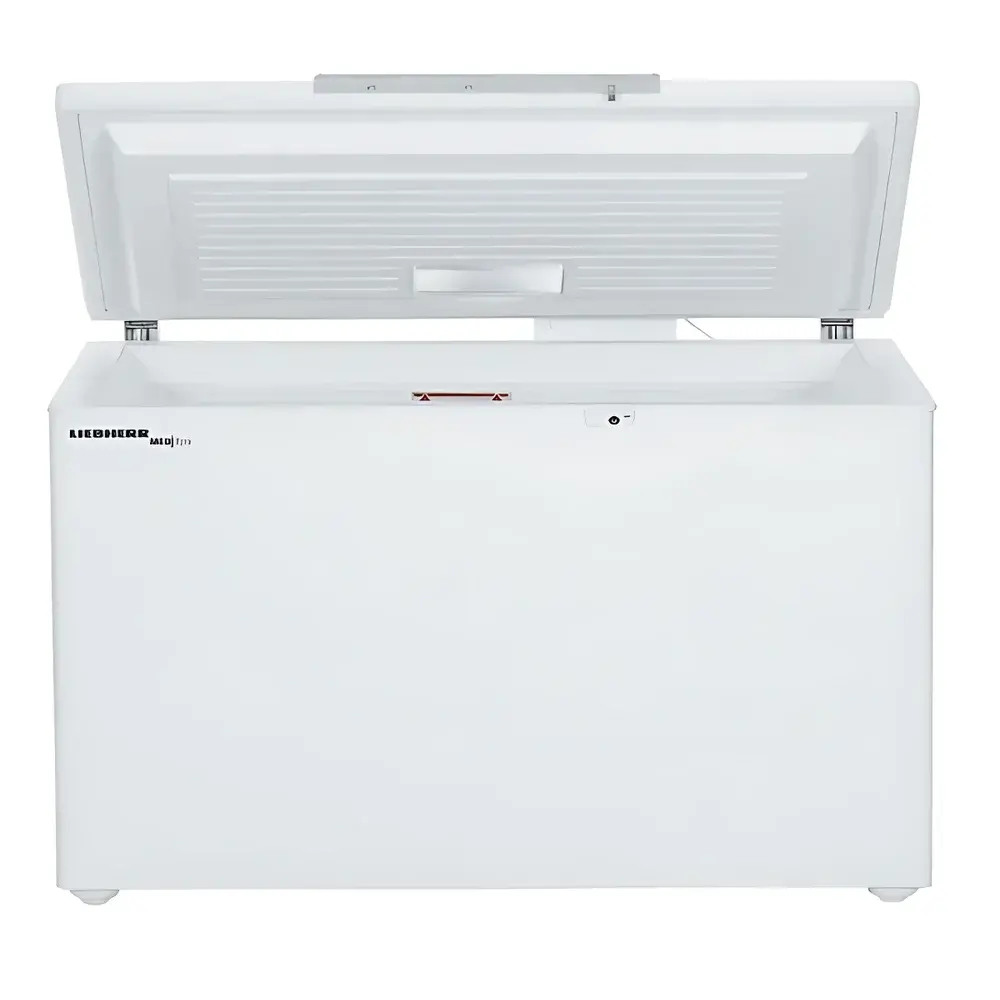
Liebherr LGT 4725 Ultra-Low Temperature Horizontal Freezer
| Brand | Liebherr |
|---|---|
| Origin | Austria |
| Model | LGT 4725 |
| Type | Horizontal ULT Freezer |
| Effective Volume | 459 L |
| Interior Dimensions (W×D×H) | 1648 × 808 × 919 mm |
| External Dimensions (W×D×H) | 1648 × 808 × 919 mm |
| Power Supply | 220 V ±10 V |
| 24-h Energy Consumption | 4.352 kWh |
| Temperature Range | −10 °C to −45 °C |
| Temperature Uniformity | ±5 °C |
| Control Resolution | 0.1 °C (−10 °C to −19.9 °C), 1 °C (below −20 °C) |
| Construction | Stainless Steel Cabinet & Lid |
| Hinge Durability | ≥300,000 Cycles |
| Safety Lock | Integrated Mechanical Lock |
| Frost Reduction | StopFrost System |
| Internal Liner | Anodized White Aluminum |
| Control System | Comfort-Series Electronic Controller (Top-Mounted, 5° Forward Tilt) |
| Sensor Interface | NTC Probe with RS485 Output for LTM Monitoring Software |
| Optional External Sensor Port | Rear-Mounted Dedicated Hole |
Overview
The Liebherr LGT 4725 is a horizontally configured ultra-low temperature (ULT) freezer engineered for long-term, stable cryopreservation of sensitive biological and chemical materials in regulated laboratory environments. Operating within a precisely controlled temperature range of −10 °C to −45 °C, the unit is not classified as a “deep” or “ultra-deep” freezer (i.e., −80 °C class), but rather occupies a critical niche for applications requiring reliable sub-zero storage without extreme energy demand or mechanical complexity. Its thermodynamic architecture employs a high-efficiency cascade or multi-stage refrigeration system—optimized for stability and low thermal load fluctuation—ensuring minimal temperature deviation across the entire 459 L chamber volume. Designed and assembled in Austria under Liebherr’s ISO 9001-certified manufacturing protocols, the LGT 4725 complies with IEC 61000-6-3 (EMC) and IEC 61000-6-2 (immunity) standards, and meets EU ErP Directive 2019/2023 requirements for energy labeling and eco-design of refrigerating appliances.
Key Features
- High-Stability Temperature Control: Digital Comfort-series controller enables setpoint adjustment in 0.1 °C increments between −10 °C and −19.9 °C, and 1 °C steps below −20 °C; real-time monitoring via integrated NTC sensor ensures ±5 °C uniformity across all zones.
- Durable Mechanical Architecture: Reinforced stainless steel cabinet and lid resist corrosion and mechanical fatigue; industrial-grade hinges rated for ≥300,000 open/close cycles ensure long-term structural integrity in high-traffic labs.
- StopFrost Technology: A proprietary passive pressure-equalization system minimizes internal frost accumulation during frequent door access, reducing manual defrost frequency and preserving thermal stability during transient events.
- Modular Monitoring Integration: RS485 serial interface supports direct connection to Liebherr’s LTM (Laboratory Temperature Monitoring) software platform—enabling centralized, time-stamped logging and alarm management for up to 20 units per network node.
- Compliance-Ready Design: Rear-mounted external sensor port allows installation of calibrated, traceable temperature probes (e.g., PT100 or NIST-traceable thermistors) for independent validation—critical for GLP, GMP, and ISO 17025 audit trails.
- Energy-Efficient Operation: Achieves 4.352 kWh/24 h consumption at nominal −30 °C setpoint, validated per EN 62552-2:2016; optimized insulation and compressor staging reduce peak load and improve grid compatibility.
Sample Compatibility & Compliance
The LGT 4725 is routinely deployed for the secure storage of temperature-sensitive life science specimens including primary cell isolates, serum batches, monoclonal antibodies, viral vectors, lyophilized reagents, clinical trial reference standards, and diagnostic assay kits. Its −45 °C lower limit satisfies storage requirements specified in ASTM E2983–22 (Standard Guide for Cryopreservation of Biological Materials) and aligns with WHO Technical Report Series No. 961 Annex 5 (Good Storage Practices). While not intended for long-term archival of stem cells or genomic DNA (which typically require −80 °C or vapor-phase LN₂), it meets stringent stability criteria for intermediate-term storage (≤6 months) of proteins, enzymes, and frozen tissue blocks under ISO 20387:2018 (Biobanking) guidelines. The white anodized aluminum interior liner facilitates rapid decontamination using ethanol or hydrogen peroxide vapor—supporting biosafety level 2 (BSL-2) workflow compliance.
Software & Data Management
Liebherr’s LTM software provides FDA 21 CFR Part 11-compliant data handling when deployed with appropriate server infrastructure and user access controls. Each LGT 4725 logs timestamped temperature values, alarm events (e.g., door ajar, sensor fault, ambient overtemperature), and operational status (compressor runtime, defrost cycle initiation) into encrypted binary files. Audit trail functionality records all parameter changes—including user ID, timestamp, and pre-/post-modification values—with immutable write-once storage options. Raw data exports are available in CSV and PDF formats; optional integration with enterprise LIMS platforms (e.g., LabWare, Thermo Fisher SampleManager) is supported via OPC UA or RESTful API adapters (sold separately).
Applications
- Stabilization and interim storage of ELISA, PCR, and lateral flow assay reagents in clinical diagnostics laboratories.
- Preservation of quality control standards and reference materials used in pharmaceutical QC/QA workflows.
- Cold-chain holding for biobank accessioning prior to deep-freeze transfer or nucleic acid extraction.
- Controlled freezing of microbial cultures and fermentation intermediates in bioprocess development labs.
- Secure archiving of regulatory submission samples (e.g., stability study batches) under ICH Q5C conditions.
- Backup cold storage for university core facilities where −80 °C capacity is constrained or power resilience is prioritized.
FAQ
What is the validated temperature uniformity specification across the chamber volume?
The LGT 4725 achieves ±5 °C spatial uniformity (per EN 62552-3:2016) when measured at nine standardized locations (center, corners, mid-walls) at −30 °C steady state.
Does the unit support 21 CFR Part 11-compliant electronic signatures?
Yes—when operated with LTM software v3.2+ on a validated Windows Server environment with role-based authentication, digital signature capture, and audit trail export capabilities.
Can external temperature probes be calibrated independently of the built-in NTC sensor?
Yes—the rear-mounted sensor port accepts third-party Class A PT100 or NIST-traceable thermistors; calibration certificates must be maintained per ISO/IEC 17025 requirements.
Is the StopFrost system serviceable or field-upgradable?
No—StopFrost is a sealed, passive mechanical feature integrated into the lid gasket assembly; no maintenance or replacement parts are required over the product lifetime.
What is the minimum ambient operating temperature for installation?
The unit is rated for ambient temperatures between +10 °C and +32 °C (IEC 60068-2-1/2); operation outside this range may compromise compressor efficiency and temperature recovery time.
Related Products