
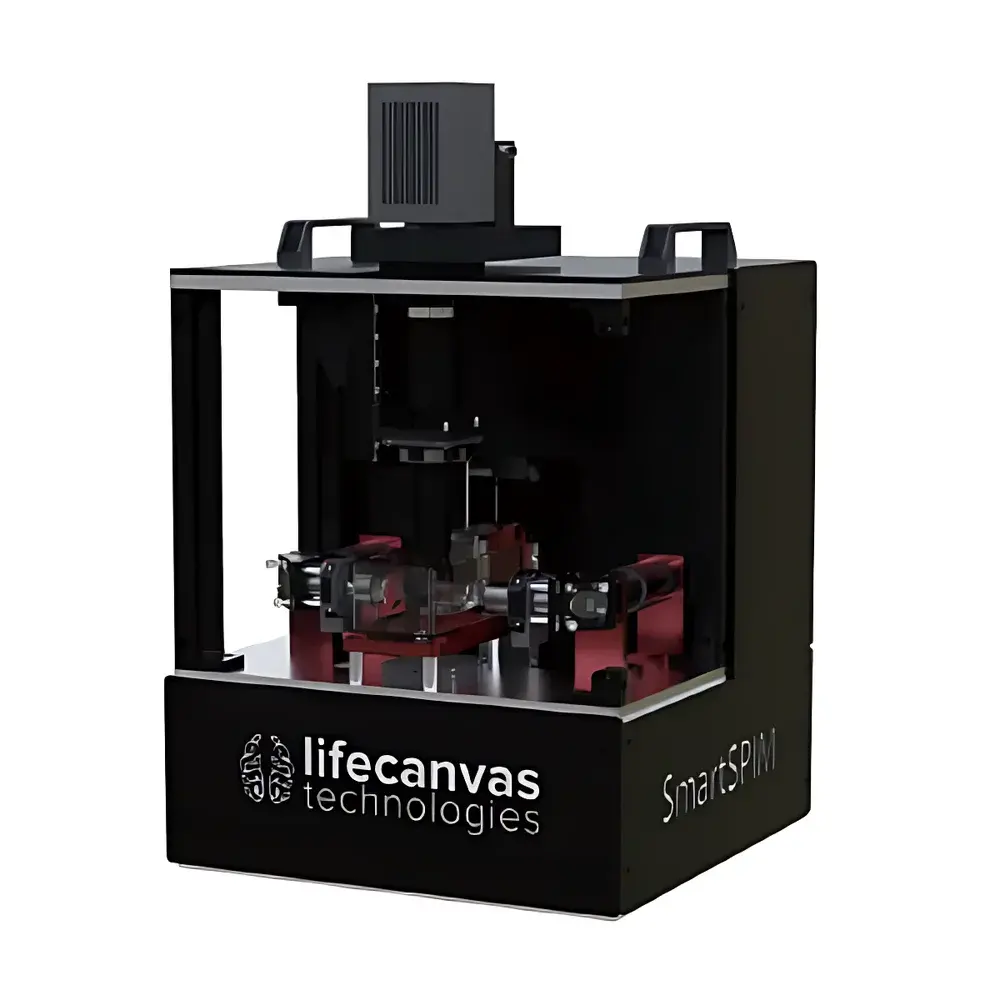
LifeCanvas SmartSPIM Mesoscopic Light Sheet Microscope
| Brand | LifeCanvas Technologies |
|---|---|
| Origin | USA |
| Model | SmartSPIM |
| Illumination | Dual-sided scanned light sheet (US Patent No. US10989661B2) |
| Sample Chamber Dimensions (Standard) | 25 mm × 25 mm × 20 mm (W × L × H) |
| Extended Chamber | 40 mm × 65 mm × 20 mm |
| Objective NA (Illumination) | 0.125 |
| Tube Lens | 180 mm EFL, achromatic wide-spectrum correction |
| Standard Detection Objective | 3.6×, NA = 0.3, WD = 18 mm, pixel size = 1.8 µm × 1.8 µm (with 50 mm EFL tube lens) |
| Optional Objectives | 1.63×, 9×, 15×, 22× |
| Axial Resolution (3.6×) | PSF<sub>z</sub> = 3.2–4.0 µm |
| Field of View (3.6×) | 3650 µm |
| Lateral Sampling (3.6×) | 1.8 µm/pixel |
| Z-step | 4 µm |
| Max Frame Rate | 20 FPS |
| Whole Mouse Brain Imaging Time (Single Channel) | ≤30 min |
| Camera | 2048 × 2048 sCMOS, rolling shutter synchronized with light sheet scan, QE = 82%, max 80 fps |
| Laser Lines (Standard) | 488 nm, 561 nm, 639 nm (3 lines) |
| Optional Lasers | 405 nm, 445 nm, 690 nm, 785 nm (up to 6 total) |
| Acquisition Workstation | Intel Core i7-10700K (3.8 GHz), 32 GB DDR4 quad-channel RAM, onboard 1 GbE/10 GbE NIC, Windows 10 Pro, 4K display |
| Software | SmartSPIM Acquisition & Post-processing Suite (real-time tile correction, block alignment, stripe artifact removal, GPU-accelerated 3D reconstruction) |
| Analysis Workstation | AMD Ryzen Threadripper 3960X (24-core), 128 GB DDR4 quad-channel RAM, 32 TB RAID 0 storage (4 × 8 TB, 7200 RPM), Windows 10 Pro |
Overview
The LifeCanvas SmartSPIM Mesoscopic Light Sheet Microscope is an engineered platform for high-speed, low-phototoxicity volumetric imaging of cleared and intact biological specimens at mesoscopic scale. It implements a patented dual-sided scanned light sheet illumination architecture (US10989661B2), wherein orthogonal beam scanning generates a thin, uniform light sheet that propagates axially across the sample volume while minimizing scattering-induced intensity decay and optical aberrations. This design enables isotropic resolution preservation over extended axial ranges—critical for whole-organ imaging such as murine brain mapping—and supports simultaneous multi-channel excitation with precise temporal synchronization between illumination pulses and camera rolling-shutter readout. The system is optimized for use with established tissue clearing protocols (e.g., CUBIC, CLARITY, iDISCO+) and integrates seamlessly into GLP-compliant imaging pipelines requiring traceable acquisition metadata, audit trails, and reproducible spatial calibration.
Key Features
- Dual-sided scanned light sheet illumination with real-time dynamic focusing and adaptive beam shaping for uniform sheet thickness (<5 µm FWHM) across >15 mm axial range
- Modular objective turret supporting rapid interchange of detection optics: standard 3.6× (NA 0.3, 18 mm WD) and optional 1.63×, 9×, 15×, or 22× objectives for scalable magnification and resolution trade-offs
- Wide-spectrum corrected 180 mm EFL tube lens system enabling chromatic fidelity across 405–785 nm excitation range
- High-quantum-efficiency (82%) 2048 × 2048 sCMOS sensor with hardware-synchronized rolling shutter, delivering 20 FPS volumetric capture at full resolution and sub-pixel lateral sampling (1.8 µm/pixel at 3.6×)
- Integrated multi-laser engine with three standard solid-state lasers (488/561/639 nm) and expansion capability for up to six wavelengths—including near-UV (405 nm) and NIR (690/785 nm)—for multiplexed immunolabeling and spectral unmixing workflows
- Dedicated acquisition and analysis workstations configured for deterministic I/O throughput: dual-system architecture separates real-time streaming (i7-10700K + 32 GB RAM + 10 GbE) from computationally intensive 3D registration, deconvolution, and atlas alignment (Threadripper 3960X + 128 GB RAM + 32 TB RAID 0)
Sample Compatibility & Compliance
The SmartSPIM accommodates specimens ranging from embryonic organoids to adult mouse brains, with standard chamber dimensions of 25 mm × 25 mm × 20 mm (W × L × H) and extended configurations up to 40 mm × 65 mm × 20 mm. Its open-sample design permits direct immersion mounting in refractive-index-matched media (e.g., FocusClear, RIMS, 80% glycerol) without mechanical compression. All optical components comply with ISO 10110 surface quality standards; laser safety conforms to IEC 60825-1:2014 Class 3R requirements. Data acquisition software enforces FDA 21 CFR Part 11–compliant electronic signatures, session-level audit logging, and immutable metadata embedding (including timestamped laser power calibration, objective identification, and Z-stack step verification). The platform is validated for use in ISO/IEC 17025-accredited laboratories performing quantitative neuroanatomical phenotyping per ASTM E3214-21 guidelines.
Software & Data Management
SmartSPIM Acquisition Software provides a deterministic, low-latency interface for hardware orchestration—including laser TTL triggering, piezo stage sequencing, and camera exposure gating—with real-time preview of tile overlap, intensity homogeneity, and motion artifacts. Built-in block-based correction algorithms compensate for illumination nonuniformity and stage drift during long acquisitions. Post-processing is performed using SmartSPIM Reconstruction Suite, which implements GPU-accelerated iterative deconvolution (Richardson-Lucy), automatic stripe artifact suppression via Fourier-domain filtering, and rigid/non-rigid 3D mosaicking with sub-micron registration accuracy. Output formats include OME-TIFF (with complete OME-XML metadata), N5, and HDF5—fully compatible with Fiji/ImageJ, Imaris, Vaa3D, and Allen Institute’s MindScope pipelines. Raw data integrity is preserved via checksummed archival and optional integration with institutional LIMS via RESTful API.
Applications
- Whole-brain connectomics: mapping neuronal projections in Thy1-YFP-H or MAP2-GFP transgenic mice with single-cell resolution across >108 voxels
- Developmental biology: time-lapse imaging of organogenesis in cleared zebrafish embryos or postnatal mouse limb buds
- Tumor microenvironment profiling: 3D quantification of immune cell infiltration, vascular density, and hypoxia marker distribution in orthotopic glioblastoma models
- High-throughput phenotyping: automated batch acquisition of >50 cleared specimens per week under standardized illumination and focus protocols
- Multiscale correlation: bridging light-sheet data with serial two-photon tomography (STP) or micro-CT volumes via landmark-based affine registration
FAQ
What tissue clearing methods are validated for use with the SmartSPIM?
LifeCanvas provides protocol documentation and empirical validation for CUBIC, CLARITY, uDISCO, and PACT. Refractive index matching and optical homogeneity are verified using NIST-traceable immersion media calibration standards.
Can the system perform multi-view fusion without manual repositioning?
Yes—the SmartSPIM supports automated rotational sample mounting (optional motorized rotation stage) and includes native multi-angle acquisition mode with integrated view registration and weighted fusion in the reconstruction pipeline.
Is remote operation supported for core facility deployment?
The acquisition workstation supports secure RDP and VNC access with role-based permissions; all control signals and metadata streams are encrypted using TLS 1.3, and session logs are exportable in CSV/JSON for facility usage auditing.
How is spatial calibration maintained across objective changes?
Each objective is factory-characterized for magnification, distortion, and working distance; calibration profiles are embedded in firmware and auto-loaded upon turret indexing, ensuring consistent voxel size reporting in OME-TIFF headers.
Does the software support batch processing of large-scale datasets?
Yes—SmartSPIM Reconstruction Suite includes command-line interfaces (CLI) for headless execution on HPC clusters, with Slurm/PBS job script templates and memory-aware tiling strategies for datasets exceeding 100 TB.





