
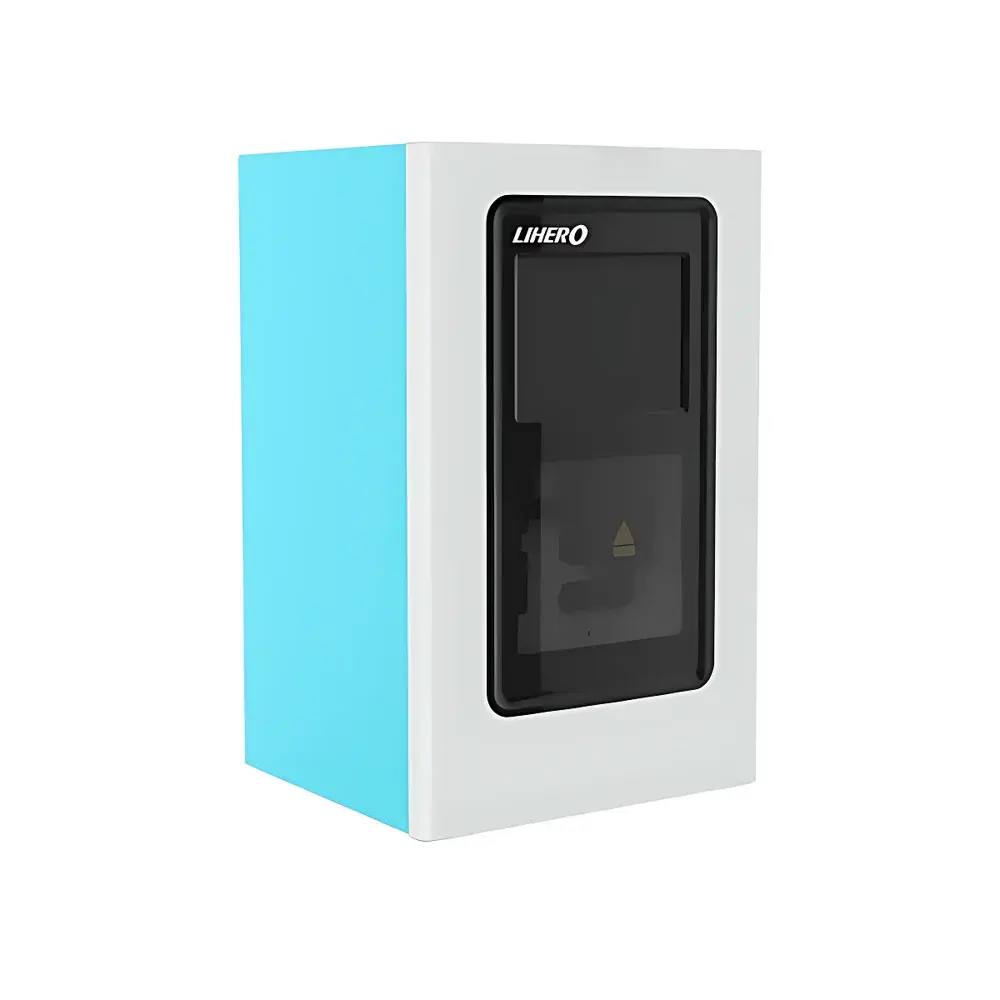
Lihero LFS-2002(TN) Total Nitrogen Analyzer
| Brand | Lihero |
|---|---|
| Model | LFS-2002(TN) |
| Measurement Principle | High-Temperature Alkaline Persulfate Oxidation + UV Spectrophotometry (220 nm & 275 nm) |
| Detection Range | 0.05–100 mg/L TN (typical, configurable) |
| Detection Method | A = A₂₂₀ₙₘ − 2 × A₂₇₅ₙₘ |
| 消解条件 | 120–124 °C, ≥0.11 MPa, 30 min |
| Optical System | Dual-Wavelength UV Photometer with Auto-Balanced Optical Path |
| Calibration Modes | Zero Check, Span Check, Standard Calibration, Curve Auto-Standardization, Spike Recovery Test |
| Compliance Support | ASTM D5176, ISO 11908, HJ 636-2012, EPA 351.2 (adapted), GLP/GMP-ready data logging |
| Remote Interface | Modbus TCP/IP, RS485, Optional 4G/LTE Data Upload |
| Operating System | Embedded Linux Real-Time OS |
| Self-Diagnosis | Integrated Sensor Health Monitoring, Reagent Level Sensing, Optical Path Stability Verification, Fault Logging & Cloud Upload |
Overview
The Lihero LFS-2002(TN) Total Nitrogen Analyzer is an automated, laboratory-grade online and at-line instrument engineered for precise, trace-level quantification of total nitrogen (TN) in surface water, wastewater, drinking water, and industrial effluents. It implements the internationally recognized high-temperature alkaline persulfate oxidation method—fully compliant with ISO 11908:2015, ASTM D5176, and China’s HJ 636-2012 standard protocols—followed by dual-wavelength ultraviolet spectrophotometric detection. Water samples are introduced via a non-contact plunger pump, routed through a multi-port selection valve, and accurately metered using photoelectric liquid-level sensing. The sample is then transferred to a sealed, pressurized digestion cell where sodium hydroxide and potassium persulfate reagents facilitate complete oxidation of organic nitrogen, ammonia, nitrite, and nitrate into nitrate under controlled thermal conditions (120–124 °C, ≥0.11 MPa, 30 min). Following acidification with hydrochloric acid to remove carbonate interference, absorbance is measured simultaneously at 220 nm (nitrate peak) and 275 nm (background correction for dissolved organic carbon and turbidity). The corrected absorbance is calculated as A = A220nm − 2 × A275nm, enabling robust compensation for color and suspended solids—critical for real-world environmental matrices.
Key Features
- Non-contact plunger pump sampling system eliminates cross-contamination and ensures long-term mechanical reliability across variable sample viscosities and particulate loads.
- Photoelectric liquid-level metering with auto-balancing sensor compensation guarantees volumetric accuracy ±1.5% over extended operational cycles.
- Sealed high-pressure digestion chamber maintains consistent thermal and chemical reaction kinetics, achieving >95% oxidation efficiency for refractory nitrogen species including pyrrole, indole, and heterocyclic amines.
- Dual-wavelength UV photometric detection with real-time optical path self-balancing minimizes drift and enhances signal stability—typical 24-hour baseline drift < ±0.002 AU.
- Integrated spectral interference correction algorithms dynamically suppress turbidity and chromophore effects without requiring physical filtration or dilution.
- Comprehensive on-board calibration suite includes zero check, span verification, standard curve auto-standardization, spike recovery assessment (per ISO/IEC 17025 Annex B), and multi-point linearity validation.
- Fault-resilient architecture with embedded diagnostics: reagent depletion alerts (NaOH, K2S2O8, HCl, deionized water), component health monitoring (pump actuation, valve sequencing, temperature/pressure sensor integrity), and out-of-range data flagging with timestamped event logging.
Sample Compatibility & Compliance
The LFS-2002(TN) accommodates raw influent, clarified effluent, reservoir water, and pretreated groundwater—with optional inline filtration (5–10 µm) recommended for high-suspended-solid applications (>100 mg/L TSS). It meets regulatory data integrity requirements for environmental monitoring programs governed by national discharge permits and municipal compliance reporting. Instrument firmware supports audit-trail-enabled operation per GLP and GMP principles, with immutable event logs, user-access-controlled calibration records, and time-stamped measurement metadata exportable in CSV or XML formats. All analytical outputs are traceable to NIST-traceable nitrate standards and validated against certified reference materials (CRMs) such as NIST SRM 1643e and LGC QC-1012.
Software & Data Management
Powered by a real-time embedded Linux OS, the analyzer features a secure web-based HMI accessible via local Ethernet or remote TLS-encrypted connection. Configuration, method setup, calibration history, and diagnostic reports are managed through a role-based interface supporting up to four permission tiers (Operator, Technician, Supervisor, Administrator). Raw spectral data, corrected absorbance values, and concentration results are stored locally for ≥90 days and optionally transmitted via Modbus TCP/IP to SCADA systems or cloud platforms (AWS IoT Core, Azure IoT Hub) using configurable polling intervals (1–1440 minutes). All communications comply with IEC 62443-3-3 security profiles; data payloads include digital signatures to prevent tampering during transit.
Applications
- Continuous monitoring of TN in municipal wastewater treatment plant (WWTP) influent, bioreactor zones, and final effluent discharge points.
- Regulatory compliance testing for industrial pretreatment programs (e.g., textile, pharmaceutical, food processing facilities).
- Research-grade nutrient flux studies in watershed management and eutrophication modeling projects.
- Quality control of reclaimed water used in agricultural irrigation or industrial cooling circuits.
- Support for ISO 5667-3 field sampling campaigns with portable deployment kits (optional battery-powered variant available).
FAQ
What digestion method does the LFS-2002(TN) use, and how does it compare to UV-persulfate alternatives?
It employs high-temperature (120–124 °C), high-pressure (≥0.11 MPa) alkaline persulfate oxidation—a thermodynamically driven process that achieves near-complete conversion of all nitrogen species, including recalcitrant organics unreactive under ambient UV activation.
Can the analyzer operate unattended for extended periods?
Yes—designed for 30-day unattended operation with standard reagent packs; optional reagent level telemetry and predictive maintenance alerts enable proactive servicing scheduling.
Is the instrument compatible with third-party LIMS or ERP systems?
Fully interoperable via Modbus TCP/IP, OPC UA (add-on module), and RESTful API endpoints supporting JSON-formatted data exchange and command injection.
How is calibration traceability maintained?
All calibrations reference CRM-certified nitrate solutions; instrument-specific correction factors and curve-fit parameters are digitally signed and archived alongside each analysis batch.
Does the system support method validation per ISO/IEC 17025?
Yes—built-in tools generate full validation reports including LOD/LOQ determination, precision (repeatability & intermediate precision), trueness (spike recovery %), linearity (R² ≥ 0.999), and robustness testing logs.







