
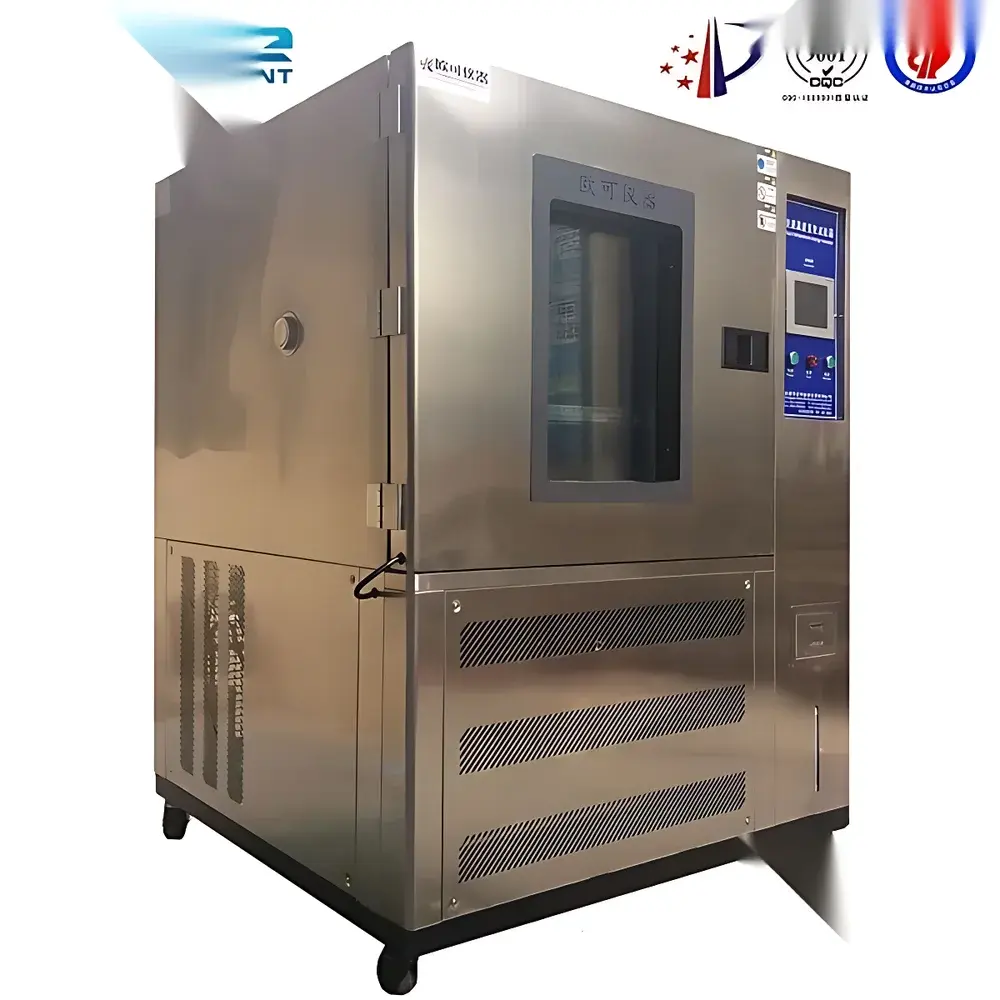
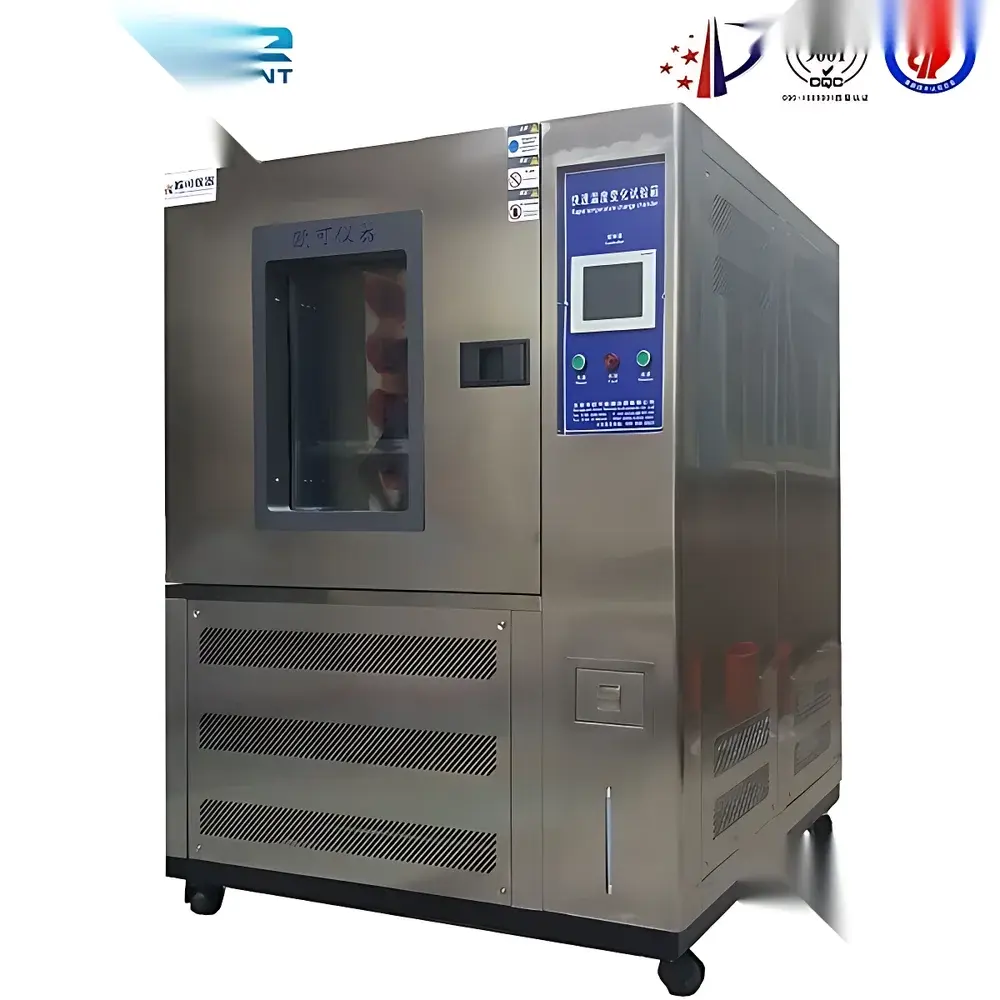
Linear Rapid Temperature Change Test Chamber
| Brand | Custom OEM / Other Brands |
|---|---|
| Origin | Imported |
| Manufacturer Type | Authorized Distributor |
| Capacity | 80 L |
| Internal Dimensions (H×W×D) | 400 × 500 × 400 mm |
| Temperature Range | −70 °C to +150 °C |
| Temperature Uniformity | ±0.5 °C |
| Heating System | Nickel-Chromium Alloy Wire Heater |
| Cooling System | Hermetic Compressor (Tecumseh or equivalent), Eco-Friendly Refrigerant |
| Insulation | Rigid Polyurethane Foam + Glass Wool |
| Interior Material | Mirror-Finish Stainless Steel (SUS304) |
| Exterior Material | Powder-Coated Steel or Stainless Steel |
| Air Circulation | Centrifugal Blower |
| Temperature Sensor | PT100 Dry-Bulb Sensor |
| Control Mode | Balanced Temperature Control (BTC) |
| Ramp Rate | Linear, −70 °C ↔ +150 °C in <90 min |
| Ambient Operating Condition | +5 °C to +35 °C |
| Power Supply | 2Φ 3W 220 VAC ±10% |
| Safety Protections | Compressor Overheat/Overcurrent/High-Pressure, Heater Dry-Burn Prevention, Chamber Over-Temperature Cut-off |
Overview
The Linear Rapid Temperature Change Test Chamber is an engineered environmental simulation system designed to execute precise, repeatable, and linear thermal cycling profiles across extreme temperature ranges—from −70 °C to +150 °C. Unlike conventional thermal chambers relying on stepwise or dwell-based conditioning, this chamber employs a balanced temperature control (BTC) architecture, dynamically modulating heating and refrigeration outputs in real time to maintain strict linearity and minimal overshoot during transitions. Its core function is to replicate accelerated thermal stress conditions encountered in real-world deployment—such as aerospace launch-to-orbit thermal shock, automotive under-hood cycling, or outdoor electronics exposure to diurnal extremes—enabling rigorous reliability validation per international test standards including MIL-STD-810H Method 503.6, IEC 60068-2-14, and JEDEC JESD22-A104E.
Key Features
- Linear Ramp Precision: Achieves programmable ramp rates with ≤±0.5 °C temperature fluctuation throughout the full operating range; verified via traceable PT100 dry-bulb sensor array calibrated to ISO/IEC 17025-accredited standards.
- Dual-Mode Thermal Actuation: Integrates high-efficiency nickel-chromium alloy resistive heating with a hermetically sealed, low-GWP refrigeration circuit (R513A or R134a compliant), enabling symmetric heating and cooling performance—both −70 °C → +150 °C and +20 °C → −70 °C completed in under 90 minutes.
- Robust Thermal Isolation: 120 mm thick composite insulation comprising rigid polyurethane foam (λ ≈ 0.022 W/m·K) and layered glass wool minimizes parasitic heat leakage and ensures stable chamber boundary conditions during rapid transients.
- Corrosion-Resistant Construction: Interior chamber fabricated from electropolished SUS304 stainless steel with mirror finish (Ra ≤ 0.4 µm) prevents particulate shedding and facilitates cleaning for cleanroom-compatible applications; exterior housing options include powder-coated carbon steel or full stainless steel.
- Fail-Safe Protection Suite: Embedded hardware-level safeguards include compressor discharge temperature monitoring, refrigerant high-pressure cut-off, heater open-circuit detection, and independent over-temperature limiter—each triggering immediate power isolation without controller dependency.
Sample Compatibility & Compliance
This chamber accommodates test specimens up to 80 L volume (400 × 500 × 400 mm internal cavity), supporting standard test fixtures, PCB carriers, and small- to medium-sized assemblies—including automotive ECUs, photovoltaic modules, optical isolators, and medical device enclosures. It complies with electromagnetic compatibility requirements per EN 61326-1 for laboratory use and meets structural safety provisions of IEC 61010-1. While not pre-certified to UL or CSA, its design basis aligns with clause 11.2 (thermal hazard mitigation) and clause 12.3 (mechanical integrity) of those standards. For regulated industries, the chamber supports integration into GLP/GMP environments when paired with optional audit-trail-capable controllers meeting FDA 21 CFR Part 11 data integrity requirements.
Software & Data Management
The system supports both standalone operation via integrated single-point PID controller and networked supervision using optional PC-based software (e.g., WinTest Pro or custom LabVIEW drivers). All configurations provide real-time graphing of chamber setpoint vs. actual temperature, ramp rate calculation, deviation alarms, and CSV-exportable log files timestamped to ±100 ms resolution. Optional firmware upgrades enable event-triggered data capture (e.g., at temperature inflection points), user-defined pass/fail thresholds, and automated report generation compliant with ISO/IEC 17025 documentation frameworks.
Applications
- Aerospace component qualification per MIL-STD-810H, particularly thermal vacuum interface testing and avionics box survivability assessment.
- Automotive electronics validation—including ADAS sensors, battery management systems, and infotainment units—under SAE J2380-recommended thermal cycling profiles.
- Photovoltaic module reliability screening per IEC 61215-2 MQT11 (thermal cycling) and IEC 61646 for thin-film technologies.
- Material science research on coefficient-of-thermal-expansion (CTE) mismatch in multi-layer ceramic capacitors (MLCCs), solder joint fatigue modeling, and polymer crystallinity shifts.
- Quality assurance for medical devices requiring environmental stress screening (ESS) per ANSI/AAMI/ISO 13485:2016 Annex C protocols.
FAQ
What is the maximum allowable specimen mass for thermal inertia compensation?
The chamber is rated for thermal load stability with specimens ≤15 kg; heavier loads require extended stabilization time and may affect ramp linearity—consult engineering support for custom thermal inertia modeling.
Can the chamber operate continuously at −70 °C or +150 °C?
Yes; sustained operation at extremes is supported, though continuous −70 °C requires periodic defrost cycle management per manufacturer maintenance schedule.
Is remote monitoring and alarm notification available?
Standard Ethernet or RS485 interfaces support Modbus TCP/RTU integration with SCADA or building management systems; email/SMS alerts require third-party middleware configuration.
Does the system meet RoHS and REACH material compliance?
All internal wetted materials—including gaskets, insulation binders, and sensor housings—conform to EU Directive 2011/65/EU (RoHS2) and Regulation (EC) No 1907/2006 (REACH) SVHC screening criteria.
What calibration documentation is supplied with delivery?
Each unit ships with a factory calibration certificate covering temperature uniformity and ramp accuracy at three points (−40 °C, 25 °C, +85 °C), traceable to NIST or equivalent national metrology institute standards.



