
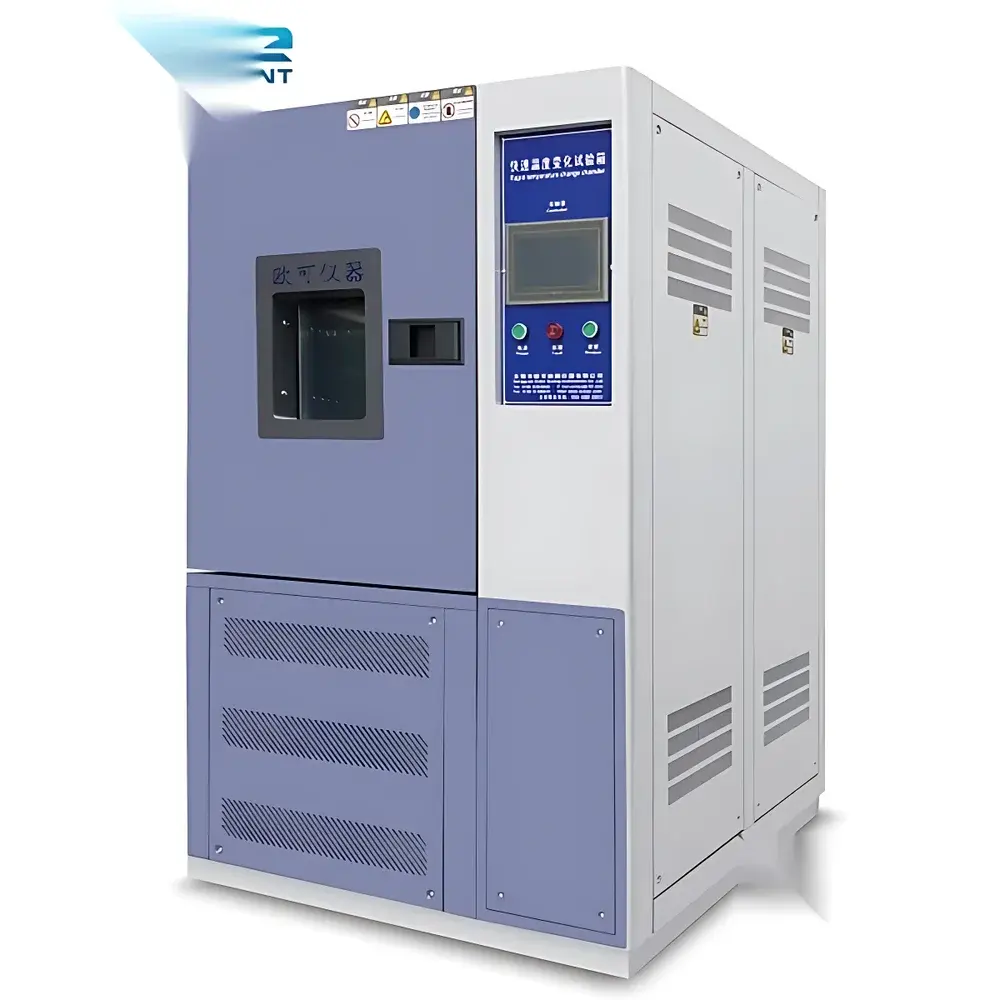
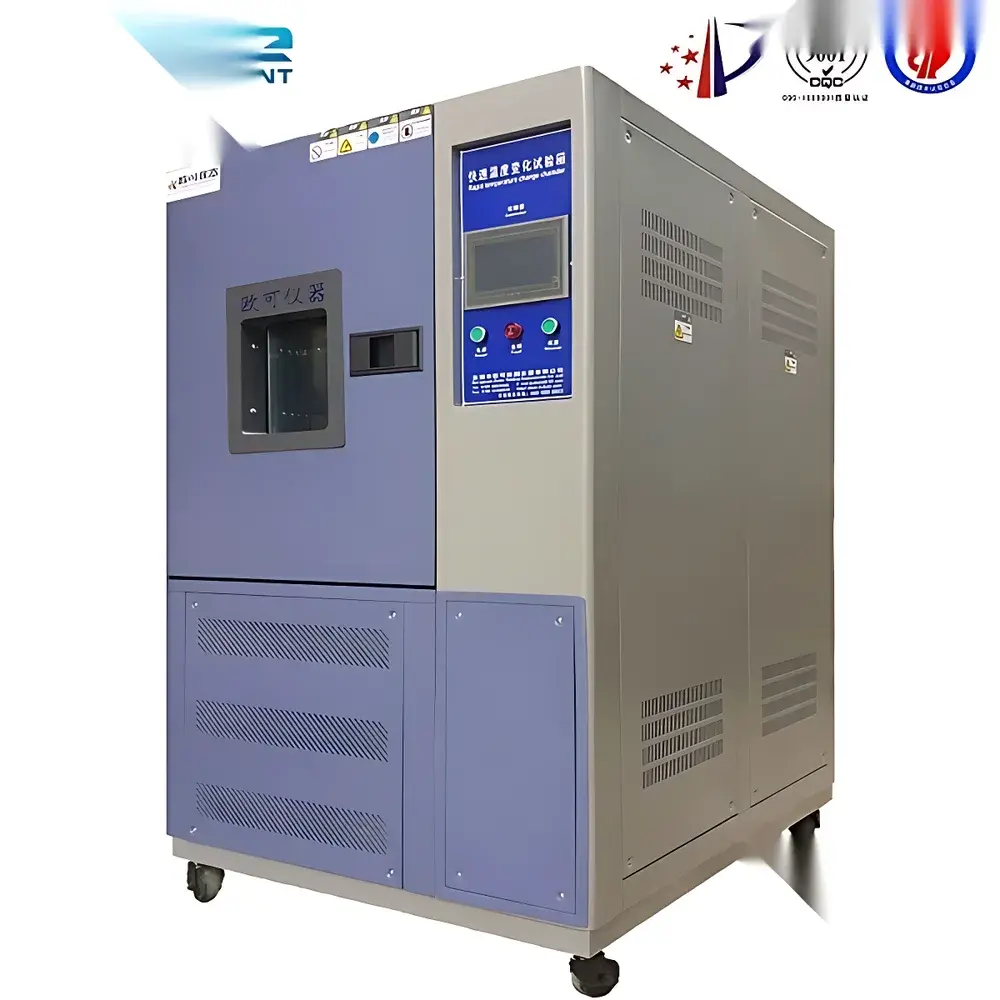
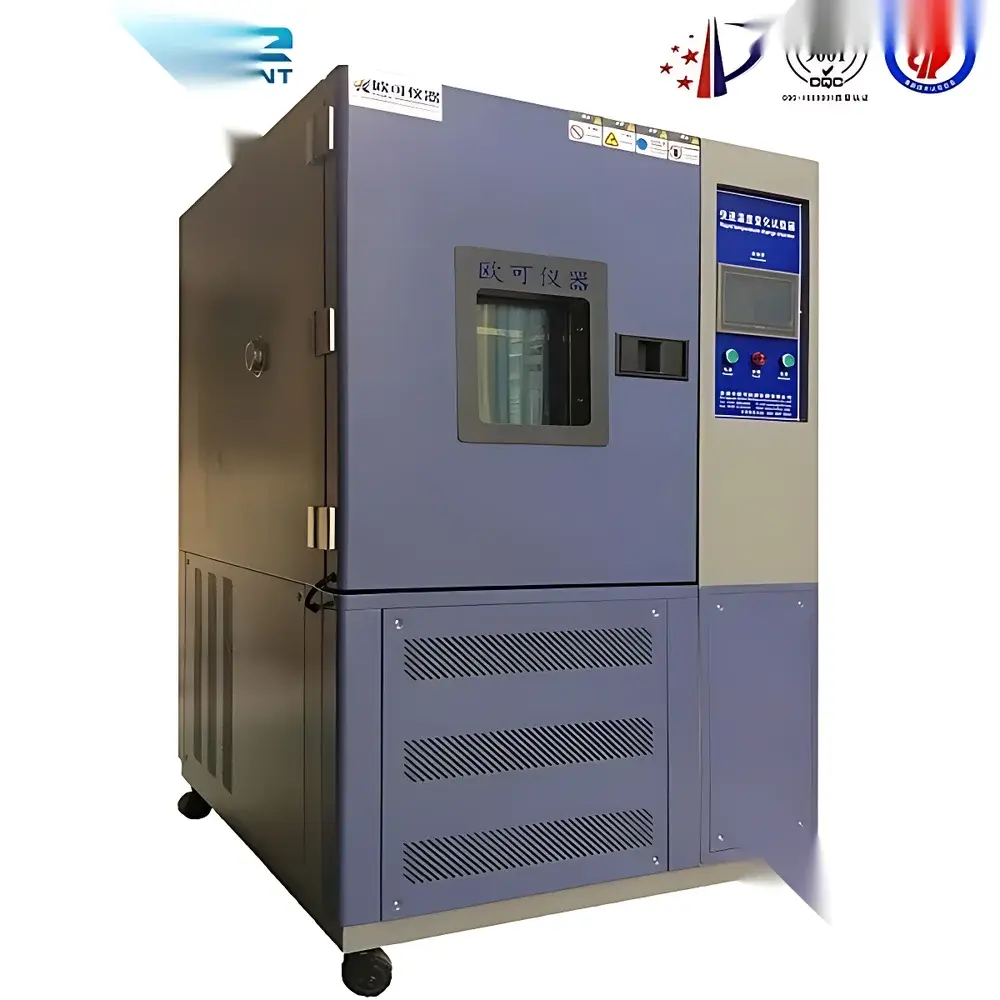
Linear Rapid Temperature Change Test Chamber – Compliant with GB & IEC Environmental Testing Standards
| Brand | OEM / Generic |
|---|---|
| Origin | Imported |
| Manufacturer Type | Authorized Distributor |
| Price | USD 2,650 (FOB) |
| Temperature Range | -70°C to +180°C |
| Ramp Rate | Up to 15°C/min (linear, load-dependent) |
| Uniformity | ±0.5°C |
| Stability | ±0.3°C |
| Control Resolution | 0.01°C |
| Humidity Range (if equipped) | 20–98% RH |
| Compliance | GB/T 5170.2, GB/T 5170.5, GB/T 2423.1–2423.4, GB/T 2423.22, IEC 60068-2-1, IEC 60068-2-2, IEC 60068-2-14 |
Overview
The Linear Rapid Temperature Change Test Chamber is a precision-engineered environmental simulation system designed for accelerated thermal stress testing of electronic components, automotive modules, aerospace materials, and industrial assemblies. It operates on the principle of forced-air convection with dual independent refrigeration and electric heating circuits, enabling programmable linear temperature transitions between extremes—typically from −70 °C to +180 °C—with ramp rates up to 15 °C per minute under no-load conditions. Unlike step-stress or dwell-based chambers, this system executes strictly linear thermal profiles to replicate real-world thermal shock scenarios without overshoot or dwell artifacts, supporting deterministic failure analysis and HALT/HASS protocol development. Its architecture complies with the metrological and operational requirements defined in GB/T 5170.2 (temperature test equipment calibration), GB/T 2423.22 (temperature change test method N), and harmonized IEC 60068-2 series standards—ensuring traceable, auditable, and repeatable test outcomes in GLP and GMP-regulated environments.
Key Features
- Robust chamber construction using SUS304 brushed stainless steel interior and cold-rolled steel exterior with electrostatic powder coating for corrosion resistance and long-term dimensional stability
- High-efficiency cascade refrigeration system with environmentally compliant HFC refrigerants (R404A/R23), integrated with PID-controlled resistive heating elements for precise thermal actuation
- Triple-layer insulated walls: rigid polyurethane foam core (≥100 mm thickness) + vacuum-deposited aluminum foil vapor barrier + fine glass wool reinforcement for thermal inertia minimization and uniformity optimization
- Large observation window with double-glazed low-E tempered glass and integrated LED viewing lamp, enabling real-time visual monitoring without compromising thermal integrity
- Intelligent air circulation design featuring centrifugal blower, adjustable vane diffusers, and symmetrical duct layout to maintain ±0.5 °C temperature uniformity across the working volume (per GB/T 5170.2)
- Touchscreen controller with embedded Ethernet port, supporting Modbus TCP and optional RS485 interface for SCADA integration and remote supervision
Sample Compatibility & Compliance
This chamber accommodates standard test specimens up to 500 mm × 500 mm × 500 mm (W×D×H) and supports mounting fixtures for PCBs, battery packs, sensors, and encapsulated optoelectronic devices. All structural and control subsystems are validated against national and international environmental test standards—including GB/T 2423.1 (cold), GB/T 2423.2 (dry heat), GB/T 2423.3 (constant damp heat), GB/T 2423.4 (cyclic damp heat), and GB/T 2423.22 (temperature change)—with full documentation available for audit readiness. Calibration certificates are traceable to CNAS-accredited laboratories and align with ISO/IEC 17025 requirements. Optional humidity control module extends compliance to GB/T 5170.5 and IEC 60068-2-78 for combined temperature-humidity stress profiling.
Software & Data Management
The embedded controller firmware supports user-defined multi-segment thermal programs (up to 99 cycles, 999 steps), automatic data logging at configurable intervals (1–60 s), and real-time graphing of chamber setpoint, actual temperature, and deviation. Exported CSV files include timestamps, thermocouple channel IDs, and alarm event markers—enabling post-test statistical process control (SPC) analysis. For regulated industries, optional validation packages include IQ/OQ documentation templates, electronic signature support, and audit trail functionality compliant with FDA 21 CFR Part 11 and EU Annex 11 requirements. Remote access via secure HTTPS enables centralized fleet management across distributed lab networks.
Applications
- Qualification testing of automotive ECUs per ISO 16750-4 and AEC-Q200
- Thermal cycling validation of lithium-ion battery cells and BMS hardware
- Reliability screening of military-grade connectors and avionics enclosures
- Material coefficient-of-thermal-expansion (CTE) characterization under controlled ramp profiles
- Pre-compliance verification for IEC 60068-2-14 (change of temperature) and MIL-STD-810H Method 503.5
- Process window qualification for conformal coating adhesion and solder joint integrity
FAQ
What is the difference between linear temperature change and thermal shock testing?
Linear temperature change applies a controlled, constant-rate transition between two setpoints, minimizing transient thermal gradients. Thermal shock typically involves rapid transfer between separate hot/cold chambers, inducing higher mechanical stress. This chamber supports both modes—but its primary design intent is standardized linear ramp testing per GB/T 2423.22 and IEC 60068-2-14.
Can the chamber be validated for ISO/IEC 17025 accredited testing?
Yes—when paired with third-party certified reference thermometers (e.g., Class A PT100 probes) and calibrated per GB/T 5170.2, the system meets uncertainty budgets required for ISO/IEC 17025 accreditation. Full validation documentation kits are available upon request.
Is remote monitoring and alarm notification supported?
Standard Ethernet connectivity enables SNMP traps, email alerts (SMTP), and integration with enterprise CMMS platforms via OPC UA or MQTT protocols. Optional cellular failover module ensures continuity during LAN outages.



