
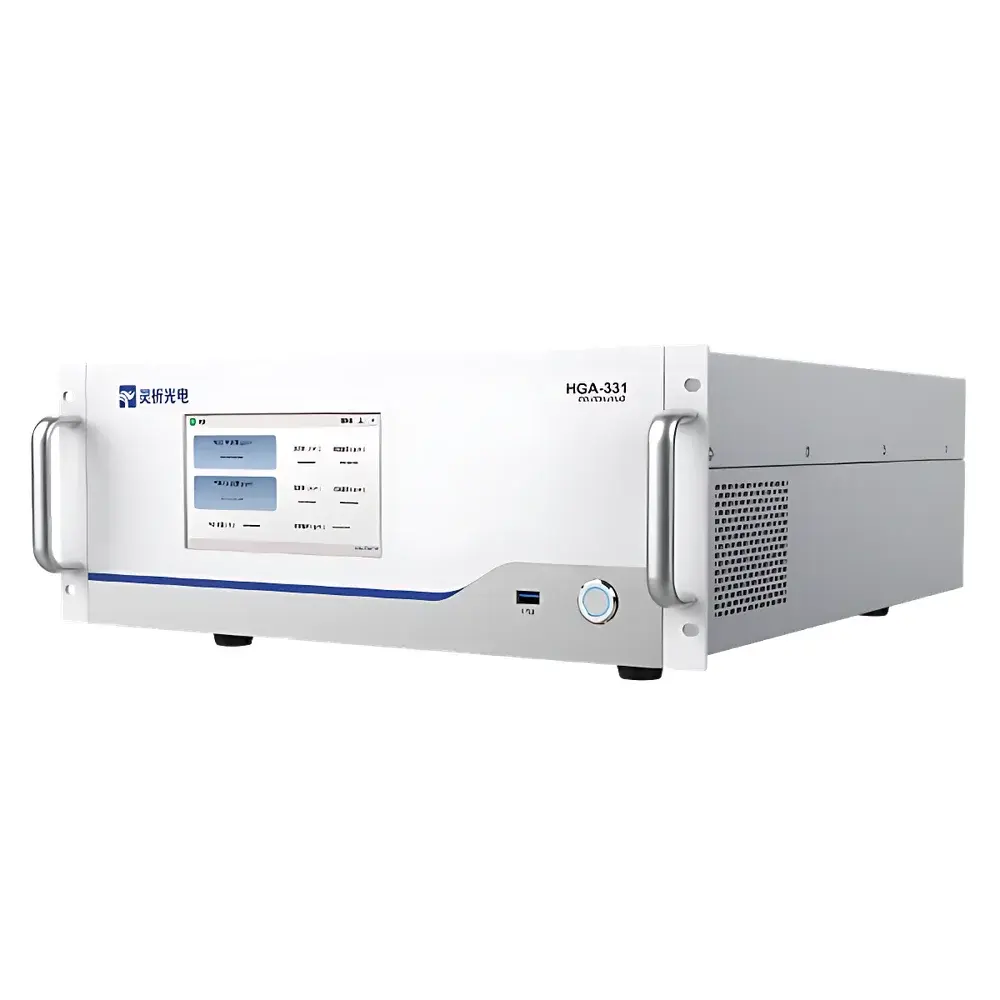
Lingxi Optoelectronics HGA-331 High-Precision Greenhouse Gas Analyzer
| Brand | Lingxi Optoelectronics |
|---|---|
| Origin | Zhejiang, China |
| Model | HGA-331 |
| Measurement Principle | Cavity Ring-Down Spectroscopy (CRDS) |
| Detection Gases | CO₂, CH₄, H₂O (simultaneous) |
| Sensitivity | < 1 ppb (for CO₂ and CH₄) |
| Compliance | WMO Global Atmosphere Watch (GAW) Performance Specifications |
| Temperature & Pressure Control | Integrated active thermal and barometric stabilization |
| Output | Dry-mole-fraction concentrations (H₂O-corrected) |
| Data Logging | Internal storage + Ethernet/RS-232/USB interfaces |
Overview
The Lingxi Optoelectronics HGA-331 High-Precision Greenhouse Gas Analyzer is an advanced in-situ trace gas measurement system engineered for continuous, unattended monitoring of atmospheric carbon dioxide (CO₂), methane (CH₄), and water vapor (H₂O) at parts-per-trillion (ppt)-level precision. Built upon the physical principle of Cavity Ring-Down Spectroscopy (CRDS), the instrument leverages ultra-stable high-finesse optical cavities to achieve effective path lengths exceeding 20 km within a compact, thermally isolated optical bench. This enables sub-ppb detection limits and exceptional signal-to-noise ratio without requiring cryogenic cooling or external laser tuning. The analyzer operates on direct absorption spectroscopy at near-infrared wavelengths—specifically targeting rovibrational transitions of CO₂ (~1.57 µm), CH₄ (~1.65 µm), and H₂O (~1.39 µm)—ensuring species-specific quantification with minimal spectral interference. Designed to meet the stringent metrological requirements of the World Meteorological Organization’s Global Atmosphere Watch (WMO-GAW) program, the HGA-331 delivers long-term stability suitable for reference-grade atmospheric observatories, flux tower networks, and regulatory compliance monitoring.
Key Features
- Simultaneous real-time quantification of CO₂, CH₄, and H₂O mole fractions with independent calibration traceability to NIST-standard gas mixtures
- Integrated dual-stage temperature and pressure stabilization: cavity temperature controlled to ±0.01 °C; pressure regulated to ±0.05 kPa—minimizing refractive index drift and line-broadening artifacts
- Proprietary water-vapor correction algorithm that computes dry-mole-fraction concentrations using in situ H₂O measurements, eliminating dilution bias without physical drying or permeation membranes
- Drift performance of <±0.1 ppb CO₂ and <±0.05 ppb CH₄ over 30-day intervals under field-deployed conditions (verified per WMO-GAW intercomparison protocols)
- Ruggedized industrial enclosure (IP54 rated) with internal shock-absorbing mounts, wide ambient operating range (−20 °C to +45 °C), and low power consumption (<120 W)
- Modular optical architecture supporting future firmware-upgradable spectral channels for additional gases (e.g., N₂O, CO) via optional hardware kits
Sample Compatibility & Compliance
The HGA-331 accepts sample air drawn through standard 1/4″ OD stainless-steel or PFA tubing at flow rates of 0.5–2.0 L/min. No pre-concentration, chemical scrubbing, or catalytic conversion is required. Sample inlet design complies with WMO-GAW recommendations for particulate filtration (0.2 µm PTFE membrane), hydrophobic protection, and laminar-flow conditioning. All measurement outputs are reported as dry-air mole fractions (nmol·mol⁻¹), aligned with the WMO-CO₂ and WMO-CH₄ reporting conventions. The analyzer meets ISO 17025 technical competence requirements when operated within certified laboratory environments and supports audit-ready data integrity features including time-stamped raw absorbance spectra, calibration event logs, and sensor health diagnostics. It is compatible with GLP/GMP-aligned workflows and supports optional 21 CFR Part 11-compliant electronic signature modules for regulated environmental reporting.
Software & Data Management
The HGA-331 ships with Lingxi’s proprietary Analytical Control Suite (ACS v4.x), a cross-platform application providing remote configuration, real-time spectral visualization, automated zero/span validation, and customizable alarm thresholds. Data output conforms to CF Standard Names and NetCDF-4 format for seamless integration into ICOS, NOAA GML, and ACTRIS data pipelines. Internal SD-card logging (up to 1 year at 1-Hz resolution) coexists with streaming over Ethernet (TCP/IP or Modbus TCP) or serial (RS-232/485) interfaces. All firmware updates, spectral calibrations, and diagnostic reports are digitally signed and version-controlled. Audit trails include operator ID, timestamp, parameter change history, and checksum-verified raw ring-down decay files—enabling full reproducibility and traceability per ISO/IEC 17025 Clause 7.7.
Applications
- Long-term baseline monitoring at WMO-GAW stations and national atmospheric observatories
- Urban and regional greenhouse gas inversion modeling using dense sensor networks
- Facility-level carbon accounting and verification per ISO 14064-3 and GHG Protocol Corporate Standard
- Eddy covariance flux measurements integrated with EC-155 or CSAT3B sonic anemometers
- Mobile platform deployment (vehicle, drone, ship) for spatially resolved emission mapping
- Method development and intercomparison studies for next-generation CRDS and OA-ICOS platforms
FAQ
Does the HGA-331 require external calibration gases during routine operation?
No—factory-calibrated against primary standards traceable to NIST; optional on-site zero/span checks can be performed using certified synthetic air and multi-component target gases.
How is water vapor interference corrected without removing H₂O from the sample stream?
The instrument applies a first-principles radiative transfer model that accounts for pressure-broadening, line-mixing, and continuum absorption effects of H₂O on CO₂ and CH₄ spectral lines—outputting dry-mole-fraction values directly.
Can the HGA-331 operate unattended for extended periods in remote locations?
Yes—designed for >6-month continuous operation with onboard diagnostics, watchdog timers, and automatic recovery from brownout or communication loss events.
Is the raw spectral data accessible for third-party analysis?
Yes—full ring-down decay waveforms, fitted time constants, and residual spectra are exportable in HDF5 format with metadata compliant with FAIR principles.
What maintenance is required beyond periodic inlet filter replacement?
Annual verification of cavity mirror reflectivity (>99.998%) and pressure transducer accuracy; no consumables or optical alignment required under normal operating conditions.
Related Products







