
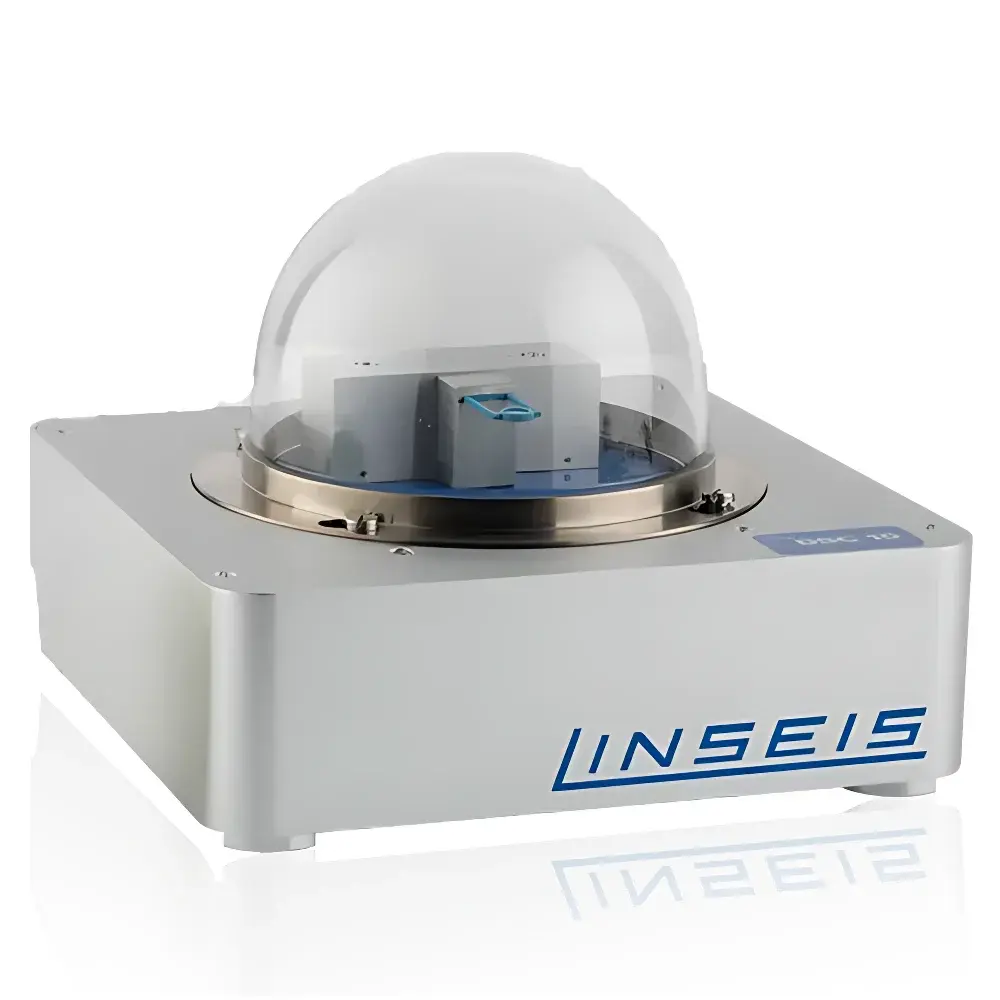
LINSEIS Chip-DSC 10 Advanced Differential Scanning Calorimeter
| Brand | LINSEIS |
|---|---|
| Origin | Germany |
| Model | Chip-DSC 10 (Chip-DSC L66 Advanced) |
| Instrument Type | Differential Scanning Calorimeter (DSC) |
| Temperature Range | –180 to 600 °C (with optional quench cooling) |
| Temperature Accuracy | ±0.2 K |
| Temperature Precision | ±0.02 K |
| Heating/Cooling Rate | 0.001–300 K/min (up to 500 K/min ballistic cooling from 400 °C) |
| DSC Signal Range | ±2.5 to ±1000 mW |
| Thermal Resolution | 0.03 µW |
| Digital Resolution | 16.8 million data points per trace |
| Atmosphere Options | Inert or oxidative (static/dynamic) |
| Calibration Frequency | Recommended every 6 months |
| Compliance | ASTM E794, ISO 11357-1 to -7, USP <1163>, GLP-ready audit trail support |
Overview
The LINSEIS Chip-DSC 10 Advanced is a high-performance differential scanning calorimeter engineered for precision thermal analysis under demanding experimental conditions. Unlike conventional DSC systems relying on macro-scale furnaces and thermocouple-based sensing, the Chip-DSC 10 implements a monolithic microelectromechanical sensor architecture—integrating resistive heating elements, platinum RTD temperature sensors, and thermopile-based heat-flow detection onto a single silicon chip. This chip-based design eliminates thermal lag, minimizes heat capacity (<10 mg total active mass), and enables true isothermal stability and ultrafast dynamic response. The instrument operates on the principle of symmetric heat-flux DSC, where differential power input required to maintain equal temperatures between sample and reference positions is measured in real time. Its compact footprint, USB-powered operation, and compatibility with standard laptop or mobile device control make it suitable for benchtop deployment in QC labs, academic research facilities, and hazardous-material screening environments.
Key Features
- Monolithic chip sensor platform with integrated heater, RTD, and thermopile—enabling direct heat-flow measurement without signal post-processing
- Ultra-low thermal mass yields exceptional dynamic performance: heating rates up to 300 K/min and ballistic cooling rates up to 500 K/min (from 400 °C to 30 °C in ≤4 min)
- High thermal resolution of 0.03 µW supports quantitative enthalpy determination for sub-milligram samples (e.g., 2.8 mg airbag initiators)
- Temperature precision of ±0.02 K and accuracy of ±0.2 K meet ASTM E794 and ISO 11357-2 calibration requirements
- Full-range operation from –180 °C to 600 °C enabled by optional open-container quench cooling system using liquid nitrogen or mechanical cryocooler interfaces
- Field-replaceable sensor chip—swap completed in <10 seconds; full recalibration achievable within 30 minutes—minimizing downtime during high-throughput or hazardous-sample workflows
- USB-powered operation (5 V DC) eliminates need for dedicated power conditioning; compatible with Windows, macOS, and Linux via LINSEIS ThermoSoft™ v5.x
Sample Compatibility & Compliance
The Chip-DSC 10 accommodates solid, powder, thin-film, and small-volume liquid samples (0.1–10 mg typical). Its inert atmosphere capability (N₂, Ar, He) and optional oxidative gas control (air, O₂) support testing under ISO 11357-3-compliant oxidation onset protocols. For energetic materials—including propellants, pyrotechnics, and battery electrolytes—the chip’s sacrificial design mitigates risk of furnace damage: unlike conventional DSCs where sensor failure necessitates full furnace replacement, Chip-DSC users replace only the disposable sensor module. All firmware and software modules comply with FDA 21 CFR Part 11 requirements for electronic records and signatures, including full audit trail logging, user access controls, and electronic signature capture. Routine calibration uses certified indium, tin, and zinc standards traceable to NIST SRMs; calibration verification follows ISO/IEC 17025 guidelines.
Software & Data Management
ThermoSoft™ v5.x provides native support for modulated DSC (MDSC®), step-scan analysis, Cp quantification (e.g., sapphire reference method), and real-time derivative evaluation (dH/dt). Raw data are stored in vendor-neutral ASCII format with embedded metadata (timestamp, operator ID, atmosphere, purge flow, calibration status). Batch processing supports automated peak integration, baseline correction using polynomial or tangent methods, and comparative kinetics modeling (e.g., Ozawa-Flynn-Wall, Kissinger). Export options include CSV, Excel (.xlsx), and universal .tdms (NI LabVIEW-compatible). Audit trail logs record all parameter changes, data edits, and report generation events with ISO 13485-aligned timestamping and user attribution.
Applications
- Fast screening of polymer crystallinity, glass transitions (Tg), cold crystallization, and melting behavior at variable scan rates (5–500 K/min) while maintaining enthalpy reproducibility ≤±1.5%
- Thermal stability assessment of Li-ion battery cathode/anode materials under inert and air atmospheres per UN 38.3 and IEC 62133 protocols
- In-situ observation of thermochromic phase transitions using optional top-view optical module (1080p camera, synchronized with thermal data acquisition)
- Specific heat capacity (Cp) determination via amplitude-modulated DSC—validated against sapphire reference with ≤3.5% deviation across 50–300 °C
- Hazard evaluation of explosive formulations and hypergolic propellants, leveraging rapid cooldown capability to arrest exothermic runaway prior to thermal decomposition propagation
- Food science applications including fat polymorphism, starch gelatinization, and protein denaturation kinetics under controlled humidity (optional RH module)
FAQ
Does the Chip-DSC 10 require external cooling equipment to reach –180 °C?
Yes—sub-ambient operation down to –180 °C requires the optional quench cooling accessory, which employs an open cryogenic bath surrounding the chip sensor. Liquid nitrogen is the standard coolant; closed-cycle refrigerators may be integrated upon request.
Can the chip sensor be calibrated in-house without sending it to a service center?
Yes—ThermoSoft™ includes guided calibration routines using supplied indium, tin, and zinc standards. Full multi-point temperature and sensitivity calibration can be performed in <30 minutes by trained personnel.
Is the instrument compliant with GMP/GLP documentation requirements?
Yes—audit trail functionality, electronic signature support, and 21 CFR Part 11–compliant data archiving are enabled by default. Validation packages (IQ/OQ/PQ) are available for regulated pharmaceutical and medical device laboratories.
What is the minimum detectable enthalpy change for a 1 mg polymer sample?
At 10 K/min scan rate, the system achieves a signal-to-noise ratio >100:1 for ΔH ≥ 0.5 J/g, corresponding to ~0.5 µJ for a 1 mg sample—sufficient for detecting subtle cold-crystallization events in semi-crystalline polyolefins.
How does the chip architecture improve resolution of overlapping thermal events?
The absence of thermal diffusion delays and uniform thermal coupling between sample and reference positions enable baseline fidelity <0.1 µW over 100 °C spans, permitting deconvolution of adjacent Tg and cold-crystallization peaks separated by as little as 2.5 °C.



