
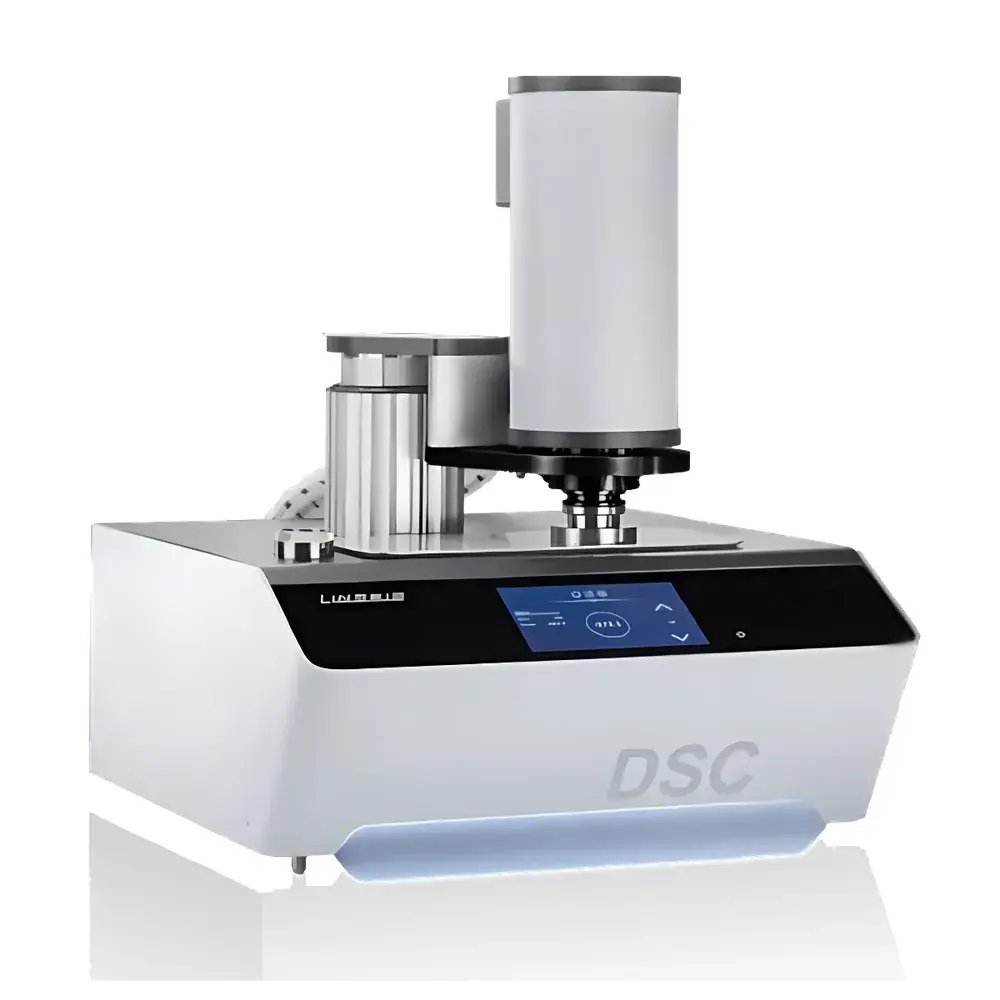
LINSEIS DSC L62 High-Temperature Differential Scanning Calorimeter
| Brand | LINSEIS |
|---|---|
| Origin | Germany |
| Model | DSC L62 |
| Instrument Type | DSC |
| Temperature Range | −150 °C to 1750 °C |
| Heating/Cooling Rate | 0.001–50 K/min |
| DSC Signal Range | ±2.5 mW to ±250 mW |
| Sensor Types | DSC, DTA, DSC–Cp |
| Thermocouple Options | E, K, S, B |
| Vacuum Capability | down to 10⁻⁵ mbar |
| Atmosphere Control | inert, oxidizing, reducing (static/dynamic) |
| Modulated Temperature Function | Yes |
| Interface | USB |
Overview
The LINSEIS DSC L62 is a high-precision, modular differential scanning calorimeter engineered for rigorous thermal analysis across an exceptionally broad temperature range—from cryogenic conditions at −150 °C up to ultra-high temperatures of 1750 °C. Based on the heat-flux measurement principle, the DSC L62 quantifies the difference in heat flow between a sample and an inert reference as both are subjected to identical, precisely controlled temperature programs. This enables accurate determination of enthalpy changes (ΔH), specific heat capacity (Cp), phase transition temperatures (e.g., glass transitions, melting, crystallization), and reaction kinetics. Its robust furnace architecture—compatible with interchangeable sensor modules and multiple thermocouple types (E, K, S, B)—ensures metrological stability and traceable calibration over decades of operation. The system’s vacuum-tight design (down to 10⁻⁵ mbar) supports high-purity atmosphere control and eliminates convective artifacts, making it suitable for quantitative Cp measurements and high-temperature thermochemical studies under inert, oxidative, or reducing environments.
Key Features
- Modular furnace platform supporting rapid sensor interchange between DSC, DTA, and DSC–Cp configurations
- Ultra-wide temperature capability: −150 °C to 1750 °C, with S-type thermocouple option enabling stable baseline performance up to 1450 °C
- Precise thermal control: programmable heating/cooling rates from 0.001 to 50 K/min, with high reproducibility across rate ranges
- High-sensitivity heat-flux detection: dynamic signal range of ±2.5 mW to ±250 mW, optimized for low-mass samples and subtle thermal events
- Vacuum-sealed measurement chamber compatible with static/dynamic gas purging and full vacuum operation (≤10⁻⁵ mbar)
- Integrated temperature modulation capability for advanced separation of reversing and non-reversing thermal effects
- USB-based digital interface compliant with Windows-based acquisition software; supports time-stamped data logging and real-time parameter monitoring
Sample Compatibility & Compliance
The DSC L62 accommodates diverse sample geometries and chemistries via a wide selection of crucibles—including high-purity alumina, platinum, gold, graphite, and sapphire—each validated for specific temperature and atmosphere constraints. Its modular sensor design allows seamless switching between DSC and DTA modes without hardware recalibration, facilitating comparative analysis per ISO 11357 and ASTM E794 standards. All thermal calibrations (temperature, enthalpy, Cp) are traceable to NIST-certified reference materials. Data acquisition and storage comply with GLP/GMP requirements, including audit-trail functionality, user-access controls, and electronic signature support when configured with validated software packages. The system meets essential electromagnetic compatibility (EMC) and safety directives per CE marking (2014/30/EU, 2014/35/EU).
Software & Data Management
Acquisition and analysis are performed using LINSEIS’s ThermoSoft® platform—a validated, Windows-native application supporting multi-channel real-time plotting, baseline correction, peak integration, kinetic modeling (e.g., Kissinger, Ozawa-Flynn-Wall), and Cp calculation via the step-heating method. Raw data are stored in vendor-neutral ASCII format with embedded metadata (timestamp, operator ID, instrument serial number, calibration history). Export options include CSV, Excel, and universal .tdms formats compatible with MATLAB, OriginLab, and Python-based analytical workflows. Optional 21 CFR Part 11 compliance modules provide role-based access control, electronic signatures, and immutable audit trails required for regulated pharmaceutical and medical device development.
Applications
The DSC L62 serves as a core analytical tool in advanced materials R&D, metallurgy, ceramics, and functional oxide synthesis. For instance, in ferrite production, it characterizes exothermic spinel formation (e.g., Fe₂O₃ + MeO → MeFe₂O₄ at ~735 °C), polymorphic transitions, and multi-stage melting behavior (e.g., endothermic peaks at 1034 °C and 1321 °C corresponding to distinct phase liquefaction events). It further enables quantitative Cp mapping of refractory alloys, oxidation kinetics of SiC composites, and decomposition thermodynamics of energetic materials. In academic and industrial QC labs, its reproducibility and extended temperature range support ASTM E1269 (Cp), ASTM E1356 (glass transition), and ISO 11357-2 (melting/crystallization) testing protocols.
FAQ
What thermocouple types are supported, and how do they affect maximum operating temperature?
The DSC L62 supports E-, K-, S-, and B-type thermocouples. S- and B-types are recommended for high-temperature operation (>1200 °C); the S-type sensor delivers optimal baseline stability up to 1450 °C.
Can the system perform true heat capacity (Cp) measurements?
Yes—when equipped with the DSC–Cp sensor module and operated under vacuum or inert gas, the system implements the step-heating method per ASTM E1269, delivering absolute Cp values with <±2% uncertainty.
Is the vacuum chamber compatible with coupling to hyphenated techniques?
Yes—the standard flanged outlet supports direct coupling to quadrupole mass spectrometers (QMS) or FTIR gas cells via heated transfer lines, enabling simultaneous thermal and evolved-gas analysis (EGA-DSC).
Does the system support automated sample handling?
An optional 16-position robotic autosampler is available, enabling unattended sequential analysis with integrated crucible recognition and thermal history tracking.
How is calibration verified and maintained over time?
Calibration is performed using certified reference materials (e.g., In, Zn, Sn, Al, Ag, Au, Ni) at defined transition points; software logs all calibration events with operator ID, date, and deviation metrics—fully auditable per ISO/IEC 17025 requirements.



