
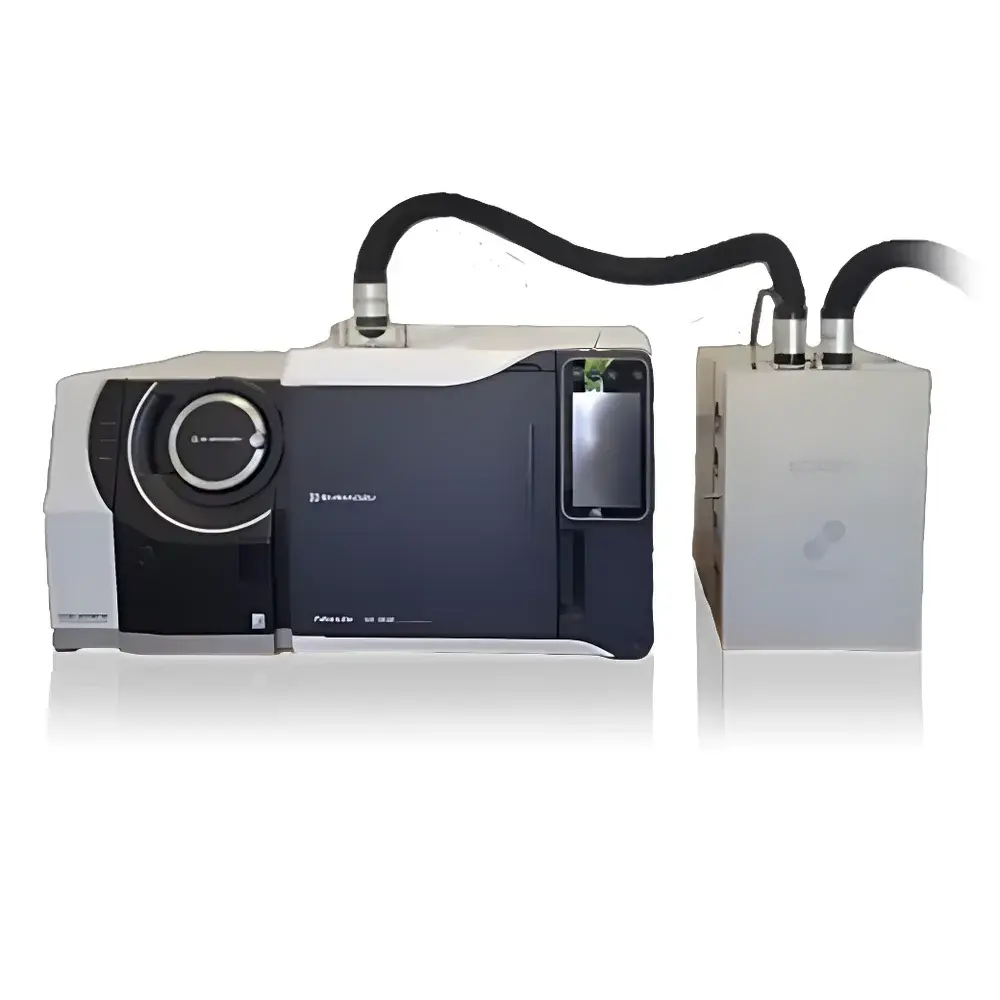
LINSEIS L40 EGA GC-MS Coupled Thermal Analysis System
| Brand | LINSEIS |
|---|---|
| Origin | Germany |
| Model | L40 EGA GC-MS |
| Temperature Range | Up to 1200 °C |
| Interface Type | Heated Capillary Transfer Line (100–350 °C) |
| GC Oven | Programmable, -10 to 350 °C |
| MS Detector | Quadrupole Mass Spectrometer (m/z 1–1000) |
| Detection Limit | <10 pg for selected ions |
| Compliance | ASTM E2892, ISO 11358-2, USP <1031>, GLP-ready data audit trail |
Overview
The LINSEIS L40 EGA GC-MS is a fully integrated thermal analysis–gas chromatography–mass spectrometry coupling system engineered for rigorous evolved gas analysis (EGA) of solid and polymeric materials under controlled thermal stress. It combines a high-stability horizontal or vertical thermobalance (TGA or TGA-DTA/DSC configuration) with a dedicated, temperature-regulated capillary interface and a benchtop quadrupole GC-MS platform. The system operates on the principle of real-time or stop-flow EGA: volatile and semi-volatile species released during programmed heating—whether from solvent desorption, polymer degradation, catalytic decomposition, or oxidative volatilization—are swept via inert carrier gas through a heated transfer line directly into the GC inlet. Separation occurs in a fused-silica column under precise oven temperature programming, followed by electron ionization (EI) and mass spectral detection across m/z 1–1000. This architecture ensures minimal band broadening, quantitative transfer efficiency, and unambiguous compound identification—critical for mechanistic interpretation of thermal decomposition pathways.
Key Features
- High-fidelity thermal interface: 350 °C maximum capillary line temperature with active zone control, eliminating condensation and adsorption artifacts for polar, high-boiling, or reactive analytes.
- Modular integration: Compatible with LINSEIS L75/L81 thermobalances and optional DTA/DSC sensors; supports both continuous-flow and time-resolved (step-heating) EGA modes.
- GC-MS performance: Programmable GC oven (-10 to 350 °C), split/splitless injection, and NIST library-searchable quadrupole MS with unit-mass resolution and <10 pg absolute detection limit for target ions (e.g., H₂O, CO, CO₂, NH₃, CH₄, benzene, formaldehyde).
- Thermal stability & reproducibility: Dual-zone furnace design with ±0.1 °C temperature homogeneity over 50 mm sample length; mass loss precision <0.1 µg at 1 mg sample load.
- Software-synchronized acquisition: Single-platform control (LINSEIS ThermoSoft + GC-MS Workstation) enables time-aligned TGA weight-loss curves, GC chromatograms, and extracted ion chromatograms (EICs) with timestamped event markers.
Sample Compatibility & Compliance
The L40 EGA GC-MS accommodates solids (powders, fibers, films, composites), gels, and cured resins—typically 0.5–20 mg loaded in platinum, alumina, or quartz crucibles. It supports inert (N₂, Ar), oxidative (air, O₂), or reducing (5% H₂/Ar) atmospheres up to 1 bar. All hardware and software components comply with ASTM E2892 (Standard Guide for Evolved Gas Analysis), ISO 11358-2 (Polymer thermogravimetry — Part 2: EGA protocols), and USP <1031> (Thermal Analysis). Data handling conforms to 21 CFR Part 11 requirements, including electronic signatures, audit trails, and secure user access levels—validated for GLP and GMP environments in pharmaceutical, aerospace, and battery material development labs.
Software & Data Management
ThermoSoft v6.0 provides full instrument orchestration: real-time TGA/DTA curve overlay with evolving ion signals, automated peak deconvolution of co-eluting species, and retention index calibration using n-alkane standards. Raw GC-MS data are stored in ANDI/NetCDF format; spectral libraries (NIST, Wiley, custom) support automated compound identification with confidence scoring. Quantitative workflows include internal standard calibration (e.g., deuterated analogs) and response factor normalization against reference gases (CO₂, CH₄). All reports generate PDF/CSV exports with metadata traceability—sample ID, operator, method version, calibration status, and raw data hash verification.
Applications
- Pharmaceutical: Identification of residual solvents, excipient degradation products (e.g., PEG oxidation), and polymorph-specific dehydration pathways per ICH Q5C guidelines.
- Polymers & Composites: Mapping pyrolysis mechanisms in carbon fiber prepregs, flame retardant decomposition (e.g., release of Br• radicals), and crosslinking byproduct evolution (acetaldehyde, styrene).
- Battery Materials: Quantifying HF, PF₅, and CO₂ evolution from NMC cathodes upon overcharge or thermal runaway simulation.
- Geochemistry & Catalysis: In situ monitoring of coke formation on zeolites, clay dehydration stages, and metal oxide reduction intermediates (e.g., NOₓ, SO₂).
- Environmental: Screening microplastic thermal fingerprints and identifying additive leachates (phthalates, BPA) under simulated landfill conditions.
FAQ
What sample types are compatible with the L40 EGA GC-MS?
Solid samples—including powders, thin films, monoliths, and composite laminates—with mass between 0.5 mg and 20 mg are optimal. Liquids and gels require pre-drying or matrix-assisted loading to avoid spattering.
Can the system perform simultaneous TGA-GC-MS and DSC-GC-MS measurements?
Yes—when configured with a LINSEIS L81 Hyphenated Platform, the system supports concurrent TGA-DSC-GC-MS acquisition, enabling direct correlation of enthalpic events (e.g., melting endotherms) with evolved gas profiles.
Is the GC-MS module compliant with regulatory data integrity standards?
Yes—the entire software stack implements 21 CFR Part 11-compliant audit trails, role-based permissions, electronic signatures, and immutable raw data archiving.
How is background contamination minimized during low-level EGA detection?
The system employs ultra-high-purity carrier gas purification (oxygen/moisture scrubbers), cold trap-free GC inlet design, and automated blank subtraction routines using pre-run inert atmosphere baselines.
What maintenance intervals are recommended for routine operation?
Capillary interface cleaning every 50 runs; GC column reconditioning monthly; MS source cleaning quarterly; annual vacuum pump oil replacement and mass calibration verification.



