
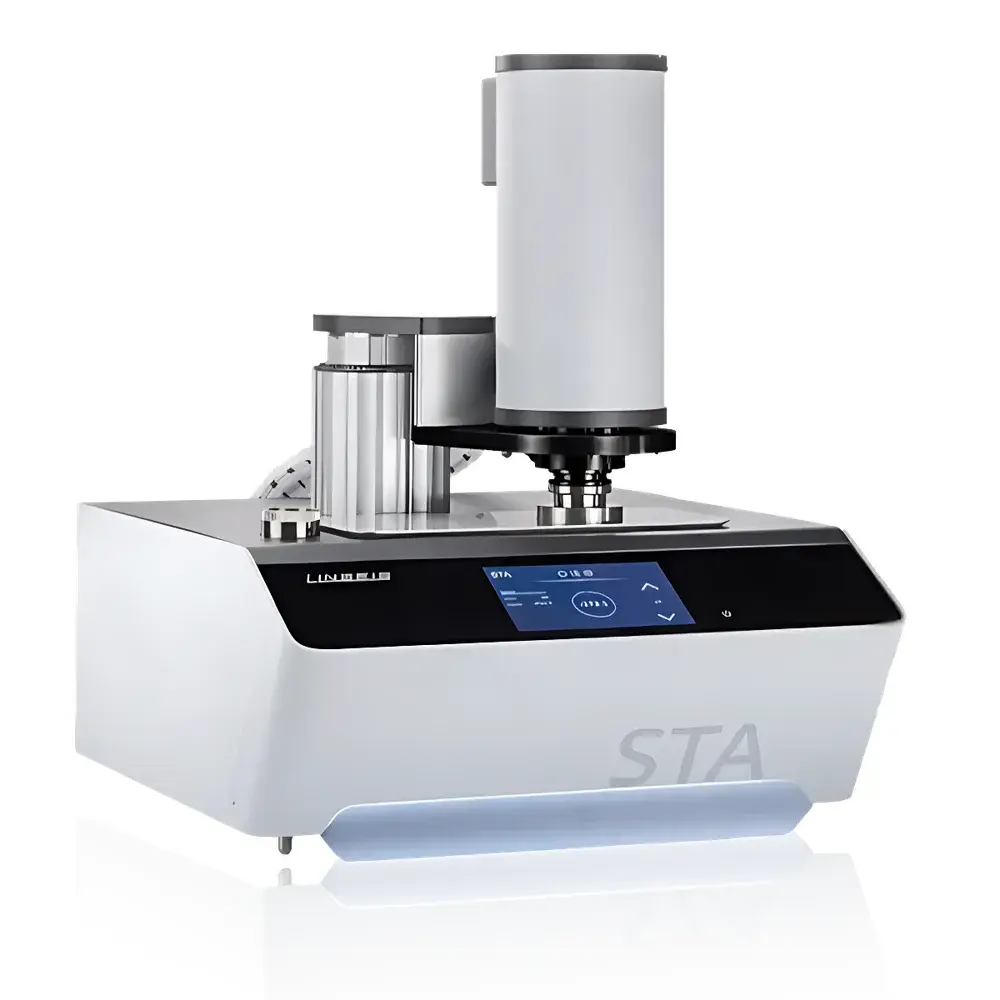
LINSEIS STA L81 High-Temperature Simultaneous Thermal Analyzer
| Brand | LINSEIS |
|---|---|
| Origin | Germany |
| Model | STA L81 |
| Temperature Range | −150 to 2400 °C |
| Heating Rate | 0.01–100 K/min |
| Temperature Stability | ±0.001 °C |
| Maximum Sample Mass | 5 g / ±2500 mg |
| Atmosphere Control | Vacuum (down to 10⁻² mbar), Pressure up to 5 bar (optional) |
| TG Resolution | 0.01–0.1 µg |
| DSC Sensor Types | E, K, S, B, C (C = DTA-only) |
| DSC Sensitivity | ~4–22.5 µW |
| DSC Resolution | 0.3–1.2 µW |
| DTA Sensitivity | 1.5 µV/mW |
| DTA Resolution | 0.03 nV |
| DTA Range | ±250–±2500 µV |
| Optional Autosampler | 42-position |
Overview
The LINSEIS STA L81 is a high-precision simultaneous thermal analyzer engineered for rigorous materials characterization under extreme thermal conditions. It integrates thermogravimetric analysis (TGA) and differential scanning calorimetry (DSC) — or differential thermal analysis (DTA) — into a single, synchronized measurement platform. Based on the principle of concurrent mass change detection (via high-resolution electromagnetic force compensation balance) and heat flow differential measurement (using multi-junction thermocouple arrays), the STA L81 delivers temporally aligned, artifact-minimized data critical for kinetic modeling, phase transition identification, and decomposition pathway validation. Its operational envelope spans from cryogenic conditions (−150 °C) to ultra-high temperatures (2400 °C), enabled by interchangeable furnace modules — including quartz, alumina, silicon carbide, and graphite variants — each optimized for specific atmosphere compatibility, thermal homogeneity, and longevity. The system is fundamentally designed for traceable, reproducible thermal analysis in research laboratories and industrial R&D centers where compliance with ISO 11357, ASTM E1131, ASTM E1269, and ICH Q5C is required.
Key Features
- Triple-range high-sensitivity microbalance: selectable capacities (5 g, 25 g, 35 g) with resolution down to 0.01 µg, enabling precise quantification of minute mass changes during dehydration, oxidation, or volatilization.
- Modular furnace architecture: rapid exchange of furnace types supports application-specific optimization — e.g., low-temperature cryo-furnaces for polymer glass transitions, high-purity graphite furnaces for refractory metal studies, or corrosion-resistant ceramic furnaces for aggressive halogen-containing atmospheres.
- Multi-sensor DSC/DTA capability: configurable sensor types (E, K, S, B, C) allow selection of optimal thermal sensitivity and noise immunity; C-type DTA sensors provide galvanic isolation for corrosive gas environments (e.g., Cl₂, HF, SO₂).
- Integrated atmosphere control: vacuum operation down to 10⁻² mbar (with external pump), pressure capability up to 5 bar (optional), and programmable gas switching (up to 4 gases) with mass flow controllers meeting ISO 8573-1 Class 2 purity standards.
- Automated calibration & purge: built-in reference material recognition (In, Zn, Al, Ag, Ni) enables fully automated temperature and enthalpy calibration; auto-purge sequences minimize cross-contamination between runs.
- Thermal stability engineering: active temperature stabilization circuitry maintains ±0.001 °C baseline drift over 24 h, ensuring long-duration kinetic experiments (e.g., isothermal aging, solid-state reaction monitoring) retain metrological integrity.
Sample Compatibility & Compliance
The STA L81 accommodates diverse sample forms — powders, fibers, thin films, bulk ceramics, metallic alloys, and hydrated cements — within crucibles of alumina, platinum, gold, graphite, or sapphire. Crucible geometry and lid configuration are selected to optimize gas diffusion, prevent spattering, and ensure representative heat transfer. For regulated environments, the instrument supports audit-ready operation: full electronic records with time-stamped metadata, user-access logs, and 21 CFR Part 11–compliant software options (including electronic signatures and immutable audit trails). All firmware and calibration certificates comply with GLP and GMP documentation requirements, and hardware design conforms to CE, UL 61010-1, and EMC Directive 2014/30/EU standards.
Software & Data Management
ThermoSoft™ v8.x — the native control and analysis suite — provides real-time synchronization of TGA, DSC/DTA, and optional evolved gas analysis (EGA) signals. It includes advanced deconvolution algorithms for overlapping endothermic/exothermic events, model-free kinetic analysis (Friedman, Ozawa-Flynn-Wall), and quantitative residue composition estimation via multi-step curve fitting. Raw data export is supported in ASTM E1578-compliant .tdf format, as well as ASCII, CSV, and universal .itx for third-party integration (e.g., MATLAB, Origin, Thermo-Calc). Data security protocols include role-based access control, encrypted local storage, and optional networked backup to NAS or LIMS systems compliant with ISO/IEC 27001.
Applications
- Advanced ceramics & refractories: Quantifying phase transformations (e.g., α→β-SiC, mullite formation), sintering onset, and decomposition kinetics of precursors under inert or reducing atmospheres.
- Cement & construction materials: Resolving sequential dehydration, hydroxide decomposition (Ca(OH)₂ at ~570 °C), and carbonate decarbonation (CaCO₃ at ~800 °C) with correlated mass loss and enthalpy change.
- Battery materials: Evaluating thermal runaway thresholds, SEI layer stability, cathode oxygen release (e.g., NMC, LFP), and electrolyte decomposition under controlled O₂ or Ar.
- Pharmaceuticals: Polymorph screening, hydrate/solvate stability assessment, and compatibility testing per ICH Q1E and USP <1162> guidelines.
- Metallurgy: Solidus/liquidus determination, eutectic melting behavior, and oxidation kinetics of superalloys in air or synthetic air mixtures.
- Carbonaceous materials: Pyrolysis profiling of biomass, coke reactivity, and graphitization onset in inert or CO₂ atmospheres.
FAQ
What furnace options are available for the STA L81, and how do they affect maximum operating temperature?
The STA L81 supports five interchangeable furnace types: quartz (up to 1000 °C), alumina (1400 °C), silicon carbide (1750 °C), graphite (2000 °C), and high-density graphite (2400 °C). Each is matched to specific crucible materials and atmosphere compatibility.
Can the STA L81 perform evolved gas analysis (EGA) in real time?
Yes — the system features a heated transfer line (up to 300 °C) compatible with FTIR, MS, or GC-MS coupling. Capillary diameter and heating profile are optimized to prevent condensation and ensure quantitative gas transport.
Is automatic calibration traceable to national standards?
All calibrations use NIST-traceable reference materials (In, Zn, Al, Ag, Ni), with certificate-of-calibration issued per ISO/IEC 17025 requirements.
How does the system handle reactive or corrosive atmospheres?
Corrosion-resistant furnace linings, DTA-only sensor configurations (type C), and Hastelloy gas lines enable safe operation with Cl₂, HCl, SO₂, and HF up to 1000 °C.
What sample throughput enhancements are available?
A motorized 42-position autosampler with independent temperature-controlled sample storage (−20 to 150 °C) enables unattended multi-day operation with full thermal history logging.



