
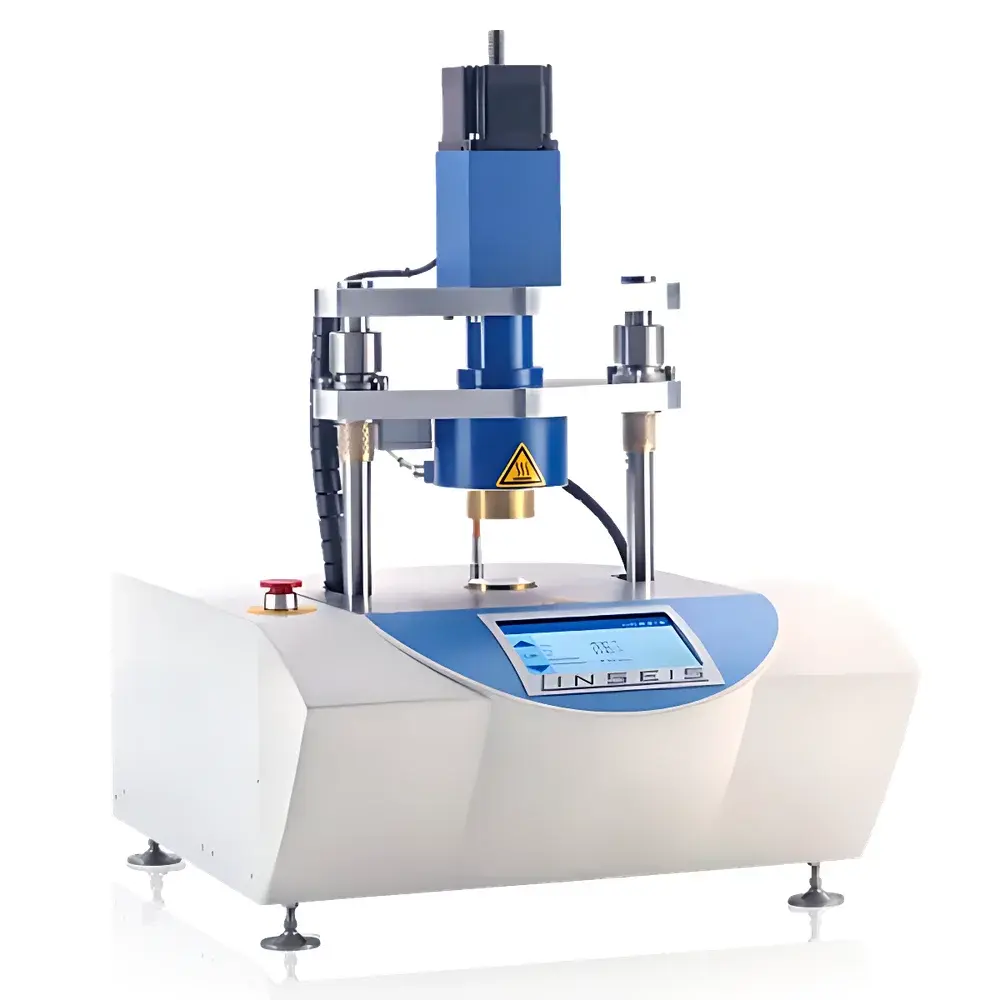
LINSEIS TEG-Tester (TEG L34) Thermoelectric Conversion Efficiency Measurement System
| Brand | LINSEIS |
|---|---|
| Origin | Germany |
| Model | TEG-Tester (TEG L34) |
| Temperature Range | Ambient to 300 °C (hot side) / −20 °C to 300 °C (cold side) |
| Sample Diameter | Ø20–60 mm (circular) or 20×20–40×40 mm (rectangular) |
| Thickness Capacity | Up to 25 mm |
| Clamp Force | 2–5 kN (motor-driven) |
| Current Range | 0–3 A DC |
| Voltage Range | 0–12 V DC |
| Voltage Resolution | 1.6 µV |
| Current Resolution | 1 µA |
| Voltage Accuracy | ±0.3 % |
| Current Accuracy | ±0.3 % |
| Temperature Accuracy | ±0.1 °C |
| Thermocouple Type | E-type |
| Reference Block Materials | Aluminum, Brass, Copper (custom options available) |
| Heating Power | 1.0 kW |
| Cooling Capacity | 1.0 kW at 10 °C / 0.5 kW at −20 °C |
| Pump Flow Rate | 27 L/min at 0.7 bar |
| Reservoir Volume | 3.8–7.5 L |
| Refrigerant | R449A |
| Sampling Interval | <10 ms |
| Operating Modes | CC, CV, FOC, MPPT, P&O |
| Heat Dissipation Capacity | 36 W |
Overview
The LINSEIS TEG-Tester (TEG L34) is a precision-engineered thermoelectric conversion efficiency measurement system designed for rigorous characterization of thermoelectric generators (TEGs) and Peltier coolers under controlled thermal and electrical boundary conditions. Based on the fundamental principles of thermoelectric energy conversion—governed by the Seebeck, Peltier, and Thomson effects—the system quantifies key performance parameters including maximum power output, internal resistance, Seebeck coefficient, thermal conductance, and overall conversion efficiency (η). It operates by establishing a well-defined temperature gradient across a thermoelectric module while simultaneously applying programmable current loads or voltage biases, enabling dynamic assessment of device behavior under real-world operating regimes. The instrument integrates calibrated reference blocks with traceable thermal conductivity and known heat capacity to determine absolute heat flow via Fourier’s law, thereby eliminating reliance on indirect estimation methods. Its architecture supports both steady-state and transient thermoelectric testing protocols aligned with ASTM D5470, ISO 18434-1, and IEC 60584-1 standards for thermal and electrical metrology.
Key Features
- Motor-driven mechanical clamping with active pressure balancing ensures uniform contact pressure (2–5 kN) and minimizes interfacial thermal resistance across diverse sample geometries and thicknesses (up to 25 mm).
- High-speed synchronized acquisition (<10 ms sampling interval) captures full I–V curves and dynamic load responses, supporting accurate determination of open-circuit voltage (Voc), short-circuit current (Isc), fill factor, and maximum power point (MPP) in real time.
- Multi-mode operational flexibility: constant current (CC), constant voltage (CV), fixed operating condition (FOC), maximum power point tracking (MPPT), and perturb-and-observe (P&O) algorithms enable comprehensive device mapping across varying ΔT and load conditions.
- Dual-zone thermal control delivers independent hot-side heating (0–300 °C) and cold-side cooling (−20–300 °C), powered by a 1.0 kW resistive heater and a closed-loop R449A refrigeration unit (1.0 kW @ 10 °C; 0.5 kW @ −20 °C) with integrated pump (27 L/min, 0.7 bar) and 3.8–7.5 L reservoir.
- Reference block thermometry using E-type thermocouples (±0.1 °C accuracy) and high-resolution electrical measurement (1.6 µV voltage, 1 µA current resolution; ±0.3 % accuracy) ensure metrological traceability and repeatability critical for R&D and quality assurance workflows.
Sample Compatibility & Compliance
The TEG L34 accommodates standard thermoelectric modules including circular specimens (Ø20, 25, 40, 60 mm) and square formats (20×20, 25×25, 40×40 mm), with custom fixtures available for non-standard geometries. Reference blocks are supplied in aluminum, brass, and copper—materials selected for stable thermal diffusivity and minimal thermoelectric cross-coupling. All thermal interfaces utilize high-conductivity thermal pastes compliant with RoHS and REACH directives. The system meets mechanical and electrical safety requirements per EN 61010-1 and supports GLP/GMP-aligned data integrity through hardware-enforced audit trails, user access controls, and electronic signature capability compatible with FDA 21 CFR Part 11 compliance frameworks when integrated with validated software environments.
Software & Data Management
Control and analysis are performed via LINSEIS’ proprietary TEG-Control Suite, a Windows-based application offering intuitive test sequence programming, real-time visualization of V–I/P–I curves, automated MPP tracking, and export-ready reporting in CSV, PDF, and XML formats. The software implements embedded calibration routines for electrical and thermal channels, stores full metadata (timestamp, operator ID, environmental conditions), and supports batch processing for comparative analysis across multiple samples or aging cycles. Raw data streams are timestamped at sub-millisecond resolution and stored locally with optional network backup. Integration with third-party platforms (e.g., MATLAB, LabVIEW, Python via TCP/IP API) enables advanced statistical modeling and machine learning–driven performance forecasting.
Applications
- Quantification of ZT values and temperature-dependent efficiency maps for Bi2Te3, PbTe, Skutterudites, and half-Heuslers under ΔT = 20–140 K gradients.
- Reliability assessment of thermoelectric modules during accelerated thermal cycling (−20 °C ↔ 300 °C) and long-term load testing (≥100 h) under controlled humidity and vibration profiles.
- Validation of finite-element thermal-electric models (e.g., COMSOL Multiphysics®) using experimentally derived boundary conditions and material property inputs.
- Quality control of production-line TEGs via rapid pass/fail screening against predefined efficiency, resistance, and thermal contact thresholds.
- Development of hybrid energy harvesting systems integrating TEGs with photovoltaic or piezoelectric transducers, requiring synchronized multi-physics characterization.
FAQ
What thermoelectric materials can be tested with the TEG L34?
The system is compatible with all conventional and emerging thermoelectric materials—including bismuth telluride (Bi2Te3), lead telluride (PbTe), silicon germanium (SiGe), skutterudites, and organic thermoelectrics—provided they fit within the specified dimensional and thickness limits and withstand the applied thermal and mechanical loads.
Is the system capable of measuring both generator and cooler modes?
Yes. The TEG L34 supports bidirectional operation: as a thermoelectric generator (heat-to-electricity conversion under ΔT) and as a Peltier cooler (electricity-to-heat-pumping mode), with independent control of current polarity, magnitude, and thermal boundary conditions.
How is thermal contact resistance minimized during testing?
Through motorized clamping with real-time force feedback, pressure-balanced platens, and interchangeable reference blocks matched to sample thermal expansion coefficients—combined with standardized thermal interface materials and surface flatness verification per ISO 10700.
Can the system comply with regulatory audit requirements for pharmaceutical or aerospace applications?
When deployed with validated software configuration, electronic logbooks, and documented calibration certificates (traceable to PTB or NIST), the TEG L34 supports 21 CFR Part 11, ISO 9001, and AS9100-compliant workflows, including change control, version history, and role-based access management.



