
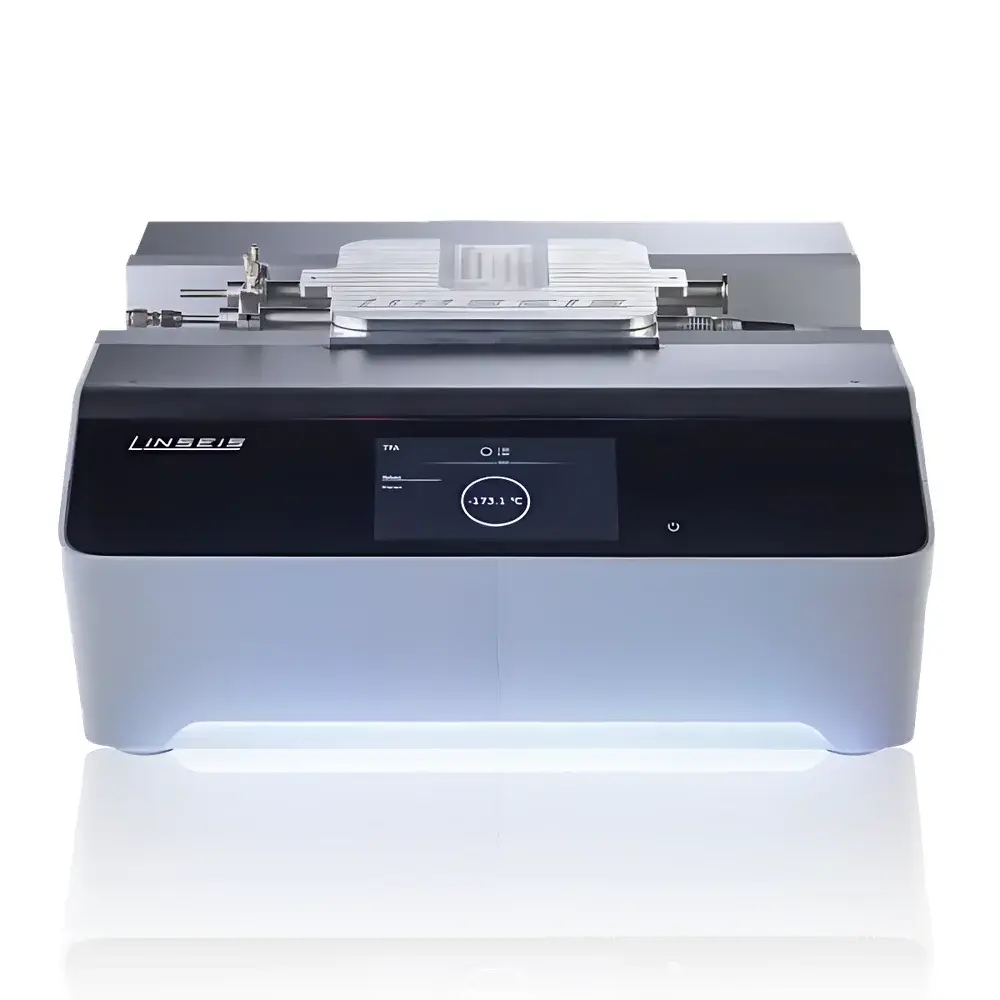
LINSEIS TFA L59 Thin-Film Physical Property Analyzer
| Brand | LINSEIS |
|---|---|
| Origin | Germany |
| Model | TFA L59 |
| Thermal Conductivity Range | 0.05–200 W/(m·K) (3ω method, in-plane configuration) |
| Temperature Range | –160 °C to 280 °C |
| Vacuum Level | 1×10⁻⁴ mbar |
| Sample Thickness Compatibility | 5 nm – 25 µm |
| Electrical Conductivity Range | 0.05–1×10⁶ S/cm (Van der Pauw four-point probe) |
| Seebeck Coefficient Range | 5–2500 µV/K |
| Optional Hall Module | Magnetic Field up to 1 T (electromagnet) or 0.5 T (permanent magnet) |
Overview
The LINSEIS TFA L59 Thin-Film Physical Property Analyzer is a fully integrated, chip-based platform engineered for simultaneous, in-plane characterization of thermal, electrical, and thermoelectric properties of thin films under controlled vacuum and variable-temperature conditions. It employs the 3ω method for high-sensitivity thermal conductivity measurement—where a sinusoidal current at frequency ω induces Joule heating at 2ω, generating a temperature oscillation at 3ω that is detected via voltage response—enabling precise determination of in-plane thermal transport across nanoscale to micrometer-thick films. Complementing this, the system integrates Van der Pauw four-point probe geometry for contactless, geometry-independent electrical conductivity/resistivity measurement, and an on-chip resistive thermometer adjacent to the measurement electrodes for direct, localized Seebeck coefficient determination. All measurements are performed along the same lateral (in-plane) direction on a single pre-patterned microfabricated sensor chip, eliminating inter-sample alignment variability and ensuring intrinsically comparable datasets.
Key Features
- Monolithic, pre-structured silicon-based measurement chips (24 per cartridge), each integrating heater/sensor lines, Van der Pauw electrode arrays, and Pt1000 resistance thermometers—designed for rapid, reproducible sample mounting without lithographic reprocessing.
- Ultra-high vacuum chamber (≤1×10⁻⁴ mbar) with dual-stage thermal control: liquid nitrogen cryostat (–160 °C minimum) and high-power resistive heater (up to 280 °C), enabling stable, programmable ramp rates from 0.1 to 5 K/min.
- Modular electronics architecture: integrated lock-in amplifier (for 3ω signal demodulation), precision current source (nA–mA range), low-noise voltage digitizer (24-bit resolution), and optional Hall effect module with electromagnet (1 T) or permanent magnet (0.5 T).
- Universal sample compatibility: supports films deposited by physical vapor deposition (PVD), chemical vapor deposition (CVD), atomic layer deposition (ALD), spin-coating, drop-casting, inkjet printing, and sputtering—without requiring post-deposition patterning.
- Standardized sample preparation aids: reusable metal shadow masks and polyimide peel-off stencils for precise electrode definition and film localization on the chip surface.
Sample Compatibility & Compliance
The TFA L59 accommodates freestanding or substrate-supported films ranging from 5 nm to 25 µm in thickness—including metallic (e.g., Au, Ni), semiconducting (e.g., Bi₂Te₃, SiGe), ceramic (e.g., AlN, ZnO), and conductive polymer (e.g., PEDOT:PSS) systems. Its measurement protocols align with ASTM E1461 (thermal diffusivity), ISO 22007-2 (thermal conductivity of thin films), and IEC 60584-1 (thermocouple reference functions). Data acquisition and instrument control comply with GLP/GMP documentation requirements; audit trails, user access levels, and electronic signature support are available via optional software modules compliant with FDA 21 CFR Part 11.
Software & Data Management
LINSEIS ThermoSoft™ v6.2 provides full instrument orchestration: automated temperature ramping, synchronized multi-parameter acquisition (κ, σ, S, RH, μH, nH), real-time signal monitoring, and batch processing for ZT = S²σT/κ calculation. Raw data are stored in HDF5 format with embedded metadata (timestamp, vacuum pressure, setpoint deviation, lock-in phase/amplitude). Export options include CSV, MATLAB (.mat), and ASCII for third-party analysis (e.g., Python SciPy, OriginPro). Calibration routines follow NIST-traceable standards for resistance (Fluke 752A), temperature (SPRTs certified to ITS-90), and voltage (Keysight 3458A).
Applications
- Thermoelectric material screening: simultaneous quantification of κ, σ, and S across –160 °C to 280 °C enables accurate ZT mapping for candidate thin-film TE layers (e.g., Bi–Sb alloys, SnSe, organic-inorganic hybrids).
- Process development validation: correlation of deposition parameters (e.g., sputter power, ALD cycle count, annealing time) with in-plane transport anisotropy in heterostructures and graded films.
- Fundamental transport studies: decoupling phonon vs. electron contributions to thermal conductivity via temperature-dependent 3ω analysis; carrier-type identification via Hall sign reversal in doped oxides.
- Flexible electronics qualification: thermal stability assessment of printed conductive traces (Ag nanoparticle inks, carbon nanotube networks) under thermal cycling stress.
FAQ
What sample substrates are compatible with the TFA L59?**
Silicon wafers, quartz, sapphire, glass, and flexible polymer foils (e.g., Kapton) — provided the film is electrically isolated from the substrate or the substrate’s thermal contribution is negligible relative to the film.
Is calibration required before each measurement?**
No routine recalibration is needed; the system uses factory-characterized chips with traceable thermal and electrical reference data. Chip-to-chip drift is compensated via on-board Pt1000 thermometer verification prior to each run.
Can the TFA L59 measure cross-plane properties?**
No — the platform is optimized exclusively for in-plane (lateral) transport characterization. Cross-plane thermal conductivity requires complementary techniques such as time-domain thermoreflectance (TDTR) or 3ω with suspended membranes.
How is electrical contact established for Van der Pauw measurements?**
Using non-destructive spring-loaded tungsten probes contacting pre-defined Ti/Au pads on the chip periphery; no wire bonding or lithography is required.
Is remote operation supported?**
Yes — ThermoSoft™ supports secure remote access via VPN, enabling unattended overnight measurements and centralized lab fleet management.



