
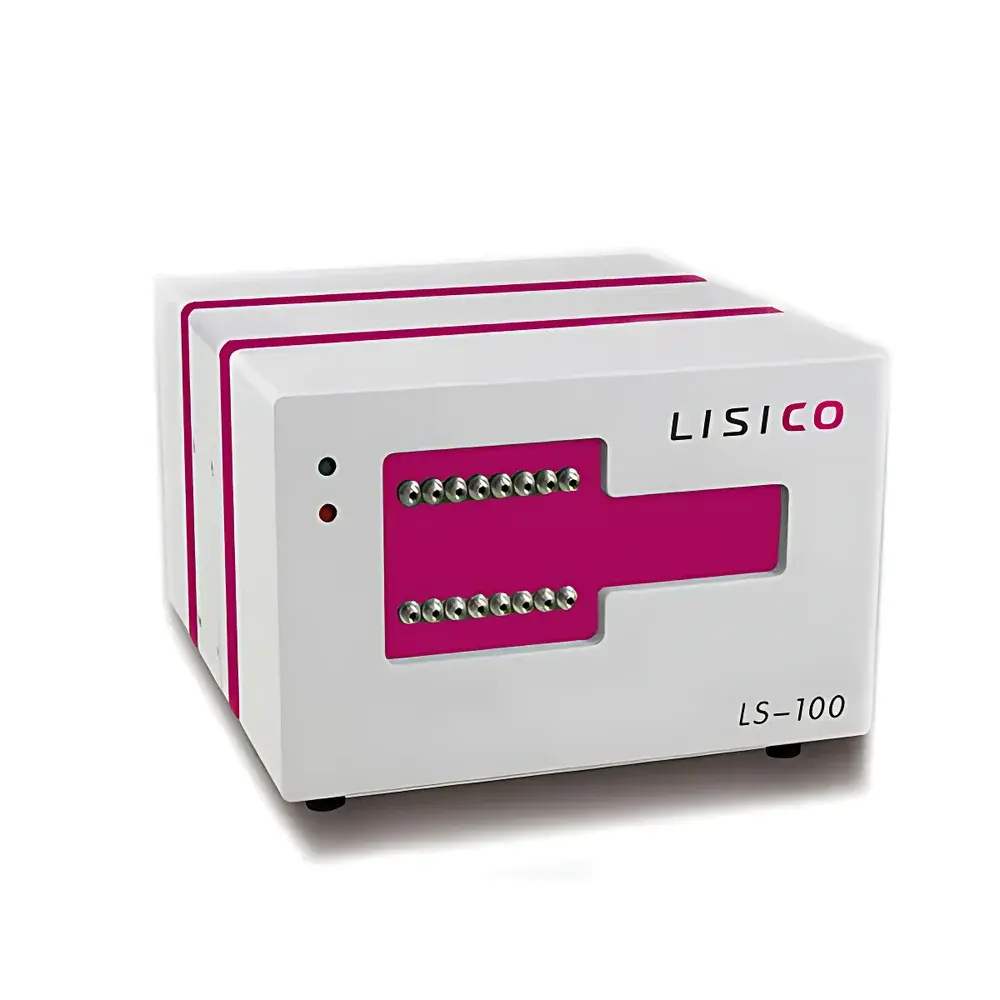
LISICO LS-100 Fourier Transform Near-Infrared Spectrometer
| Brand | LISICO |
|---|---|
| Model | LS-100 |
| Instrument Type | Laboratory FT-NIR Spectrometer |
| Configuration | Modular Benchtop System |
| Optical Architecture | Michelson Interferometer with Solid-State Laser Reference |
| Spectral Range | 10,000–4,000 cm⁻¹ (1,000–2,500 nm) |
| Resolution | Adjustable down to 4 cm⁻¹ |
| Detector | Thermoelectrically Cooled InGaAs |
| Sampling Modes | Transmission (liquids), Diffuse Reflectance (solids), Non-contact Reflectance (Dual-Eye probe) |
| Connectivity | USB 3.0, Ethernet, Optional Fiber-Optic Interface (up to 8 channels) |
| Software Platform | S-Cal (PLS/QPLS modeling), S-Seq (automated sequence control), S-Online (real-time DCS integration) |
Overview
The LISICO LS-100 is a laboratory-grade Fourier Transform Near-Infrared (FT-NIR) spectrometer engineered for high reproducibility, operational flexibility, and method transferability across R&D, QC, and process support environments. Based on a stabilized Michelson interferometer architecture with solid-state laser wavelength calibration, the LS-100 delivers precise, interference-free spectral acquisition in the 10,000–4,000 cm⁻¹ range (1,000–2,500 nm), optimized for quantification of overtone and combination bands of C–H, O–H, N–H, and S–H functional groups. Its modular design supports both benchtop operation and scalable deployment—enabling seamless transition from method development in the lab to multi-point online monitoring via the LS-100-Pro configuration. The system operates without sample preparation, solvent use, or consumables, aligning with green analytical chemistry principles and reducing total cost of ownership.
Key Features
- Stable FT-NIR core: Dual-beam Michelson interferometer with integrated He–Ne laser reference for real-time path-length correction and long-term wavenumber accuracy (±0.05 cm⁻¹ over 24 h)
- Thermoelectrically cooled InGaAs detector: Enables high signal-to-noise ratio (SNR > 15,000:1 at 100 scans) and low dark current drift, critical for quantitative repeatability
- Modular sampling interface: Supports interchangeable optical modules—including M-Cube temperature-controlled transmission cell (±0.1 °C stability), laboratory liquid transmission probe, diffuse reflectance solid probe, and non-contact Dual-Eye reflectance probe for fragile or moving samples
- Scalable architecture: Base LS-100 unit can be upgraded to LS-100-Pro—a rack-mounted 8-channel host accepting up to eight independent NIR fiber-optic inputs (low-OH silica fiber, max. 150 m length per channel)
- Compliance-ready software suite: S-Cal provides full PLS, QPLS, and PCR modeling workflows with residual analysis, outlier detection, and model validation reports compliant with ASTM E1655 and ISO 12099 guidelines
Sample Compatibility & Compliance
The LS-100 accommodates diverse physical forms—liquids, pastes, powders, films, and granules—without grinding, dilution, or chemical derivatization. Its non-destructive nature preserves sample integrity for reanalysis or archival. Regulatory alignment includes built-in audit trail logging (user actions, parameter changes, calibration events), electronic signature support, and data export formats compatible with LIMS and ELN systems. S-Cal and S-Online comply with FDA 21 CFR Part 11 requirements for electronic records and signatures when deployed in GxP environments. All optical components meet IEC 61000-4 electromagnetic compatibility standards, and the system is CE-marked for laboratory use within the EU.
Software & Data Management
S-Cal serves as the quantitative modeling engine, supporting multivariate calibration development, cross-validation (leave-one-out, k-fold), robustness testing, and limit-of-detection estimation. It generates ASTM-compliant calibration reports with standard error of prediction (SEP), bias, and R² metrics. S-Seq enables unattended batch analysis through customizable measurement sequences—including auto-zeroing, background acquisition, and pass/fail logic based on spectral quality indicators. For continuous operations, S-Online interfaces directly with DCS/SCADA systems via OPC UA or Modbus TCP, delivering real-time concentration values (e.g., moisture %, active pharmaceutical ingredient wt%, iodine value) with timestamped metadata and uncertainty estimates. All raw interferograms and spectra are stored in HDF5 format for traceability and third-party reprocessing.
Applications
- Battery materials: Quantitative determination of residual moisture in Li-ion cathode/anode coatings (<0.01% w/w LOD), electrolyte purity (LiPF₆ decomposition products), and total alcohol content in NMP solvents
- Pharmaceutical manufacturing: In-process monitoring of API content in wet granules, solvent composition during extract concentration, and polymorphic form identification in lyophilized cakes
- Polymer synthesis: Real-time tracking of NCO content in polyurethane prepolymers, hydroxyl number in polyether polyols, and vinyl group concentration in silicone elastomers
- Fuel blending: Prediction of research/motor octane numbers (RON/MON), olefin and aromatic content, and distillation endpoints (T10/T50/T90) in gasoline streams
- Food & feed: Rapid analysis of protein, fat, moisture, and free fatty acid content in oilseeds, meat emulsions, and compound feeds—validated against AOAC Official Methods
- Textile composition: Identification and quantification of blended fibers (cotton, linen, nylon 6/6, spandex) in finished fabrics using spectral library matching and PLS regression
FAQ
What spectral resolution options does the LS-100 support?
The LS-100 offers user-selectable resolution settings from 4 cm⁻¹ (standard) to 16 cm⁻¹, configurable via software without hardware modification.
Can existing calibration models developed on other NIR platforms be imported into S-Cal?
Yes—S-Cal accepts PMF, GRAMS/32, and ASTM E1655-compliant .cal files; models undergo spectral alignment and residual variance mapping prior to deployment.
Is the LS-100-Pro suitable for hazardous area installations?
The LS-100-Pro host is rated for Class I, Division 2 environments; field probes and fiber-optic terminations require ATEX/IECEx-certified enclosures for Zone 1/2 deployment.
How is wavelength accuracy maintained during extended operation?
A dual-reference system combines a stabilized He–Ne laser for interferometer path-length correction and an internal polystyrene standard for post-acquisition wavenumber validation per ASTM E1421.
Does the system support PAT (Process Analytical Technology) implementation per FDA guidance?
Yes—the LS-100 platform meets all technical criteria outlined in FDA’s PAT Framework (2004), including real-time measurement capability, multivariate data handling, and integrated risk-based method validation tools in S-Cal.





