
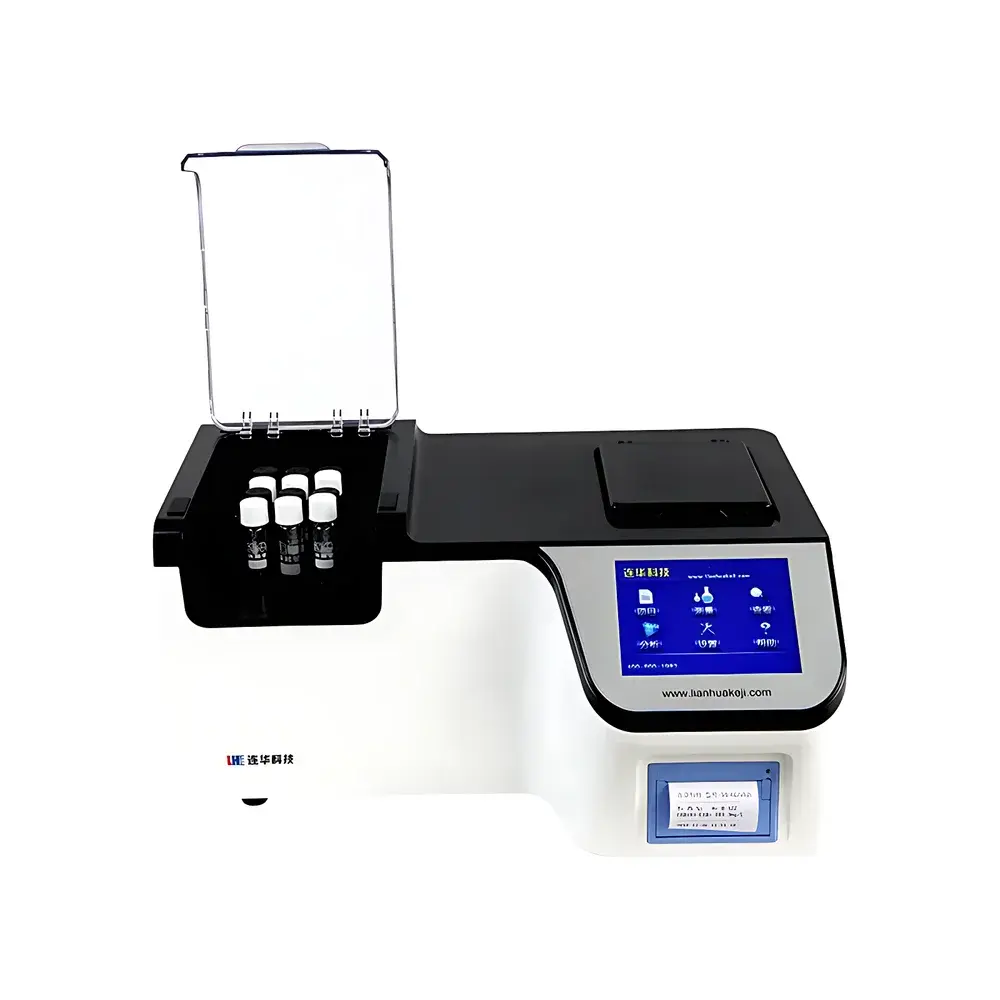
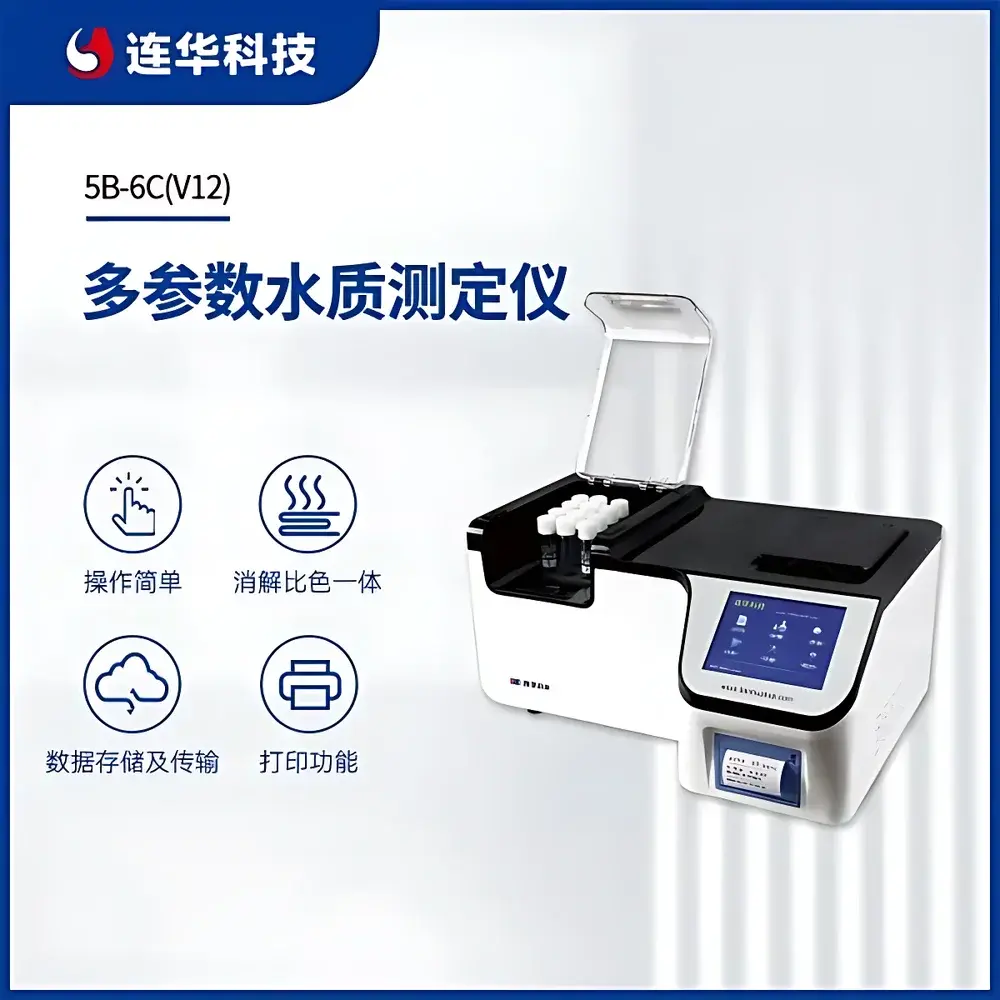
LoHAN Tech 5B-6C(V12) Multi-Parameter Water Quality Analyzer
| Brand | LoHAN Tech |
|---|---|
| Origin | Beijing, China |
| Manufacturer Type | OEM/ODM Manufacturer |
| Country of Origin | China |
| Model | 5B-6C(V12) |
| Instrument Type | Laboratory Water Quality Analyzer |
| Measurable Parameters | COD, Ammonia Nitrogen (NH₃-N), Total Phosphorus (TP), Total Nitrogen (TN), Turbidity, Color, Suspended Solids (SS) |
| Optical System | Dual-path interference-free photometric system supporting both cuvette and tube colorimetry |
| Integrated Digestion Unit | Yes, with intelligent temperature ramping, programmable timing, and thermal overprotection |
| Display | 5.6-inch full-color capacitive touchscreen |
| Data Storage Capacity | 16,000 measurement records |
| Connectivity | USB port + infrared data transmission |
| Built-in Thermal Printer | Yes |
| Calibration | Automated standard curve generation and storage using certified reference standards |
| Compliance | HJ/T 399–2007 (Rapid Digestion Spectrophotometric Method for COD), JJG 975–2002 (Verification Regulation for COD Analyzers) |
Overview
The LoHAN Tech 5B-6C(V12) Multi-Parameter Water Quality Analyzer is a fully integrated, benchtop laboratory instrument engineered for precise, standardized quantification of critical water quality indicators in municipal, industrial, and environmental monitoring laboratories. It operates on the principle of spectrophotometric analysis following digestion-coupled colorimetric reactions—specifically aligned with HJ/T 399–2007 for chemical oxygen demand (COD), and compatible methodologies for ammonia nitrogen (NH₃-N), total phosphorus (TP), total nitrogen (TN), turbidity, color, and suspended solids (SS). The analyzer combines optical detection, thermal digestion, and embedded data management into a single robust architecture—eliminating inter-laboratory variability introduced by standalone digesters or manual calibration protocols. Its design targets compliance-driven workflows where traceability, repeatability, and audit readiness are mandatory—not optional.
Key Features
- Interference-free dual-optical-path photometric system enables simultaneous, non-cross-reactive measurement across seven parameters without optical crosstalk or wavelength recalibration.
- Integrated digestion module maintains strict thermal profiles per parameter-specific protocols: e.g., 165 °C for 15 min for COD digestion (HJ/T 399–2007), 120 °C for TP hydrolysis, and controlled low-temperature digestion for NH₃-N to prevent volatilization loss.
- Intelligent thermal control includes adaptive heating rate modulation, end-point temperature hold, and automatic thermal cutoff upon timeout or overheating—ensuring consistent reaction kinetics and operator safety.
- 5.6-inch high-resolution capacitive touchscreen interface supports intuitive icon-driven navigation, multi-language UI (English default), and context-sensitive help overlays—reducing training time and minimizing input errors.
- Automated calibration workflow accepts NIST-traceable or certified reference materials; the system computes and stores up to 24 user-defined calibration curves with slope, intercept, R², and residual error reporting.
- Thermal printer outputs compliant hard-copy reports including sample ID, date/time stamp, operator ID (if configured), method ID, raw absorbance values, and final concentration—formatted for GLP/GMP documentation requirements.
Sample Compatibility & Compliance
The 5B-6C(V12) accommodates aqueous samples ranging from clarified drinking water to highly turbid or colored wastewater matrices. Sample introduction supports both 10–30 mm pathlength cuvettes (for turbidity, color, and post-digestion assays) and 16 mm diameter digestion tubes (for COD, TP, TN, and NH₃-N). All analytical methods implemented adhere to Chinese national environmental standards: HJ/T 399–2007 (COD), HJ 535–2009 (NH₃-N), HJ 671–2013 (TP), HJ 636–2012 (TN), GB/T 13200–1991 (turbidity), GB/T 5750.4–2006 (color), and GB/T 11901–1989 (suspended solids). While not pre-certified to ISO/IEC 17025 or ASTM D1253, its documented method equivalence and built-in verification routines support laboratory accreditation preparation under CNAS or regional equivalents.
Software & Data Management
Internal firmware implements a secure, timestamped data logging structure compliant with basic ALCOA+ principles (Attributable, Legible, Contemporaneous, Original, Accurate). Each stored record contains measurement metadata: parameter name, sample ID, digestion cycle log (start/end temp/time), absorbance at specified wavelengths (e.g., 620 nm for COD, 420 nm for NH₃-N), calculated concentration, and QC flag status. USB export generates CSV files compatible with LIMS integration; infrared transmission supports legacy lab network compatibility without driver installation. Audit trail functionality logs all user-initiated actions—including curve edits, calibration resets, and printer activation—with operator ID and timestamp—meeting minimum FDA 21 CFR Part 11 readiness requirements when paired with institutional access controls.
Applications
This analyzer serves routine and regulatory testing in municipal wastewater treatment plants (influent/effluent monitoring), environmental protection agencies (surface water surveillance), industrial effluent compliance labs (textile, food processing, pharmaceutical manufacturing), and academic research facilities conducting limnological or ecotoxicological studies. Its multi-parameter capability reduces instrument footprint and cross-contamination risk compared to discrete analyzers—particularly valuable in resource-constrained or high-throughput settings where daily batch analysis of 50+ samples is typical. The integrated digestion eliminates inter-device transfer errors, while thermal stability ensures <±0.5 °C consistency across repeated runs—critical for method reproducibility in inter-laboratory comparison studies.
FAQ
Does the 5B-6C(V12) support external calibration verification with third-party standards?
Yes—it accepts certified reference materials from suppliers such as Merck, Hach, or AccuStandard; the system validates curve fit residuals against user-defined acceptance criteria (e.g., R² ≥ 0.999, max residual ≤ ±2% of mean).
Can digestion temperature and time be modified for non-standard methods?
Yes—advanced mode allows custom digestion profiles (temp range: 30–200 °C; max duration: 120 min) with password-protected access to preserve method integrity.
Is the thermal printer compatible with continuous label stock or only roll paper?
It uses standard 57 mm thermal roll paper; label stock is unsupported due to feed mechanism constraints.
How is data integrity maintained during power interruption?
Non-volatile flash memory retains all calibration curves and measurement records; the digestion unit halts safely and resumes only upon explicit user confirmation post-reboot.
What maintenance intervals are recommended for optical path cleaning and lamp replacement?
Cuvette chamber and lens surfaces require weekly isopropanol wipe-down; tungsten-halogen light source has a rated lifetime of ≥2,000 hours and triggers an on-screen warning at 90% utilization.
Related Products







